
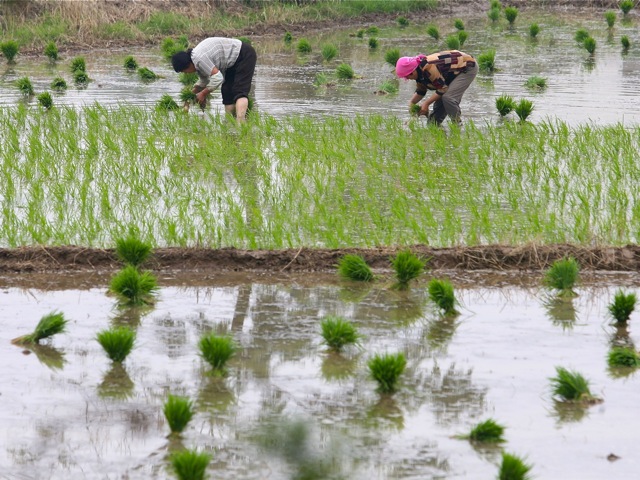
Nearly 10 percent of China’s rice is contaminated with unsafe levels of cadmium, a heavy metal known to cause cancer and other illnesses. The discovery was made by Professor Pan Genxing, an expert in soil science from Nanjing Agricultural University, who took rice samples from marketplaces throughout China.
China produces nearly 200 million tons of rice each year—most of which is consumed domestically—and Genxing estimates that nearly 20 million tons of cadmium-tainted rice are consumed in China every year.
This is the result of farmers unwittingly growing rice in soil contaminated with the metal. Cadmium and similar heavy metals can find their way into crops from industrial waste dumped into rivers. They flow into the groundwater, enter the soil, and are then absorbed by the crops.
Once introduced into the environment, heavy metals are difficult to remove and have the potential for bio-accumulation. They can be released in the form of water and air pollutants, but eventually find their way into the soil.
“Compared to air and water pollution, soil pollution is the most difficult form of pollution to detect, and is often overlooked by people. Yet, it is also the most harmful type of pollution, and the most difficult to control”, said Yang Jide, director of the Suzhou Municipal Institute of Environmental Science, reported China’s state-run media.
Based on extensive research, scholars have found that cadmium, mercury, lead, and arsenic are among the most widespread heavy metal pollutants in China.
Cadmium-Tainted Rice
Cadmium pollution is an especially serious problem for rice-growers in Southern China, since the strain of hybrid rice grown in the acidic soils there absorbs cadmium particularly well. In parts of Southern China, large swathes of land were found to be contaminated with cadmium, with over 60 percent of the rice crop in these areas contaminated with unsafe levels of the heavy metal.
According to Luo Xi-Wen, an academician at the Chinese Academy of Engineering, “heavy metal contamination has polluted more than 20 million hectares of land, which accounts for one-sixth of our country’s arable land.”
According to the World Health Organization, cadmium poisoning can cause osteoporosis, respiratory damage, irreversible kidney damage, and cancer. Most heavy metals are carcinogenic when ingested. In 2007, cancer was responsible for one in five deaths in China, an increase of 80 percent over the last 30 years, according to the Guardian.
Pollution From Industries
Heavy metal pollution typically comes from industrial processes, and while most countries take careful steps to dispose of industrial waste, China is notorious for having poorly enforced environmental regulations, which many Chinese companies blatantly disregard.
Zhou Shengxian, China’s Minister of Environmental Protection, declared at a conference last year that a total of 30 major incidents involving heavy metal pollution took place in China from 2009 to February 2011.
Dr. Huang Xiaofeng, general manager of a water treatment company, was once in charge of a pollution cleanup at an electroplating plant in Hudai Township. “Before the treatment, the soil and puddles, having been polluted for the last 30 years, were startling colors of red, yellow, and green,” Huang said, during an interview with the Economic Information Daily. “The water poison on the surface was over 10,000 times the national environmental standard. A fish put inside would have died within one minute.”
Authorities in Nanjing expelled 163 companies in 2011 for producing excessive levels of pollution. Even after the Jiangsu Provincial Academy Of Environmental Science spent a year-and-a-half restoring the soil at one of the former factory sites, the concentration of several contaminants remained beyond safe levels. In particular, the levels of nitrobenzene there were found to be 123 times above the safe limit. Experts declared the site uninhabitable.
One Chinese netizen posted a comment, stating “City authorities only focus on economic gain, so as long as you are a large company that contributes to the economy, your pollution will be overlooked. However, if higher authorities or local citizens begin to pressure these companies to deal with their pollution issues, they will simply move to some remote mountainous region, and continue to poison the innocent civilians there. This would be done in some glorious manner, such as by claiming to help develop the economy of a remote mountainous area.”
“Currently, the severity of China’s soil pollution is the worst in the world, and the current rates of soil pollution in China could possibly continue for another 30 years.” said Professor Pan in an interview with a Chinese newspaper.
Read the original Chinese article.
The Epoch Times publishes in 35 countries and in 19 languages. Subscribe to our e-newsletter.
 Friends Read Free
Copy
Facebook
Tweet
Friends Read Free
Copy
Facebook
Tweet