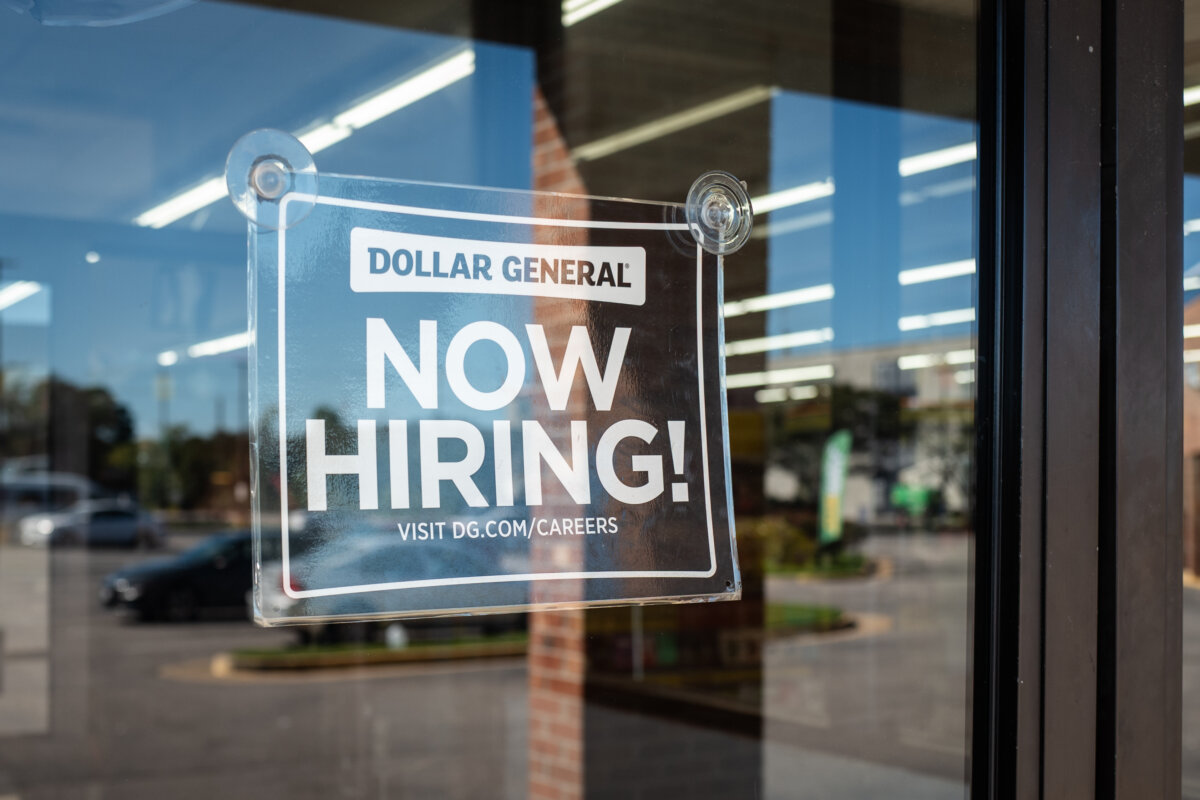

The U.S. labor market rang in the new year the same as it ended 2025: further softening.
Absent the January jobs report, economic observers paid extra attention to a wave of new employment data this week to gauge the national labor market’s health.
“What does it all tell us? Hiring has continued, but it’s been lackluster and uneven across sectors,” Mark Hamrick, senior economic analyst at Bankrate, said in a statement to The Epoch Times.
“Some have used the phrase ‘hiring recession,’ but that overstates the case.”
In January, U.S. businesses announced 5,306 hiring plans, the lowest total for the month since 2009, according to global outplacement firm Challenger, Gray and Christmas.
They are also down 13 percent from a year earlier and 49 percent from December’s hiring tally.
Demand for labor has softened significantly, according to the Bureau of Labor Statistic (BLS) report, which was released two days late due to the partial government shutdown. Job openings fell by 386,000, to 6.542 million in December 2025, the lowest since September 2020.
Employment vacancies were down almost one million from the previous year. Excluding the coronavirus pandemic, this represented the lowest reading in eight years.
November’s job openings were also revised down by 218,000, to 6.9 million.
With approximately 7.5 million unemployed people, there are more jobless individuals than available positions.
“Firms are posting fewer jobs and keeping hiring plans tight, consistent with softer hiring signals seen elsewhere,” Hamrick added.
Private businesses added a smaller-than-expected 22,000 jobs in January, according to payroll processor ADP. In addition, after job postings on Indeed rose throughout January, they began to fall in the final week of the month.
Layoffs a Mixed Picture
While hiring is muted, data highlighting job terminations have been mixed.
Total separations—quits, layoffs, discharges, retirements, and deaths—were little changed at 5.3 million in December 2025.
January’s planned job cuts rose by 108,435, a 118 percent year-over-year increase, and the highest for the month since 2009.
The layoff rate as a percentage of employment, however, remains at the low end of the firm’s series.
This could be a sign of a pessimistic outlook for the year ahead, says Andy Challenger, chief revenue officer for Challenger, Gray & Christmas.
“Generally, we see a high number of job cuts in the first quarter, but this is a high total for January. It means most of these plans were set at the end of 2025, signaling employers are less-than-optimistic about the outlook for 2026,” Challenger said in a news release.

But the headline reading could be skewed by major announcements from United Parcel Service (UPS) and Amazon.
Last week, UPS and Amazon said they would be cutting about 30,000 and 16,000 jobs, respectively.
In recent weeks, layoffs have spread across a widening set of major U.S. employers, with Dow, Home Depot, Mastercard, and The Washington Post all announcing job cuts.
At the same time, there was a notable uptick in the number of individuals filing applications for first-time unemployment benefits.
For the week ended Jan. 31, initial jobless claims surged by 22,000, to a two-month high of 231,000, according to the Department of Labor.
The unexpected jump was attributed to winter-related business disruptions, forcing households to apply for jobless benefits.
Last month’s severe winter storm was projected to have caused more than $100 billion in damage and economic losses.
“The financial fallout from this winter storm continues to climb as recovery efforts are delayed,” AccuWeather chief meteorologist Jonathan Porter said in a statement to The Epoch Times. “Extreme cold can make it harder to restore power, reopen roads and return businesses to normal operations.”
January Jobs Report
The January jobs report was postponed until Feb. 11 because of the government shutdown.
The median estimate indicates 80,000 new jobs were created to kick off 2026, and the unemployment rate held steady at 4.4 percent, according to FactSet Insights.
“If 80,000 is the actual increase in nonfarm payrolls, it will mark the largest increase since September 2025. It will also be above the trailing 12-month average of 48,700,” John Butters, vice president and senior earnings analyst at FactSet, said in a Feb. 5 note.
In addition to last month’s nonfarm payrolls, the BLS will also publish its annual benchmark revisions for the 12-month period through March 2025.
Economic observers are already bracing for enormous downward adjustments to the data.
Federal Reserve Chair Jerome Powell called it a “systematic overcount,” adding that the numbers could show monthly payroll job numbers totaling negative 20,000.
While artificial intelligence (AI) has been a contributing factor in recent employment trends, it remains unclear how much impact it is having on the labor market.
Still, the current state of employment may be a tale of two cities, according to Revelio Labs chief economist Lisa Simon.
The group’s data indicate the economy lost 13,000 jobs last month, driven by leisure and hospitality, public administration, and retail.
“January shows a labor market that is cooling, but unevenly. Employment declines were concentrated in retail, hospitality, and public administration, while several service and knowledge sectors continued to expand,” Simon said in a news release.
Likewise, says Hamrick, hiring has been “narrowly concentrated” in recent months.
BLS data show job creation has been largely centered in health care, social assistance, and private education.
“That’s not the hallmark of a robust economy lifting all boats. Some are barely staying afloat,” he said.
 Friends Read Free
Copy
Facebook
Tweet
Friends Read Free
Copy
Facebook
Tweet