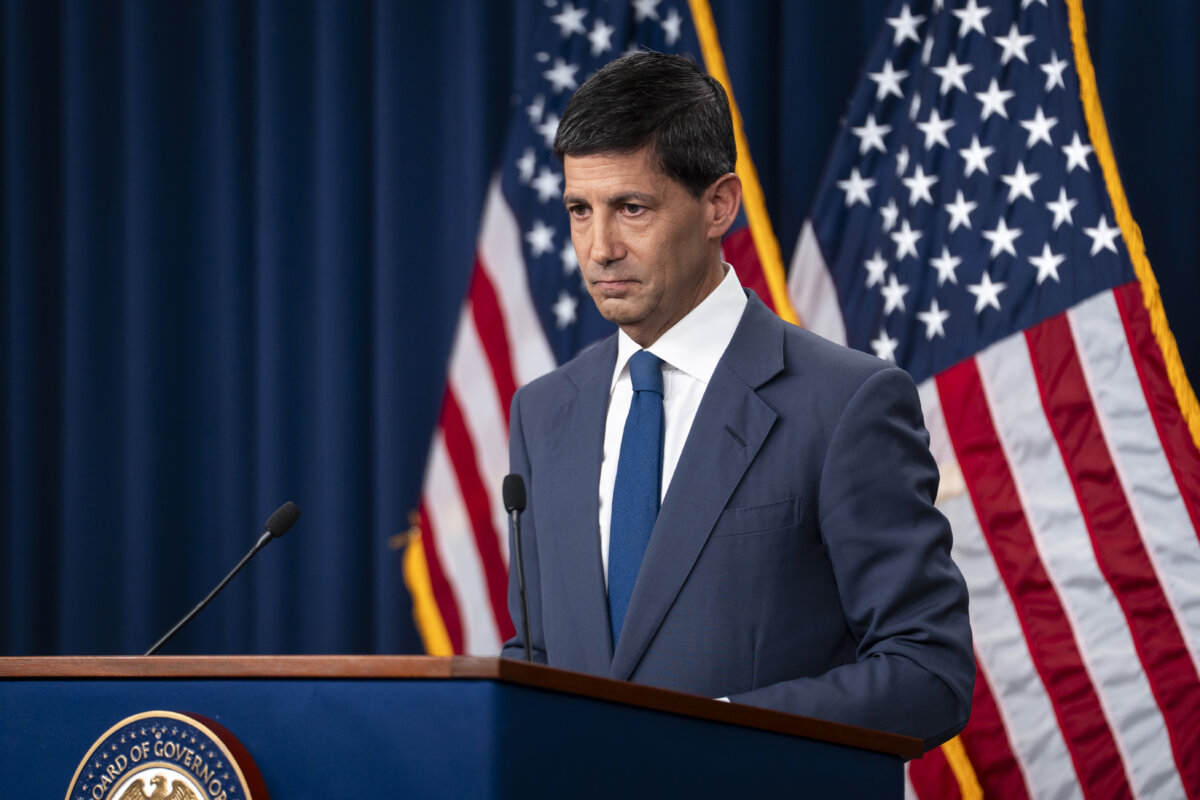

Federal Reserve officials expect one more interest rate increase before the year is over, according to minutes released on Oct. 7.
The Fed voted unanimously on Sept. 16. to follow through on the first interest rate hike since July 2023, bringing the key policy rate to a new target range of 3.75 percent to 4 percent.
But the U.S. central bank might not be one and done, the September Federal Open Market Committee meeting summary indicated.
“With regard to the outlook for monetary policy beyond the current meeting, most participants assessed that another increase in the target range for the federal funds rate would likely be appropriate by year end,” the document stated.
This matches the outlook inside the updated Summary of Economic Projections—a quarterly policy and economic forecast put together by monetary policymakers—which predicted a median federal funds rate of 4.1 percent this year.
Looking ahead, the September forecast also suggested no rate changes in 2027 and possible rate cuts in 2028 and 2029.
With the war in Iran, now approaching its ninth month, raising energy prices, monetary policymakers fear it could eventually filter through the broader economy, causing second- and third-order inflation effects.
Like the European Central Bank, the Fed would provide “insurance against inflation” as it has remained above the institution’s 2 percent target for more than 60 consecutive months, citing “stronger-than-expected demand or further adverse supply shocks.”
Following last month’s decision, futures markets had immediately penciled in another rate hike at the October meeting.
These expectations have been tempered following an influx of positive economic data, prompting traders to forecast a December increase.
The next rate action ultimately depends on what the data suggest.
“Participants emphasized, however, that they approached each meeting with an open mind and decisions at future meetings would depend on incoming information and its implications for the outlook and the balance of risks,” the minutes said.
Economic growth was robust in the second quarter, and the Atlanta Federal Reserve anticipates a solid expansion in the third quarter.
The Fed’s go-to inflation measure for August—the Personal Consumption Expenditures (PCE) Price Index—came in firmly below expectations.
But inflation has been stubborn since 2021, and consumers do not expect much relief in the year ahead.
The New York Fed’s Survey of Consumer Expectations pointed to a one-year inflation outlook of 3.9 percent—the highest since May 2023—up from back-to-back 3.6 percent readings.
The three- and five-year forecasts were little changed at 3.3 percent and 3 percent, respectively.
Despite worse-than-expected September job growth, unemployment is low, and layoffs have been tepid.
“Monthly macro data, while likely confirming a push out of the next Fed rate hike to December versus the October meeting, doesn’t change concerns around oil and inflation, fiscal sustainability, and AI hyperscaler capex competing for capital,” Justin Bergner, portfolio manager at Gabelli Funds, said in an emailed note to The Epoch Times.
Bond Market Rout
The U.S. Treasury bond market is another key challenge for the Fed.
The entire yield curve has rocketed over the past two months, fueled by persistent inflation concerns, fiscal fears, and capital competition.
The benchmark 10-year Treasury yield and the 30-year touched a 24-year high this week.
A chorus of Fed officials appear willing to continue the central bank’s inflation fight.
Next week will deliver a fresh batch of key inflation news, with the September Consumer Price Index and the Producer Price Index.
The Cleveland Fed forecasts the annual inflation rate coming in at 3.6 percent.
Excluding energy and food, the 12-month core inflation rate could hold steady at 2.4 percent.
Based on the October projections, inflation may have plateaued.
Next month’s consumer inflation expectations suggest the annual and monthly rates are far more stable.
Investors had little reaction to the minutes, but the leading benchmark averages did pare their massive midweek losses after a solid 10-year Treasury auction.
 Friends Read Free
Copy
Facebook
Tweet
Friends Read Free
Copy
Facebook
Tweet