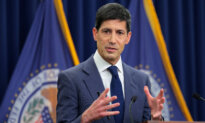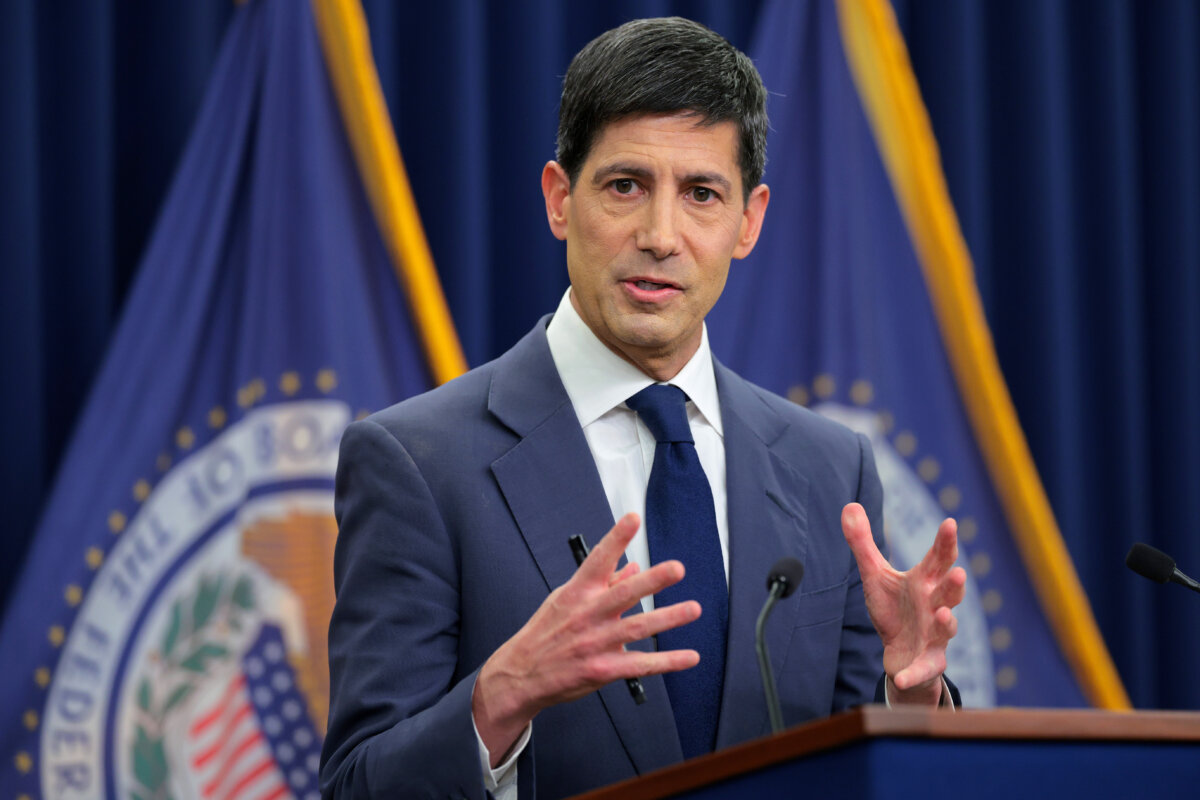

The Federal Reserve held interest rates steady at Kevin Warsh’s first policy meeting as chairman of the U.S. central bank.
Officials voted 12–0 to keep the benchmark federal funds rate unchanged at a target range of 3.5 percent to 3.75 percent.
“Economic activity is expanding at a solid pace despite elevated uncertainty that owes, in part, to the conflict in the Middle East,” the post-meeting Federal Open Market Committee statement reads. “Productivity growth and capital investment are strong. Job gains have kept pace with the workforce, and the unemployment rate has changed little.”
Inflation is still running above the committee’s 2 percent target, partly because of supply‑side shocks that have pushed up prices in areas such as energy, the Fed said.
“The Committee remains committed to restoring price stability,” it said.
The post-meeting statement is considerably shorter than in years past, clocking in at 130 words. By comparison, the April statement has 341 words.
President Donald Trump, speaking to reporters, said the Fed decision was “all right.”
When asked about the Fed possibly raising rates, the president said it is “hard to believe.”
“It just keeps the country down and it’s so, it’s so unusual,” Trump said. “But we have a very good guy over there right now, so I’m guided by what he wants.”
Byron Anderson, head of fixed income at Laffer Tengler Investments, said to The Epoch Times in an emailed note, “There was nothing for the Fed to do today except wait for the energy supply shock to subside; rate hikes don’t solve oil prices today.”
Monetary Task Force
In his first news conference, the new chairman announced a new initiative that follows through on his commitment to bring “regime change” in the areas of policy and personnel to the Federal Reserve.
Warsh confirmed to reporters that he is establishing five task forces to address the Fed’s communications, balance sheet, use and reliance on data sources, productivity and employment, and inflation frameworks.
“Each task force will serve an objective shared by everyone in the system, shared by everyone around that table that I sat with over the last couple of days, a Federal Reserve that is clear-eyed about its mission, fit for purpose, and focused on the future,” Warsh said.
The review, which should be provided by the year’s end, will examine communications broadly, including news conferences, meeting minutes, and transcripts.
He stopped short of confirming whether the Fed will adjust its long-held 2 percent inflation target.
Warsh acknowledged that change is not easy and that it is “filled with risk.”
“But our number one goal is to get monetary policy right,” he told reporters. “The way to get monetary policy right is to deliver on the remit that Congress gave us to deliver on price stability, and there was no disagreement on any of those points.”
Market watchers had been waiting for what reforms Warsh could introduce, and the meeting gave a hint of what to expect moving forward.
“We are getting a taste of communication changes with a notably shortened statement and, interestingly, no reference to the employment mandate,” Christian Hoffmann, head of fixed income at Thornburg Investment Management, said in a note emailed to The Epoch Times.
“We continue to be interested in the leadership transition and ‘regime change.'”
The Outlook
Monetary policymakers have indicated that they are willing to take a wait-and-see approach to determine whether an oil price shock from the Iranian conflict would filter through the broader economy.
Officials now anticipate that inflation will remain above its target level until 2028, according to the updated Summary of Economic Projections.
The 12-month median personal consumption expenditure inflation rate is expected to be 3.6 percent this year, up from 2.7 percent in the previous estimate.
The annual core personal consumption expenditure inflation rate, which strips out volatile energy and food prices, is also anticipated to be 3.3 percent this year, up from 2.7 percent in the March forecast.
Policymakers expect slower growth this year, coming down to 2.2 percent from the earlier prediction of 2.4 percent. Real gross domestic product growth is projected to remain slightly above 2 percent in 2027 and 2028.
Unemployment is slightly lower than before, projected at 4.3 percent, down from 4.4 percent. The jobless rates for 2027 and 2028 remained unchanged at 4.3 percent and 4.2 percent, respectively.
Warsh indicated at his Senate confirmation hearing that the U.S. labor market was at full employment based on the Fed’s dashboard of indicators.
In a note attached to the quarterly outlook, the Fed said that 18 of the 19 meeting participants submitted rate and economic projections.
Warsh told reporters that he was the one who abstained.
“It’s been the practice of this committee for participants to submit these projections, and I have encouraged my colleagues to continue to do so,” he said. “I, however, have refrained from offering any projections of my own, consistent with my long-held views on the [Summary of Economic Projections], at least as currently structured.”
He told lawmakers in April: “The Fed tells the whole world what their dots are going to be, what their forecasts are going to be.
“Well, the Fed’s human. Then they hold on to those forecasts longer than they should. I think if the Fed were to wait until it gets into a meeting before making a decision, that incremental deliberation can keep the central bank from compounding its errors. I think these are big changes that are needed.”
Market Reaction
Investors were quick to fully price in an interest rate hike later this year.
For weeks, financial markets had made a tighter monetary policy their base-case scenario because of the war in Iran, which upended global energy markets.
CME FedWatch data suggest a 60 percent chance of a rate increase at the October policy meeting.
The two-year Treasury yield, which tracks Fed policy expectations, surged by about 14 basis points to almost 4.2 percent.
“Markets and consumers should be happy that more of the same will not be the default,” Anderson said. “Inflation is a problem and has been for five years, but a unanimous agreement for no movement was appropriate.
“Warsh is inheriting a precarious situation and with it everyone should be happy with an efficient and thoughtful new Fed Chairman.”
U.S. stocks slumped following the Fed’s meeting.
The blue-chip Dow Jones Industrial Average, the broader S&P 500, and the tech-heavy Nasdaq composite index declined by as much as 1 percent toward the end of the June 17 trading session.
 Friends Read Free
Copy
Facebook
Tweet
Friends Read Free
Copy
Facebook
Tweet