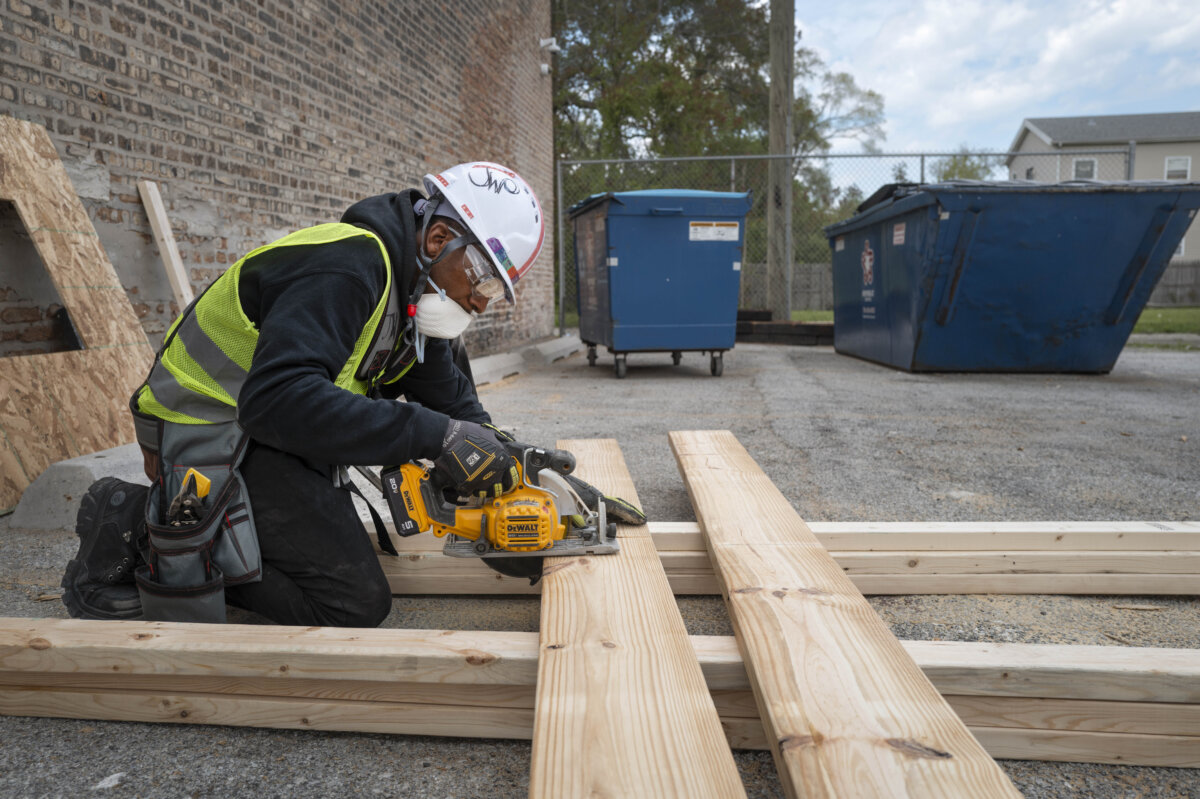

Lowe’s is working with more than 75 companies, educators, and workforce groups to train and develop 1 million people for skilled-trades careers over the next decade.
The Lowe’s Foundation on Tuesday announced the Building Futures Skilled Trades Coalition on Tuesday, bringing together employers and organizations including Nvidia, General Motors, AT&T, Bank of America, Carrier, DeWalt, and Duke Energy.
The coalition aims to help train and develop 1 million skilled tradespeople by 2035 as employers across the United States struggle to fill jobs in construction, manufacturing, telecommunications, energy, and other industries.
The U.S. Department of Education estimates that as many as 2.1 million skilled-trades jobs could go unfilled by 2030, potentially costing the economy up to $1 trillion annually.
The shortage is being driven in part by an aging workforce and too few younger workers entering the trades. According to the Education Department, for every five skilled-trades workers who retire, only two younger people enter the profession.
Building a Greater Talent Pipeline
The coalition plans to focus on three areas: changing perceptions about skilled-trades careers, expanding successful training and credential programs, and tracking whether trainees ultimately find jobs and build long-term careers.
Members pledge to challenge the perception that a four-year college degree is the default route to a successful career and promote skilled trades as an alternative path to stable, well-paying work.
The coalition also plans to connect employers, schools, and workforce organizations so that successful training programs can be expanded rather than recreated independently in different regions.
Members will develop shared methods for tracking outcomes—from enrollment and training through employment—to identify which programs are actually helping workers move into in-demand jobs.
The initiative builds on Lowe’s existing efforts to address the nationwide skilled-trades shortage.
The Lowe’s Foundation launched its Gable Grants program in 2023 with an initial $50 million commitment to help train 50,000 workers. The program has since grown to include 73 community colleges and nonprofit organizations across 30 states.
In April, the foundation expanded that commitment to $250 million, with a goal of helping train and develop 250,000 skilled tradespeople by 2035. The program supports training in fields such as carpentry, electrical work, plumbing, HVAC, and construction.
The broader coalition allows Lowe’s to extend beyond its own grants by bringing employers, educators, and other organizations into a coordinated national initiative.
“The next industrial revolution won’t be built by algorithms alone. It will be built by the millions of skilled trade professionals who power, connect, and move this country forward,” Lowe’s chairman and CEO Marvin Ellison said in announcing the coalition.
Skilled Trades in the Age of AI
As artificial intelligence (AI) rapidly reshapes the labor market, Ellison is betting that skilled trades will remain a more resilient career path.
He has noted that many of Lowe’s contractor customers already struggle to find enough skilled workers. And while AI has become increasingly powerful, Ellison said it cannot easily replace people who perform hands-on repairs, construction, and maintenance.
“AI isn’t going to fix a hole in your roof,” Ellison said at the Business Roundtable’s CEO Workforce Forum in Washington in June 2025.
“It’s not going to respond to an electrical issue in your home. It’s not going to stop your water heater from leaking.
“We’re always going to need … skilled trades individuals.”
At the same time, the growth of AI is itself increasing demand for skilled labor. Data centers and the power infrastructure that support them require electricians, HVAC technicians, construction workers, and other tradespeople to build and maintain the physical systems that enable the technology.
The growing demand for skilled labor amid the AI infrastructure boom was also highlighted by AT&T Chairman and CEO John Stankey, whose company is investing hundreds of billions of dollars to expand and upgrade its fiber and 5G networks.
“As AI and other emerging technologies become more deeply embedded in everyday life, the resilient broadband networks that underpin them will be more important than ever—and those networks can’t be built or maintained without skilled workers,” Stankey said in announcing the initiative.
 Friends Read Free
Copy
Facebook
Tweet
Friends Read Free
Copy
Facebook
Tweet