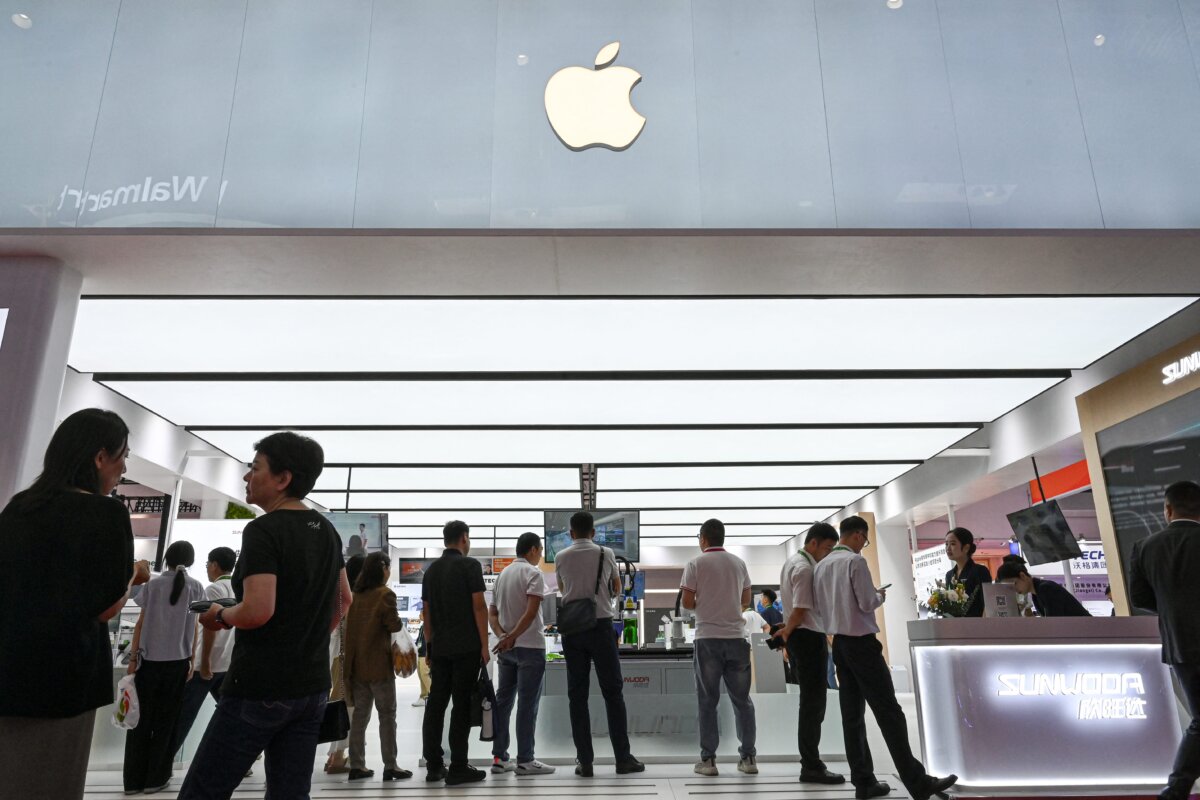

Apple, for the first time in the company’s history, is closing a store in China, as the Chinese regime shoulders mounting economic pressures and lukewarm spending at home.
The store inside the Parkland Mall in Dalian city, northeast China, will be shut down after July 8, according to a notice on Apple’s official website.
“Given the departure of several retailers at the Parkland Mall, we have made the decision to close our store there on Aug. 9, 2025,” the company said in a statement to domestic media.
The company’s decision comes as the world’s second-largest economy grapples with worsening deflationary pressure, fueled by excessive supply and weak domestic demand, coupled with a tariff war with the United States.
Retail sales growth was lower than forecast in June, with housing prices marking their steepest drop in eight months, according to official data.
The closure affects one of the two Apple stores in Dalian city; the other is located in the Olympia 66 complex, about 10 minutes away. Apple added that employees at the Parkland Mall location would be offered roles at nearby outlets.
Apple operates 41 stores in China, according to the company’s website. It accounted for less than 10 percent of its global footprint of 530-plus physical stores.
Recent data from research firm IDC revealed that China’s smartphone market contracted in the second quarter, with shipments declining at four of the top five brands due to weaker consumer demand.
Apple ranked fifth in China’s smartphone market, trailing local competitors such as Huawei, Vivo, Oppo, and Xiaomi. According to the IDC, the U.S. tech giant saw its shipments decline 1.3 percent year-on-year to 9.6 million units in the second quarter, a smaller drop compared with the 9 percent decline in the first quarter, thanks to price adjustments made to specific iPhone 16 and 16 Pro variants eligible for government subsidies.
Apple’s market share rose to 13.9 percent in the June quarter, up from 13.7 percent in the March quarter. It was Apple’s eighth straight quarter of decline, IDC data show.
In comparison, Huawei holds around an 18 percent market share, with Xiaomi at roughly 14 percent.
Meanwhile, Apple is restructuring its supply chain, diversifying production away from China. India has overtaken China as the largest supplier of smartphones imported into the United States, accounting for 44 percent of shipments in the second quarter, compared to China’s 25 percent, according to research firm Canalys.
Apple’s supplier in India generated about $14 billion in iPhone production during 2024—roughly 14 percent of global output—with plans to expand further across India and Vietnam, amid broader trade tensions.
Reuters contributed to this report.
 Friends Read Free
Copy
Facebook
Tweet
Friends Read Free
Copy
Facebook
Tweet