
The Chinese regime is leveraging opaque laws and overseas judicial pacts to expand a transnational suppression network, further exposing Taiwanese citizens to arbitrary detention in China and extradition from nations friendly to Beijing, experts warn.
Taiwan is a self-governing democracy that the Chinese Communist Party (CCP) has never controlled but has vowed to annex, potentially by force.
Taiwan’s Mainland Affairs Council (MAC)—a government agency that handles cross-strait affairs—said in an Aug. 29 Facebook post that 160 Taiwanese citizens have gone missing, 36 have been detained for questioning, and 230 are suspected of being held in custody in China between Jan. 1, 2024, and Aug. 27, 2026.
Together, they bring the total to 426 cases.
The MAC said in January that 221 Taiwanese citizens fell into the same categories in 2025, a fourfold increase from 2024.
“Taiwanese travelers are left in the dark about whether Beijing has already flagged them under its opaque legal framework,” Tseng Chien-yuan, an adjunct associate professor at Taiwan’s National Central University’s Department of Hakka Language and Social Sciences, told The Epoch Times.
The council’s announcement comes just weeks before Beijing is set to enforce a new 19-part set of border rules on Sept. 15.
Arthur Zhin-sheng Wang, secretary-general of the Asia-Pacific Elite Interchange Association in Taiwan, said China’ s new entry-exit rules are aimed at crushing Chinese dissent at home and abroad, but they could also escalate risks for Taiwanese people who enter China.
“If Chinese authorities deem someone a threat to national security, Taiwanese travelers may find themselves unable to leave the country, making entry into China extremely risky,” Wang told The Epoch Times.
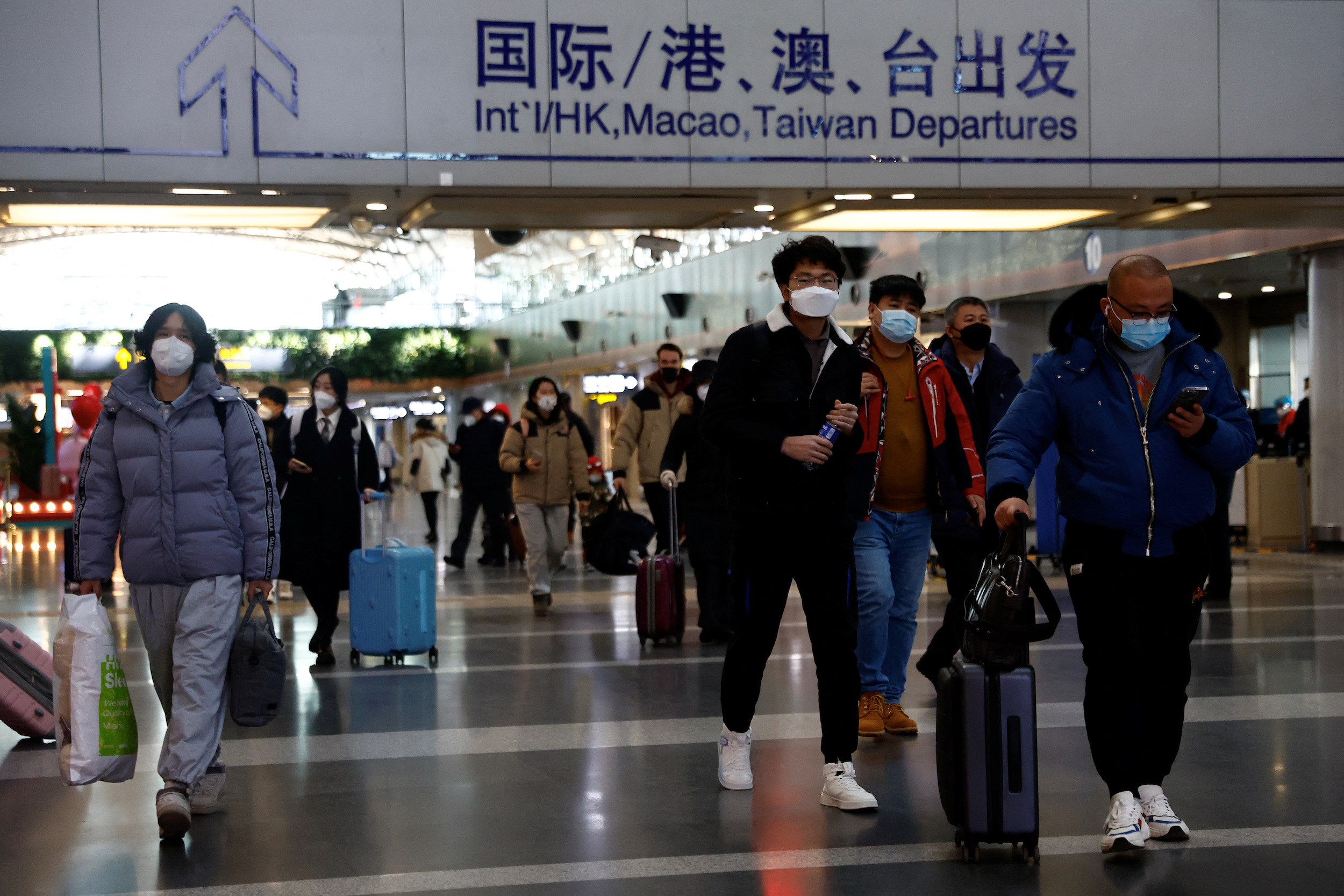 Travelers walk with their luggage at Beijing Capital International Airport, amid the COVID-19 outbreak in Beijing on Dec. 27, 2022. (Tingshu Wang/Reuters)
“China has overseas ‘police stations’ in many countries, which authorities can use to detain Taiwanese without due process,” he said.
“Beijing also has judicial assistance agreements with numerous nations, allowing it to extradite Taiwanese on fabricated charges and subject them to sham trials once they are in China.”
More than 600 Taiwanese people were extradited or deported to China from countries across Asia, Africa, and Europe between 2016 and 2019 under pressure from Beijing, according to a 2021 report by the Madrid-based rights human rights organization Safeguard Defenders.
The law, which took effect on July 1, states that organizations and individuals beyond China’s borders can be held legally accountable for “undermining ethnic unity and progress” or “inciting ethnic separatism.” Experts told The Epoch Times in March that China could use the law to penalize Taiwanese people for any past efforts to support the island’s independence.
Wang cautioned that the CCP has created a “comprehensive suppression network,” and any Taiwanese citizen who touches on topics sensitive to the Chinese regime could face persecution, regardless of whether they are inside China.
In late August, a Taiwanese parent said on social media that their son was subjected to a six-hour interrogation upon arriving in Shanghai over their past employment at Amnesty International, Taiwan’s Central News Agency (CNA) reported on Aug. 30.
The son ultimately gave up on entering China and returned safely to Taiwan.
The MAC said on Aug. 30 that while it received no formal report of the incident, the account aligns with similar cases the agency has tracked.
A spokesperson for China’s Taiwan Affairs Office claimed on Sept. 2 that Amnesty International is a “tool of international anti-China forces” and defended screening individuals tied to the organization.
‘Subverting State Power’
Wang said that the CCP is employing a carrot-and-stick united front strategy, co-opting various sectors of Taiwanese society through influence operations and economic incentives while simultaneously using legal measures to coerce them.
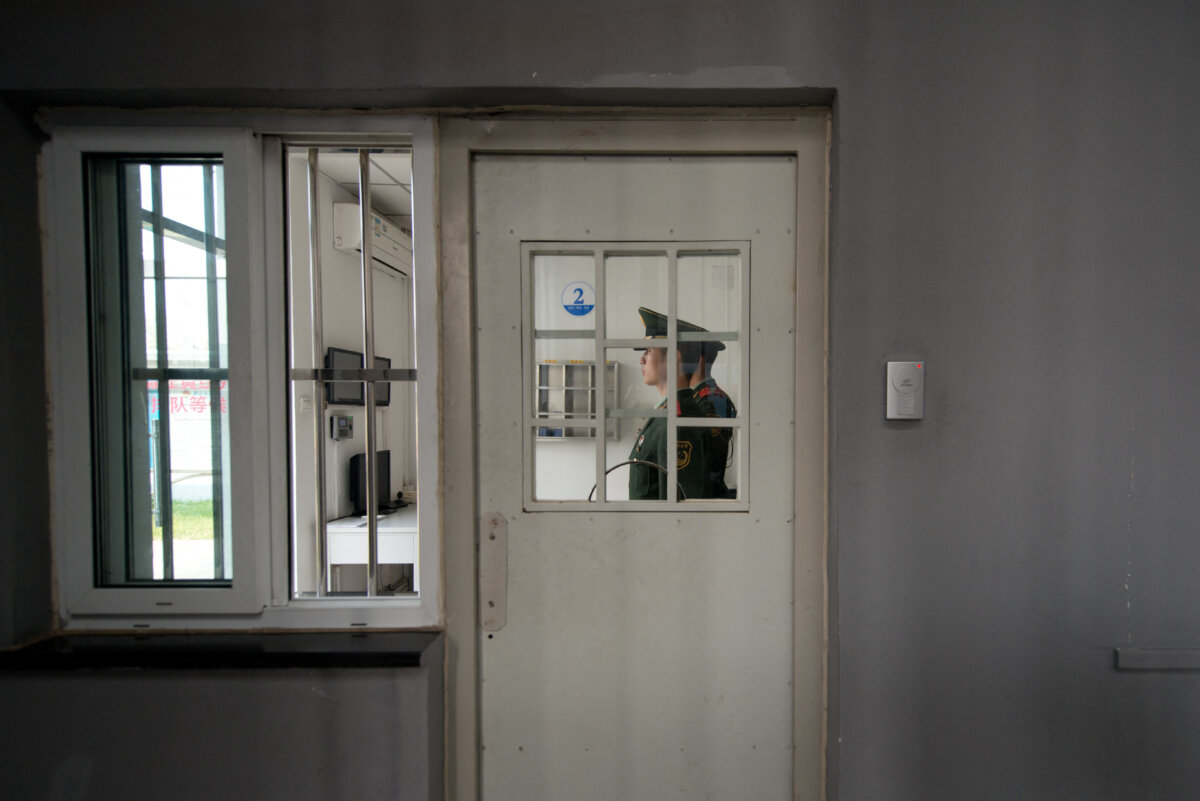
 A guard looks through the window of a hallway inside a detention center in Beijing on Oct. 25, 2012. (Ed Jones/AFP via Getty Images)
Anyone involved in pro-Taiwan activities, religious exchanges, or even just publishing work could be accused of subverting state power in China, Wang said.
Li Yanhe—a Taiwan-based publisher who was born in China but holds Taiwanese citizenship—was detained while visiting Shanghai in March 2023. Known by his pen name, Fu Cha, Li has served as the editor-in-chief of Gusa Publishing, a company that has released books critical of the Chinese regime.
The freedom of speech Taiwanese people enjoy at home instantly makes them targets for heightened scrutiny the moment they enter China, according to Tseng.
Taiwanese citizens can freely criticize the Chinese regime in Taiwan, he said. However, this information can easily reach China.
“Any past remarks that reach Beijing … can become a serious liability for Taiwanese entering China,” he added.
Growing Suppression
Wang said Beijing’s restriction of Taiwanese freedoms will only push them further away.
 People wear protective masks as they ride their motorbikes as others shop at a night market in Taipei, Taiwan, on May 15, 2021. (Ann Wang/Reuters)
A poll published by the Election Study Center at Taiwan’s National Chengchi University on July 3 shows that 63.1 percent of adults in Taiwan aged 20 and older identify exclusively as Taiwanese.
Another 30.7 percent consider themselves both Taiwanese and Chinese, while just 2.5 percent see themselves solely as Chinese—a figure that has dropped significantly since 1992.
Tseng said the CCP’s ultimate goal is maintaining stability and manipulating the Chinese people’s perception of Taiwan.
“The regime’s top priority is convincing Chinese citizens that Taiwanese desperately want to be ruled by Beijing, thereby silencing any dissent against unification,” he said.
Tseng said he expects Beijing’s United Front strategies to intensify, even if the long-term geopolitical blowback outweighs any immediate benefits.
 Friends Read Free
Copy
Facebook
Tweet
Friends Read Free
Copy
Facebook
Tweet