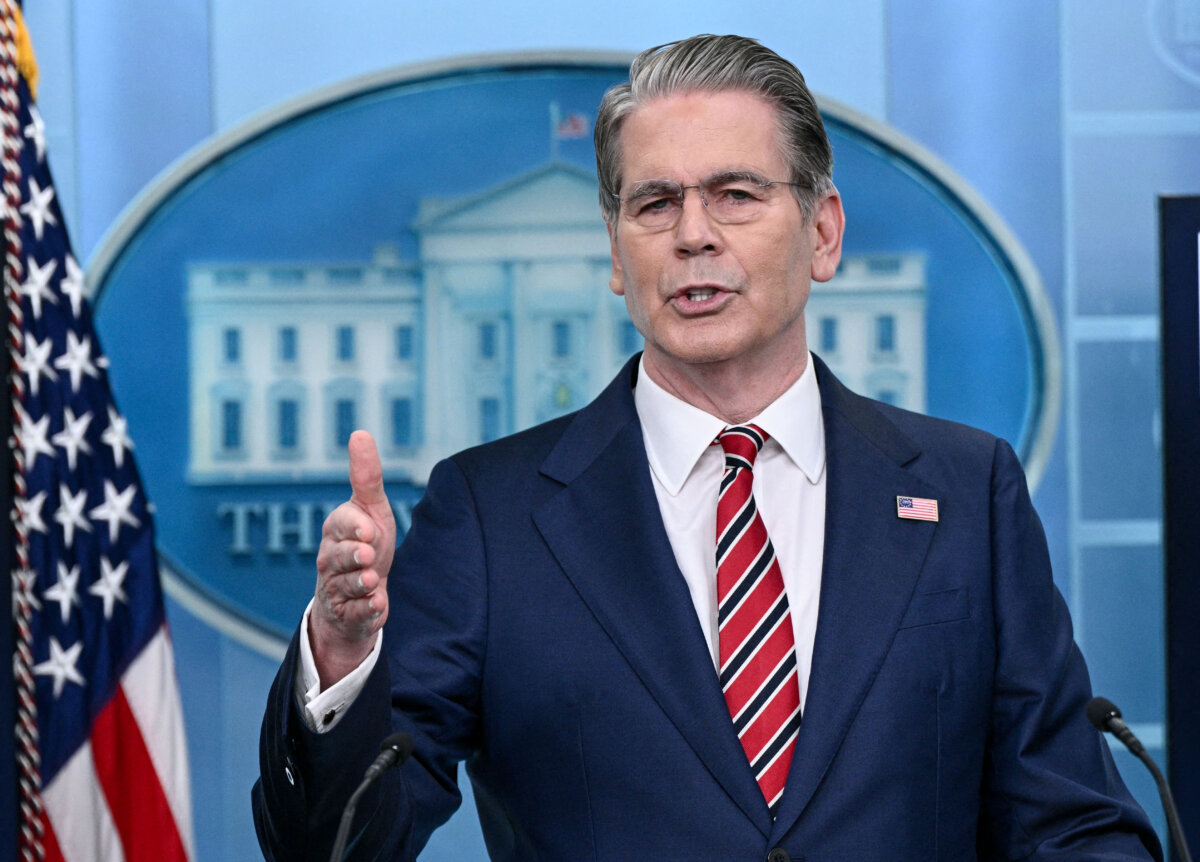
U.S. Treasury Secretary Scott Bessent will meet Chinese Vice Premier He Lifeng this week ahead of President Donald Trump’s summit with Chinese leader Xi Jinping.
In a May 10 post on X, Bessent said he would fly out on May 11 for a series of meetings in Japan and South Korea.
After meeting with Japanese Prime Minister Sanae Takaichi and Finance Minister Satsuki Katayama in Tokyo on May 12, he will travel to South Korea for talks with Chinese Vice Premier He Lifeng.
Bessent will then join Trump and Xi at their summit in China, the first meeting between the two leaders since Trump re-entered the White House in January 2025.
The summit, which begins on May 14, will be the first time the two leaders have met in person since November 2017, when Trump last visited China.
‘Economic Security is National Security’
“Economic security is national security, and I look forward to a productive series of engagements as we work to advance President Trump’s America First Economic Agenda,” Bessent wrote.
On April 30, Bessent and He held a video call, also attended by U.S. Trade Representative Jamieson Greer, at which they discussed creating a new “Board of Trade” to help manage trade ties between the world’s two largest economies.
In an interview on Fox News’ “America’s Newsroom” on May 4, Bessent had some harsh words for the Chinese regime about the Iran conflict.
“China, let’s see them step up with some diplomacy and get the Iranians to open the strait,” Bessent said.
Beijing is a strong economic ally of Tehran, and buys more than 80 percent of Iranian oil exports.
In his May 4 interview, Bessent said that by buying Iranian oil and gas, China has been “funding the largest state sponsor of terrorism.”
Taiwan Arms Decision Pending
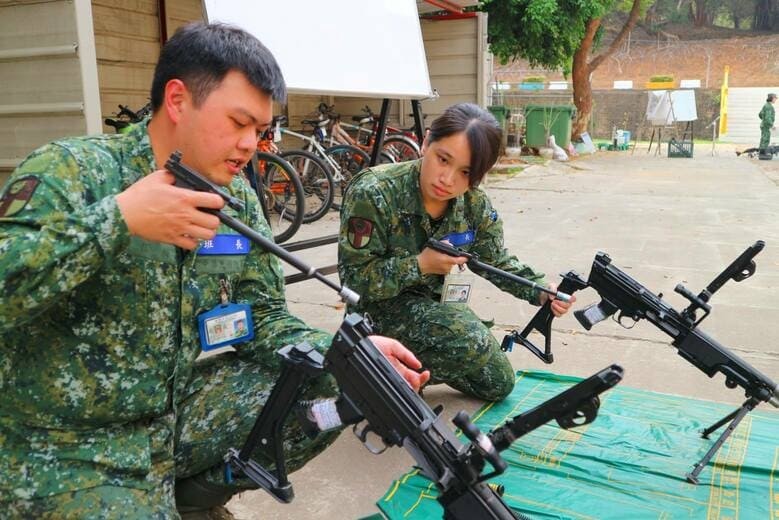
In December, Trump authorized an $11 billion arms package for Taiwan, the largest weapons sale ever to the island nation.
The arms have not been delivered. Trump acknowledged in February that he had discussed it with Xi.
“I’m talking to him about it. We had a good conversation, and we’ll make a determination pretty soon,” the president told reporters aboard Air Force One on Feb. 16.
Greer, speaking on Bloomberg Television on May 6, said China’s refusal to comply with U.S. oil sanctions on Iran “has to be a discussion item” when the leaders meet in Beijing.
Since the start of Operation Epic Fury on Feb. 28 and the subsequent U.S. naval blockade, global energy prices have surged, and sales to China have cushioned the blow to Tehran’s treasury.
According to Vortexa Analytics, China used a “dark fleet” to import a record 1.8 million barrels per day in March 2026, as buyers aggressively stocked up ahead of the conflict. While the physical volume of exports dropped in April due to the U.S. blockade, the financial impact has been mitigated by a spike in global oil prices.
While the Iranian oil trade remains a primary point of leverage, Greer said that the United States is “looking for stability with China.”
Last week, a bipartisan group of U.S. senators called for stability and closer cooperation with China during meetings in Beijing.
Sen. Steve Daines (R-Mont.) led the delegation, which included Sens. Maria Cantwell (D-Wash.), Jerry Moran (R-Kan.), and Deb Fischer (R-Neb.). They met on May 7 with Chinese Premier Li Qiang, National People’s Congress Chairman Zhao Leji, and Foreign Minister Wang Yi.
“I want to thank you for the meeting that you had [on May 6] with the Iranian foreign minister,” Daines told Wang. “You are working to de-escalate tensions, to bring peace to the Middle East, to open up the Strait of Hormuz.”
 Friends Read Free
Copy
Facebook
Tweet
Friends Read Free
Copy
Facebook
Tweet