
China said it will continue to cooperate with Russia on preventing and controlling infectious diseases, in its first official response to a suspected case of pneumonic plague in Siberia that’s causing global concerns.
Meanwhile, medical experts who spoke with The Epoch Times warned of the risks of lack of transparency with the situation.
Darya Shipilova, a 28-year-old laboratory worker at the Irkutsk Anti-Plague Research Institute for Siberia and the Far East, was hospitalized with severe pneumonia on Sept. 29 and died on Oct. 2, causing concerns of a possible plague outbreak.
Russian authorities told the World Health Organization (WHO) it had placed approximately 200 contacts under quarantine and observation. Irkutsk Governor Igor Kobzev stated that the cause of death was “pneumonia of unknown etiology (unknown origin).” Russian authorities denied that Shipilova had died of pneumonic plague.
Soon after Shipilova’s death, Russia’s neighboring countries including Uzbekistan, Kazakhstan, Kyrgyzstan, Tajikistan, and Mongolia stepped up quarantine measures and testing to prevent a potential epidemic from spreading to their territories, yet no announcements of similar preventive measures were made by Chinese authorities.
On Oct. 6, Beijing made its first official comments on the Siberia case.
Chinese Foreign Ministry spokesman Guo Jiakun said at a regular press briefing that China and Russia are cooperating and communicating closely to prevent and control infectious diseases, including plague.
Pneumonic plague is lung-based and a severe form of plague that can spread via respiratory particles.
Just over one month ago, China and Russia conducted a joint heath emergency drill from Aug. 24 to 27, near the China–Russian border in Fuyuan City in Heilongjiang Province. The drill simulated the response to infectious disease outbreaks, especially imported plague. Sergey Balakhonov, director of the Irkutsk Anti-Plague Research Institute, also participated in the drill.
The Irkutsk Anti-Plague Research Institute has been working with various Chinese institutions on related research for many years.
The Irkutsk region lies just 150 miles north of Mongolia. Although it doesn’t directly border China, the local capital is a major hub with frequent flights and rail links to Chinese cities.
International Response
Marshall Billingslea, who served as President Donald Trump’s special presidential envoy for arms control at the State Department, revealed on the social media platform X that he worked in the 1990s with Ken Alibek, “the former No. 2 in the Soviet biological weapons program, after he defected to the US. He claimed that they had engineered a strain of plague that was antibiotic-resistant & that they had worked on plague chimeras (fusing 2 or more pathogens). He specifically called out Irkutsk for being involved in the [biological weapons] program.”
“This outbreak is deeply worrisome. This may not be just ‘the plague.’ It may be far worse,” Billingslea wrote in the post.
After unverified Russian local media reports about a second victim who was also an employee of the Irkutsk Anti-Plague Research Institute surfaced, Tedros Adhanom Ghebreyesus, director-general of the WHO in Geneva, addressed them in a statement on X on Oct. 6: “WHO has requested further information to clarify the cause of the severe pneumonia, the pathogen that prompted the public health measures, and media reports of a second employee with pneumonia of undetermined cause.”
On Oct. 7, the Russian government denied reports of a death of a second employee at the research institute linked to the suspected pneumonic plague.
At a WHO press conference in Geneva, Ghebreyesus said: “We don’t yet have the full picture of this event and we’re not able to conduct a full risk assessment.”
U.S. Secretary of State Marco Rubio on Tuesday called on the Russian government to provide more information on the lab worker’s death.
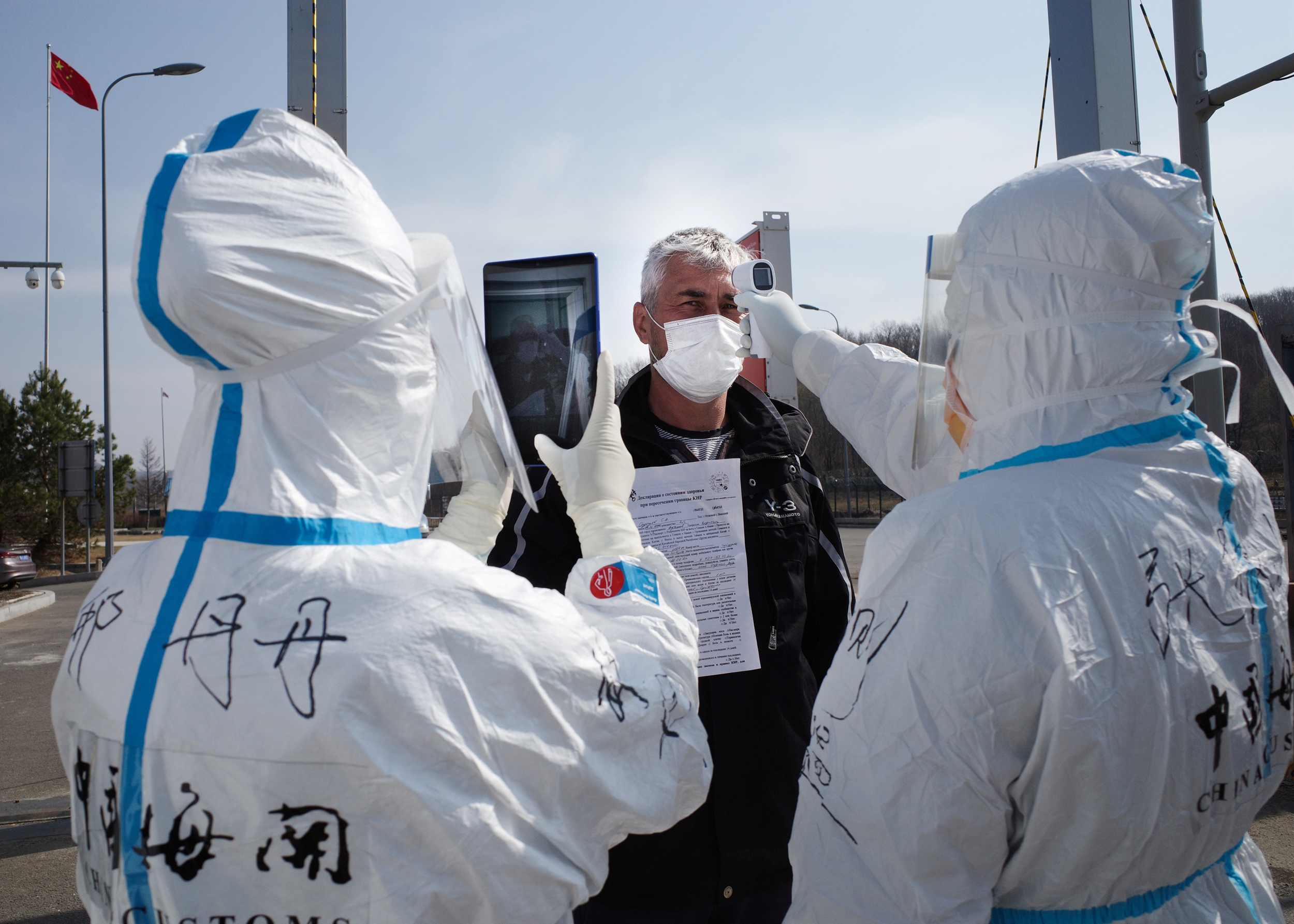 Staff wearing hazmat suits check the temperature of a driver at a customs checkpoint on the border with Russia at Suifenhe, China, on May 1, 2020. (STR/AFP via Getty Images)
Transparency Concerns
The biggest issue right now is the lack of transparency regarding the Russian lab worker’s cause of death, Xiaoxu Sean Lin, former U.S. Army microbiologist and associate professor of biomedical science at Fei Tian College Northern Campus in New York, told The Epoch Times. “Official diagnoses remain vague, yet disease control measures are extremely strict. This discrepancy itself requires further explanation,” he said.
Another issue is the question of what difficulties arose during Shipilova’s treatment, Lin said. Furthermore, Russia needs to release the results of PCR and genetic testing, he said. “In this era of advanced molecular biology, the situation cannot simply be dismissed as ‘pneumonia of unknown etiology.’”
Tang Jingyuan, a U.S.-based China analyst who is also a medical doctor, told The Epoch Times, “If the cause of her death—pneumonia of unknown origin—is not clarified, effective disease prevention measures cannot be implemented, potentially leading to an outbreak similar to the COVID-19 pandemic.
“Both the Chinese and Russian research institutes are closely linked to biological weapon development programs and engage in the artificial manipulation of viruses,” he said. “Under the totalitarian systems of the CCP and Putin’s Russia, when a suspected outbreak occurs, authorities invariably seek to cover up the truth, thereby would miss the window of opportunity to stamp out the epidemic.”
Tang Bing, Luo Ya, and The Associated Press contributed to this report.
 Friends Read Free
Copy
Facebook
Tweet
Friends Read Free
Copy
Facebook
Tweet