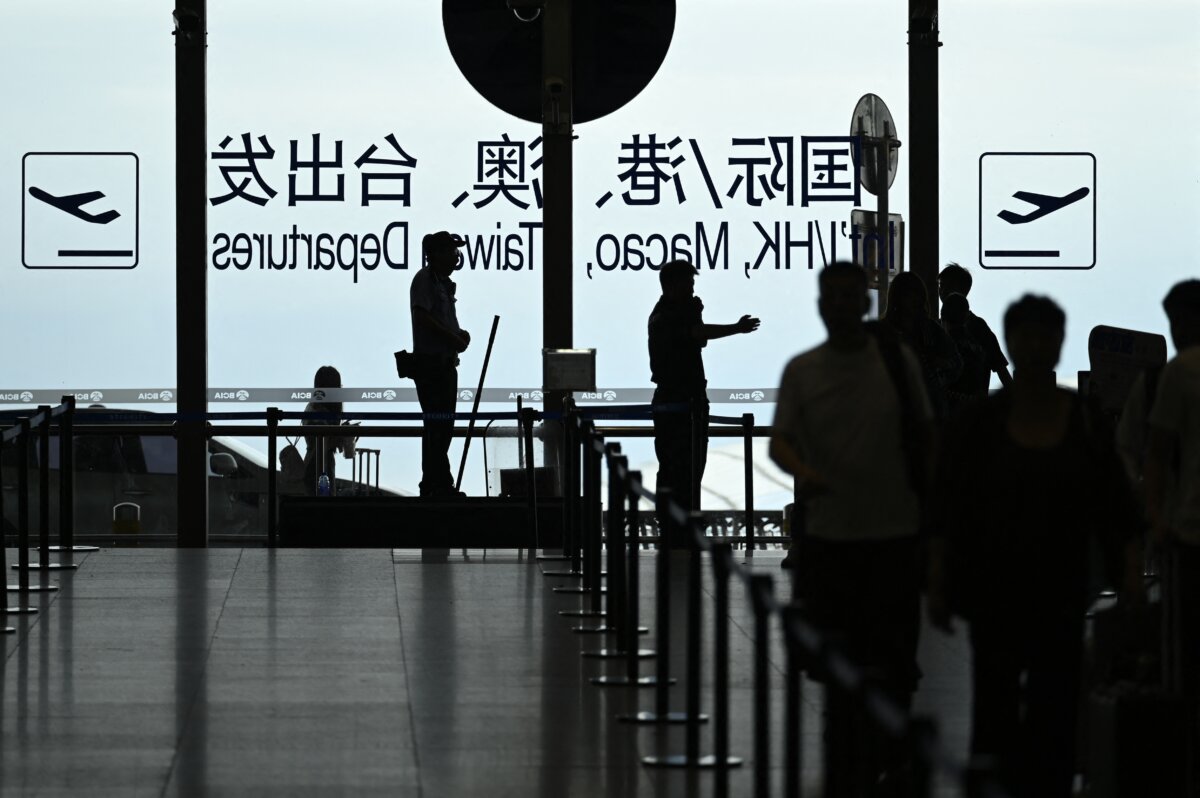

A new set of Chinese rules taking effect Sept. 15 is prompting concern among immigration advisers in China and their clients over whether the regime will gain access to detailed information about people seeking to leave the country or obtain foreign residency.
The rules, issued by China’s State Council, require agencies and individuals providing immigration advice to register with regime authorities. While the publicly released regulations specify that such agencies and their employees must be registered, they do not spell out what client information must be submitted to authorities or whether agencies will be required to regularly report client data.
Insiders in Shanghai’s immigration services industry say that regime authorities are already preparing companies for the rules’ implementation and that client information is being collected for government review. They spoke to The Epoch Times on condition of anonymity out of fear of reprisal.
The Shanghai Private Exit-Entry Service Center organized a meeting on Sept. 3 to brief member agencies on the new rules. The meeting focused on the State Council’s new regulations and instructed participants to prepare questions for discussion.
A Shanghai immigration service industry insider, surnamed Guo, told The Epoch Times that the meeting was intended less as an ordinary industry discussion than as a policy briefing for immigration agencies ahead of the rules taking effect.
“[The regulations] only say that [immigration advisory] firms must operate in a standardized manner, and also say that firms and practitioners must be registered. It does not explain the specific content,” Guo said.
She said companies may eventually be required to retain or submit client information and details of their immigration applications.
“[The regime] wants to know the circumstances of the applicants,” she said.
Registration of Immigration Advisory Firms
The State Council’s 19-article administrative regulations supplement China’s 2012 Exit and Entry Administration Law and are scheduled to take effect Sept. 15.
Article 7 stipulates that agencies and individuals providing intermediary services, including immigration advice, will be subject to registration requirements. These agencies must register with China’s immigration authority in the area where they are located, while employees must be registered through their employers.
The regulations do not publicly specify all of the information required for registration, nor do they state that agencies must routinely submit information.
A Shanghai-based immigration adviser, surnamed Ma, told The Epoch Times that her company and its employees had already completed registration.
Information including when the company was established and how many clients it currently has had to be registered, Ma said, adding that client information must also meet government standards.
“Our existing client list has all been handed over to [the authorities] for review,” she said.
The regulations provide for fines and orders to suspend business or undergo rectification for violations. In more serious cases, authorities can revoke an agency’s relevant license. Criminal liability may also apply when an offense constitutes a crime.
Withdrawn Applications
The new rules have also affected the businesses themselves, according to Ma.
She said some clients began withdrawing their documents and terminating contracts after the regulations were announced, with some even giving up deposits they had already paid.
The number of inquiries her company receives has also fallen sharply, Ma said, from dozens of calls a day seeking information about immigration services and fees to only a few.
“Clients are worried that we will hand over their information,” she said.
Ma described one client who had planned to move to Australia but abandoned the plan after the new rules were announced. The client asked the company to delete her records from its computers.
“Out of respect for the client’s wishes, we deleted her information,” Ma said.
A Shanghai-based attorney, surnamed Wang, told The Epoch Times the rules currently make clear that the registration requirement applies to immigration agencies and their employees, rather than to all people seeking to immigrate.
The publicly released regulations also do not explicitly require agencies to submit all client information to the state, he said.
However, Wang questioned whether the publicly stated requirements fully reflect how the rules will be enforced.
He said immigration agencies could become an important source of information for regime authorities seeking to identify Chinese families preparing to leave the country.
“[Immigration] agencies have already become an important part of the authorities’ investigation into immigrant families, such as which people are preparing to immigrate and whether they include executives of state-owned enterprises, people in the financial sector, engineers in the technology field, or people working in sensitive occupations,” he said.
The regulations come as many wealthy Chinese have already moved overseas, Wang said.
He added that some people have already obtained foreign citizenship or residency while continuing to spend extended periods in China.
For immigration advisers and their clients, the uncertainty now centers on how far the new registration system will extend beyond the requirements publicly set out in the regulations and what information the Chinese regime will ultimately be able to access about people preparing to establish lives abroad.
Ye Zilong contributed to this report.
 Friends Read Free
Copy
Facebook
Tweet
Friends Read Free
Copy
Facebook
Tweet