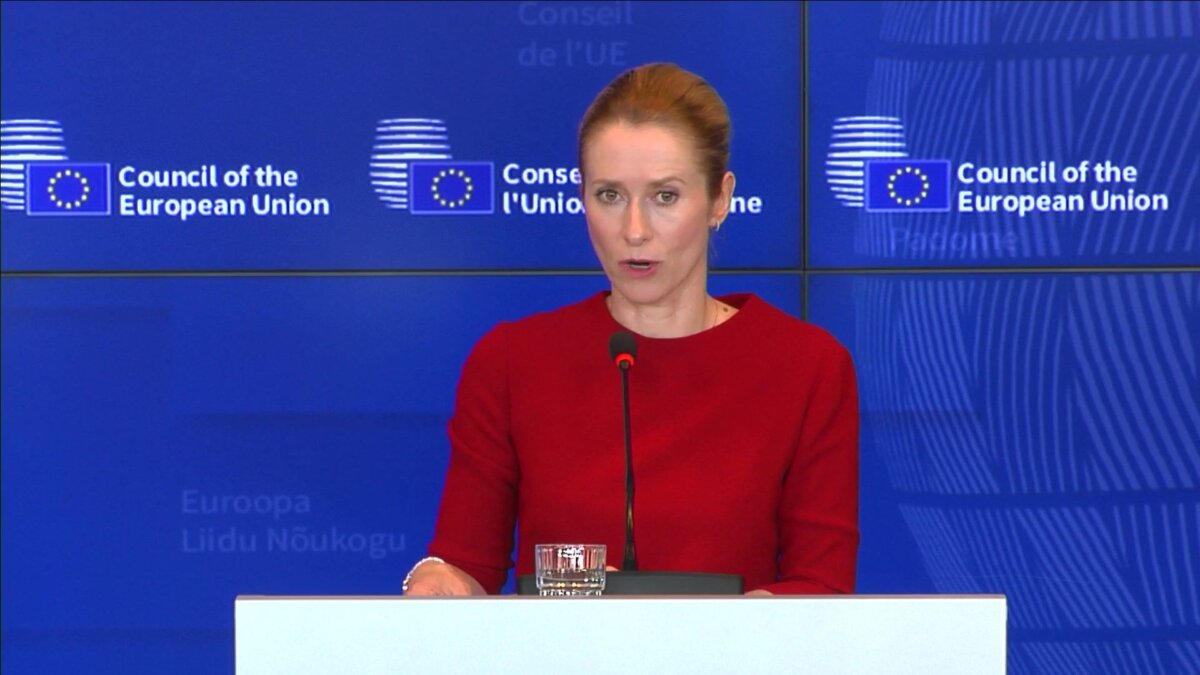

Kaja Kallas, the European Union’s foreign policy chief, said the bloc has verified reports that China’s military trained Russian troops to fight in Ukraine, putting the EU’s institutional weight behind an allegation previously reported by European media.
Kallas made the statement on June 15 after a Foreign Affairs Council meeting in Luxembourg, where ministers discussed Ukraine, sanctions, and the EU’s security relationship with China.
“We have also now verified reports that the Chinese military has been training Russian military personnel to fight in Ukraine,” Kallas said at a press conference. “We are carefully assessing the implications.”
Kallas did not publicly provide details on the number of troops trained, where the training took place, or what evidence EU officials reviewed.
The statement came on the same day that the Council of the European Union adopted new sanctions over Russia’s war in Ukraine. The Council named two Chinese companies under measures related to Russia’s military-industrial complex, but its public statement did not link either entity to the training allegation.
Sanctions Name Two Chinese Firms
The sanctions package added 34 individuals and 47 entities, and it imposed measures targeting Russia’s energy revenues, military-industrial complex, propaganda networks, hybrid activities, and human rights abuses.
Kallas said Beijing remains a “decisive enabler” of Russia’s war and that the EU sanctioned several Chinese entities in response.
The Council named Shenzhen Minghuaxin and Xinxiang Richful Lubricant Additive Company under measures related to Russia’s military-industrial complex.
The Council said the measures target manufacturers and suppliers of drones and other military equipment to Russia’s armed forces. It identified Xinxiang Richful as one of China’s largest lubricant additive manufacturers and distributors.
Reports Cited Training in China
Kallas’s remarks followed a May 19 Reuters report that cited three European intelligence agencies and documents reviewed by the news agency as saying China’s military had covertly trained about 200 Russian troops in China in late 2025.
Reuters reported that the training included drone operations and other battlefield skills, and that some Russian troops later returned to the war. Reuters said it could not independently verify whether the trained troops had taken part in combat in Ukraine.
The Reuters report said the program was laid out in a bilingual Russian-Chinese agreement finalized by senior military officials in Beijing on July 2, 2025. It also reported that the agreement barred media coverage of the visits and said third parties should not be informed.
A separate report by the German newspaper Die Welt said secret documents showed a wider China–Russia military pact that included training cooperation, front-line knowledge transfer, and new weapons deliveries. The Reuters and Die Welt reports cited different details and sourcing, and neither report’s underlying documents have been publicly released.
Chinese foreign ministry spokesman Lin Jian denied the EU allegation on June 16, saying the claim had “no factual basis” and was “nothing but smears.” He did not address the reported numbers, locations, or training content.
Moscow has not issued a direct public response to Kallas’s June 15 statement. Kremlin spokesman Dmitry Peskov previously dismissed the May Reuters report as false information published in Western media.
Chinese leader Xi Jinping and Russian President Vladimir Putin met in Beijing on May 20, the latest in a series of high-level meetings between the two leaders. Beijing said the two sides agreed to further extend the China–Russia Treaty of Good-Neighborliness and Friendly Cooperation and signed a joint statement on further strengthening their comprehensive strategic coordination. China’s foreign ministry said it was Putin’s 25th visit to China.
Kallas’s press office did not respond by publication time to a request for more details on the verified reports cited in her June 15 remarks.
 Friends Read Free
Copy
Facebook
Tweet
Friends Read Free
Copy
Facebook
Tweet