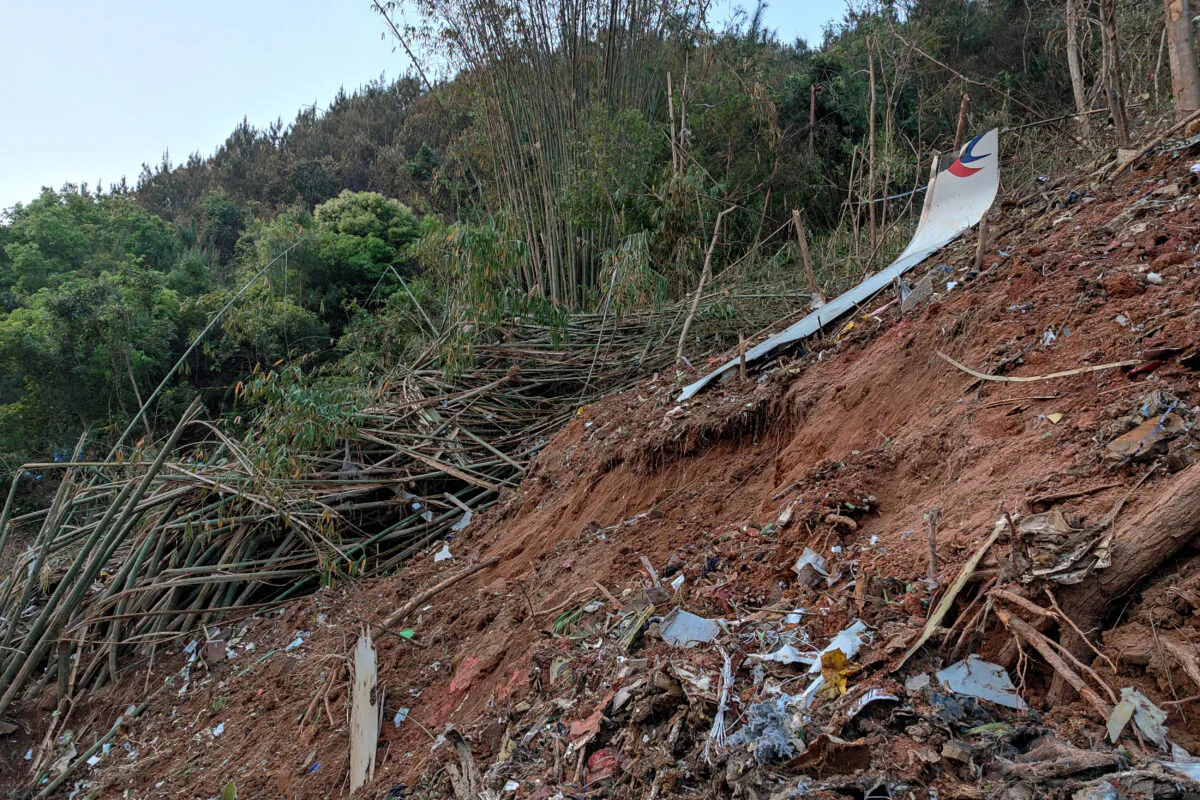

Newly disclosed U.S. investigative records are shedding light on the final moments of China Eastern Airlines Flight MU5735 in 2022, revealing critical flight data that had not been made public in the four years since the deadly crash.
The documents, prepared by the National Transportation Safety Board (NTSB) and obtained via a Freedom of Information Act (FOIA) request, indicate that both engines on the Boeing jet lost power after their fuel control switches were “moved from run position to the cutoff position” shortly before the aircraft entered a fatal dive. This finding could significantly shape understanding of the disaster’s cause.
A Long-Withheld Record Surfaces
The 261-page report, titled “Cockpit Voice and Flight Data Recorder,” was submitted by the NTSB to relevant Chinese officials on July 1, 2022. It surfaced publicly only this week after a requester used the FOIA to obtain related materials. A copy was later posted online and has been reviewed by The Epoch Times.
Under NTSB policy, records from its participation in foreign investigations may be released after two years if the investigating country has not issued a final report.
China’s aviation regulator, the Civil Aviation Administration of China, has yet to publish a final report on the crash and has not released a substantive update since March 2024.
China Eastern Flight MU5735 crashed on March 21, 2022, in a mountainous region of southern China, killing all 132 people on board. It remains the country’s deadliest aviation disaster in nearly three decades.
According to the NTSB data, the aircraft was cruising at about 29,000 feet when, 23 seconds before flight data recording stopped, both engines’ fuel switches were moved to cutoff. The engines’ core speeds dropped rapidly below the threshold needed to sustain electrical power.
Within seconds, flight controls showed abnormal inputs, including a forward push on the control column. About 20 seconds later, the flight data recorder stopped as electrical power was lost, by which point the aircraft had already descended to roughly 26,000 feet.
The recorder captured no further data from the remainder of the descent.
Independent tracking data from Flightradar24 show the aircraft plunging rapidly from cruising altitude, losing tens of thousands of feet in a little more than a minute. The plane briefly climbed for about 10 seconds before entering another steep descent and transmitting its final signal at low altitude.
The NTSB analysis found sharp, unusual variations in control forces, pitch, and roll parameters before the crash, suggesting the aircraft had entered an abnormal or uncontrolled state with highly irregular control inputs.
The report does not assign blame but provides technical evidence that could inform conclusions about whether human action, mechanical failure, or another factor triggered the sequence.
Speculation, Denials, and Silence
Since the crash, the actions of the flight crew have been a focus of speculation. Chinese officials previously said the crew was properly licensed, medically fit, and well-rested and that no mechanical faults or hazardous materials were identified before takeoff.
The prolonged absence of a final report has drawn increasing scrutiny. In China, a government response to a public information request circulating online in 2025 stated that disclosing details about the crash investigation could “endanger national security and social stability” and therefore would not be released.
A China-based aviation expert reviewing the newly disclosed U.S. data told The Epoch Times the findings raise serious questions about why more information has not been made public. He spoke on the condition of anonymity out of fear of reprisal.
“The report itself points to human factors,” he said. “It suggests the aircraft’s fuel switches were intentionally moved, turning the passengers into victims of that action.”
He also said that the existence of the report underscores that the Chinese Communist Party had access to key findings years ago.
The crash involved a Boeing 737-800 aircraft. The company, along with the NTSB, participated in the investigation at the request of Chinese authorities.
Despite the new disclosures, critical questions remain unanswered, including what prompted the apparent engine shutdown and why China’s final investigative report has not yet been released.
For the families of the victims and the broader aviation community, the newly surfaced data offer the clearest picture yet of the plane’s final moments, while underscoring how much about the disaster remains unresolved.
Lin Yan contributed to this report.
 Friends Read Free
Copy
Facebook
Tweet
Friends Read Free
Copy
Facebook
Tweet