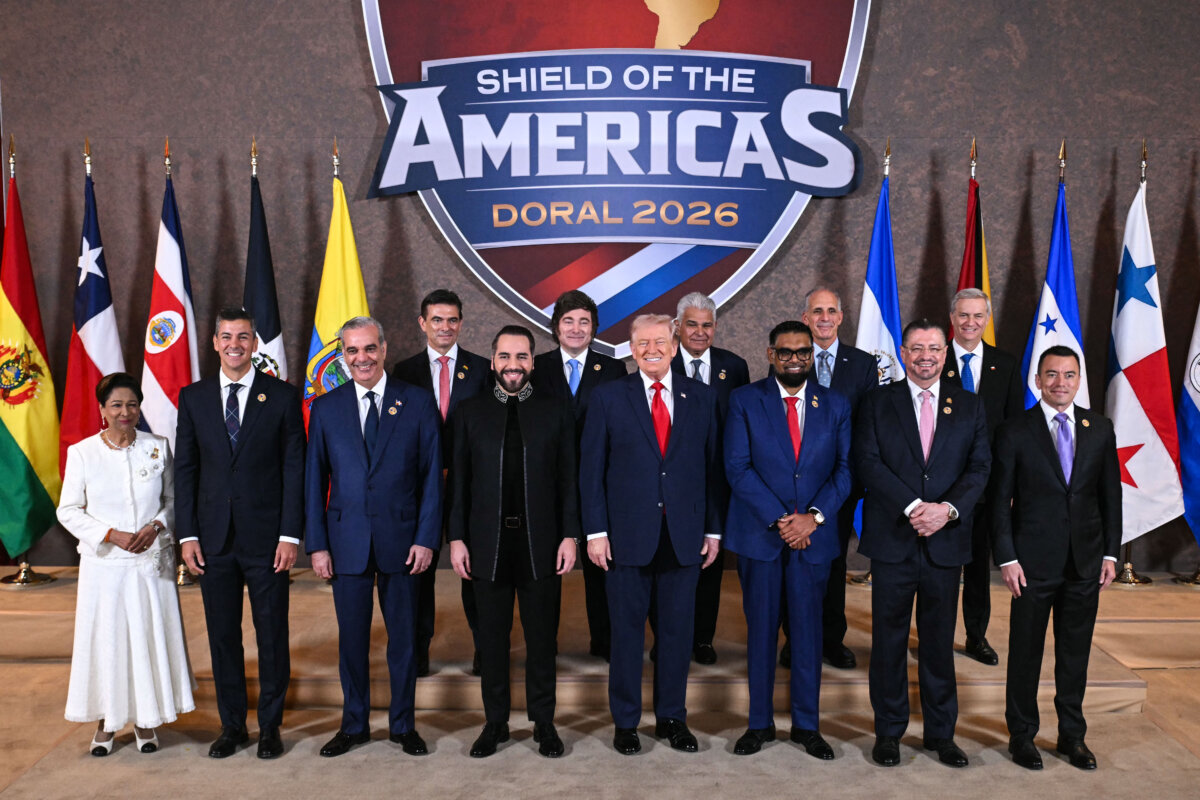
Paraguayan President Santiago Peña spoke out in favor of democratic solidarity on May 7 in Taiwan, directly challenging the expanding influence of the People’s Republic of China in the Western Hemisphere.
As Beijing issued stern demands for the South American nation to sever ties with the self-ruled island, Peña countered by doubling down on a “principled partnership” with Taipei—an alliance he framed as a vital bulwark for economic independence and regional stability.
Countering Beijing’s Diplomatic Pressure
In Beijing on May 7, Chinese Foreign Ministry spokesperson Lin Jian stated that Paraguay should “stand on the right side of history” and “sever so-called diplomatic relations with the Taiwan authorities.”
Peña, however, characterized the relationship as one built on ”a solid foundation, democracy, freedom, confidence in institutions, the dignity of hard work.” According to the Central News Agency (CNA) of Taiwan, Peña described himself as a “staunch advocate for Taiwan,” arguing that it is unreasonable for a nation of 23 million people with its own military and democratic elections to be denied international recognition.
‘Taiwan Model’ Versus Communist Influence
Peña, an economist by training, explicitly rejected the notion that Paraguay must succumb to Chinese market pressure to thrive. He noted that while China has 1.4 billion people, there are “6.6 billion others” globally to trade with.
“Compared to developing relations with China, it is better to follow the Taiwan model,” Peña told CNA, citing the dissatisfaction of other Latin American nations whose agricultural sectors have faced lopsided bargaining power when dealing with Beijing.
The Paraguayan leader said that Taiwan-Paraguay Polytechnic University represents a “strategic investment” intended to transition his nation toward advanced manufacturing and clean energy, as reported by CNA. Furthermore, Peña addressed recent incidents where Beijing allegedly pressured third countries to block flight clearances for Taiwanese officials, labeling such maneuvers a “Chinese threat” and a risk inherent to being a successful, sovereign democracy.
US Alignment and Regional Leadership
The visit coincides with heightening tensions as Beijing sends warplanes and navy vessels toward the island on a near-daily basis.
Peña signaled that his stance is bolstered by Western support, stating that the United States has “clearly expressed that it will protect countries that maintain relations with Taiwan,” according to CNA.
During a stopover in Los Angeles, Peña also met with Nasry Asfura, who was sworn in as president of Honduras on Jan. 27, 2026. Peña “strongly suggested” that the new Honduran leader examine the benefits of the Taiwan partnership. Honduras had previously switched recognition to Beijing in 2023.
 Friends Read Free
Copy
Facebook
Tweet
Friends Read Free
Copy
Facebook
Tweet