
China’s purge of senior military leaders may be pushing Beijing to rely more heavily on military intimidation and gray-zone operations against Taiwan, even as the upheaval leaves the Chinese military with a weakened command structure, according to two Chinese academics and an insider familiar with the Chinese military.
The insider and academics spoke to The Epoch Times on condition of anonymity out of fear of reprisal.
The developments are raising concerns that Beijing’s increasingly aggressive operations around Taiwan could become more difficult to control as analysts say political loyalty takes precedence over military expertise within the People’s Liberation Army (PLA).
Taiwan’s Defense Ministry has reported near-daily Chinese military activity around the island, describing the operations as increasingly aggressive and unpredictable, according to Taiwan’s national news agency CNA. Chinese military planners are studying drone swarms, long-range strikes, ammunition consumption, maritime blockades and coordination with other countries, while exploring methods that could potentially isolate Taiwan, cut off outside supplies, and weaken its defenses during the early stages of a conflict.
At the same time, the PLA is undergoing an unusually extensive leadership purge. The seven-member Central Military Commission (CMC), which formally oversees China’s armed forces, is down to just two members.
A Chinese military academic told The Epoch Times that the continuing purge suggests Xi remains deeply concerned about the loyalty of senior military commanders.
“The CMC has had so many people fall. There are already very few military members of the Central Committee,” he said. “The possibility of war is not very high, but the harassment [against Taiwan] will not stop.”
Military Pressure Continues
The academic said the purge has created serious gaps in the military command structure at a time when Beijing continues to use military pressure against Taiwan.
He said former CMC Vice Chairman Zhang Youxia had been authorized to oversee simulated training for operations against Taiwan and that it would be difficult to find a replacement with comparable experience.
“At present, the pressure on Taiwan is concentrated on military intimidation,” the academic said. “If they give up intimidation, they simply cannot come up with a better method.”
The leadership turmoil has unfolded alongside a series of high-level purges. In October last year, nine senior military officers, including CMC Vice Chairman He Weidong, were expelled from the Chinese Communist Party (CCP) and the military.
In January, the Chinese regime announced investigations into Zhang Youxia and Liu Zhenli, chief of the CMC’s Joint Staff Department.
The academic said the military could be experiencing an unusually broad leadership vacuum ahead of the CCP’s 21st National Congress next year.
The leadership upheaval does not necessarily mean that Beijing is preparing to launch an invasion of Taiwan. Instead, military pressure could continue precisely because it is one of the few tools available to a command structure weakened by political purges, according to the academic.
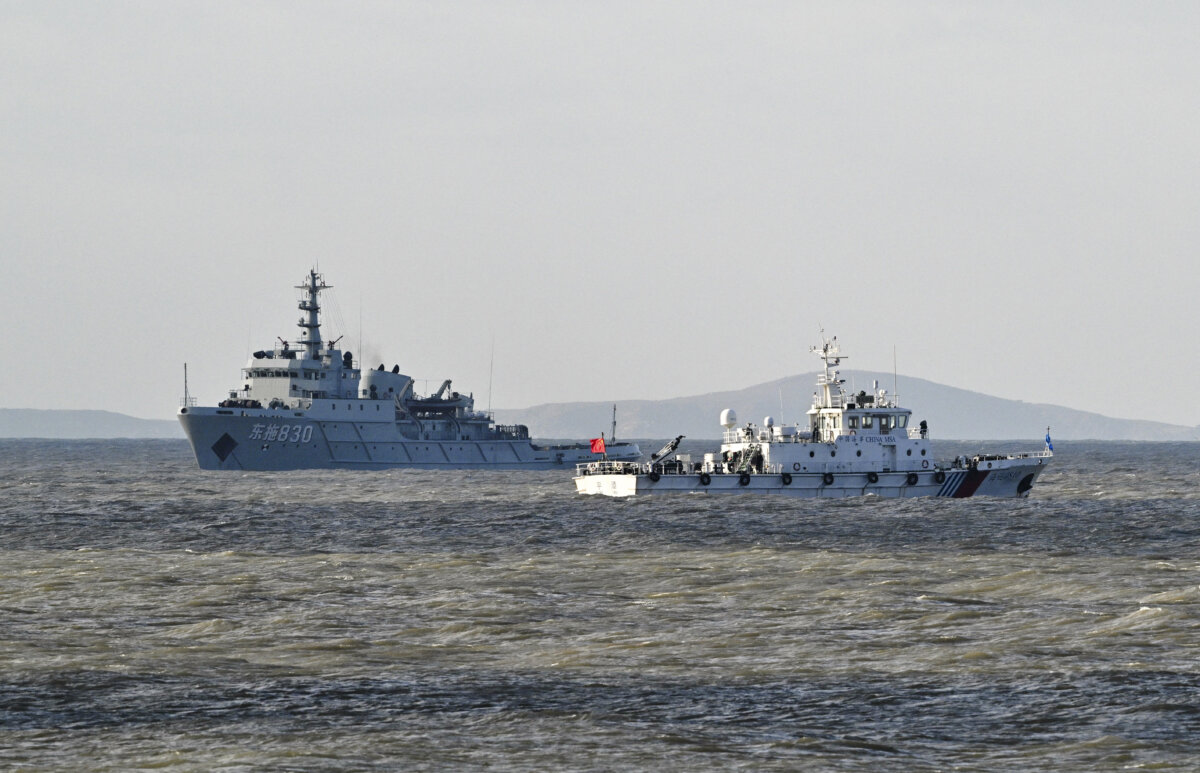
Chinese military activity around Taiwan has increasingly extended beyond conventional military exercises. Beijing has also been combining military drills, combat-readiness patrols and China Coast Guard operations, creating pressure that remains between ordinary peacetime activity and open warfare.
Taiwan’s National Security Bureau Director-General Tsai Ming-yen told reporters in July that the months of July through September are typically a period of heightened Chinese military exercises. Taiwan had detected increased activity by the Chinese navy and other maritime forces, including four Chinese naval formations operating in the western Pacific at the time.
A Chinese military academic and researcher told The Epoch Times that Beijing was increasingly integrating military exercises with combat-readiness patrols and coast guard enforcement.
The approach allows China to maintain sustained pressure on Taiwan without crossing the threshold into open conflict, the researcher said.
He cautioned, however, that the pattern should not necessarily be interpreted as preparation for an imminent attack.
“If [the CCP] wants to launch military action against Taiwan, [it] needs to first carry out war mobilization, deploy logistical support, and even more importantly, have powerful offensive weapons and a strong and effective command system,” he said.
Potential Blockade
Taiwan’s Defense Ministry has assessed that China does not yet possess all the capabilities required for a full-scale amphibious invasion of Taiwan. But Beijing has other options, including maritime isolation, a joint blockade, missile strikes, cyberattacks, and information warfare.
A blockade or maritime isolation campaign could require fewer forces than a full-scale invasion and could be conducted under the cover of military exercises or law-enforcement operations, according to researchers who spoke to The Epoch Times.
That creates a dilemma for Taiwan. If Taipei does not respond, Beijing could gradually expand its control over surrounding waters. If Taiwan responds militarily, Beijing could portray Taipei as the party responsible for escalating tensions.
Taiwanese President Lai Ching-te said on Sept. 2 that Taiwan’s defense budget for next year would exceed NT$1 trillion ($32 billion) for the first time, according to CNA. The government plans to invest in unmanned systems, AI, and Taiwan’s domestic defense industry.
The Chinese military researcher said the continued expansion of Chinese military and maritime operations around Taiwan is reducing the island’s warning time.
The greater concern, he said, is not a deliberate decision by Beijing to start a war, but the possibility that an incident could escalate when military judgment is compromised by political considerations.
For Taiwan, he said, that makes continued vigilance essential.
Shi Youliang contributed to this report.
 Friends Read Free
Copy
Facebook
Tweet
Friends Read Free
Copy
Facebook
Tweet