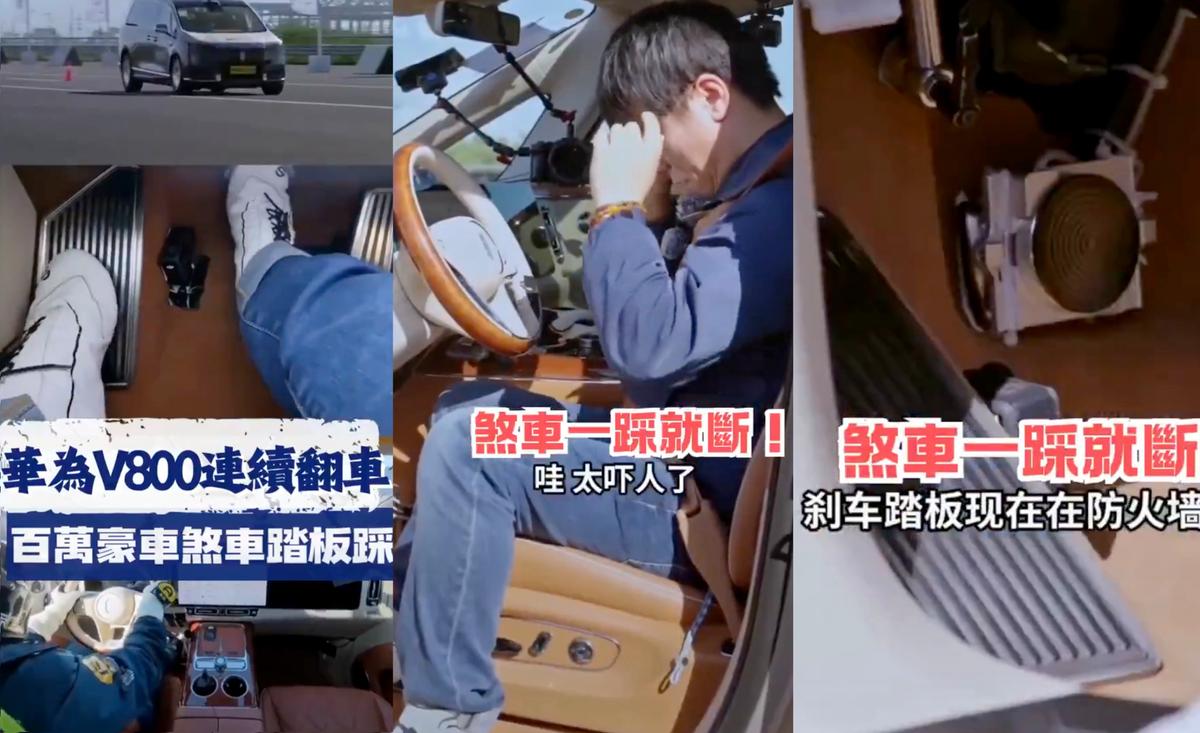

Three new Maextro V800 luxury vehicles developed by Huawei and Chinese automaker JAC Motors suffered brake pedal support failures during emergency braking tests, prompting the brand to promise free upgrades for existing owners.
Chinese automotive testing platform Dongchedi published videos on Oct. 8 showing the brake pedal brackets breaking on all three vehicles during repeated emergency stops from 100 kilometers per hour (about 62 mph).
Maextro responded the same day, saying its braking system had been developed and tested to standards that exceed national and industry requirements, according to Beijing Business Today via the news portal Sina.
The company said it would further optimize the component’s design, offer existing owners a free upgrade, and review its design verification, testing procedures, and production quality management.
The company also said no similar brake pedal bracket failures had occurred in vehicles during normal customer use.
The incident has drawn attention to the safety of the V800, a high-end new-energy vehicle launched in August with an official starting price of 766,000 yuan, ranging up to 1.016 million yuan (about $114,000 to $151,000).
3 Vehicles, Similar Failures
According to Dongchedi’s published test footage, the platform tested three new V800 vehicles in a closed testing facility.
The brake pedal support bracket broke during repeated full-force braking in all three vehicles. The first failed on its third braking attempt, the second on its fourth, and the third on its second. The third vehicle had traveled less than two miles.
Dongchedi said the failures occurred in similar locations and exhibited closely matching fracture patterns, raising questions about whether the problem could extend beyond an isolated vehicle.
It also said the emergency braking test is a basic vehicle testing procedure and can reflect situations encountered during high-speed driving.
The precise cause of the failures has not been established publicly. The test results alone do not establish whether the problem arose from component design, manufacturing, testing conditions, or another factor.
Maextro Promises Free Upgrades
In its Oct. 8 statement, Maextro said that its braking system had completed development and verification in accordance with requirements that exceed China’s national and industry standards.
The company said that, since the first vehicles were delivered, it had not encountered brake pedal support base failures in actual customer use.
“Even under nonstandard extreme testing conditions, we still hope to provide users with a higher safety margin,” the statement said.
Maextro said it would further optimize the component’s design and offer existing owners the option of a free upgrade. It also pledged to conduct a systematic review of component design verification, testing boundaries, and production quality management.
The statement did not explain why the three test vehicles experienced similar failures or provide the results of a technical investigation.
The company’s characterization of the test as an extreme, nonstandard condition has itself become part of the dispute. The central question is whether the repeated failures reveal a weakness that could affect vehicle safety, even if the test conditions were unusually demanding.
Follow-up reporting by Chinese media indicated that Huawei and JAC Motors were preparing to conduct additional tests on the V800.
A report published by Chinese media outlet National Business Daily on Oct. 9 quoted a salesperson at a Maextro customer center in Beijing as saying that Huawei and JAC had jointly engaged a third-party testing organization to examine the vehicle. The salesperson said results were expected to be released in the coming days.
In a further update on Oct. 11, Maextro customer service told Chinese financial media outlet 21Jingji that the upgrade plan for the V800’s brake pedal support base was expected to be finalized by the end of October, with upgrades scheduled to begin in November. The company had not yet finalized the technical details of the upgrade.
The Epoch Times reached out to Maextro for comment, but did not receive a response by publication time.
The findings could be important in determining whether the failures were specific to the testing conditions or point to a broader design or manufacturing issue. Details of the proposed testing, including the test procedures, the vehicles used, and whether an independent organization would publish its findings, were unclear.
Test Videos Become Difficult to Access
The dispute has also raised questions about the circulation of the test footage online.
Screenshots were circulated online showing search results for the test footage that led to an error message.
China’s state-run news agency Xinhua published Maextro’s Oct. 8 statement through its official channels. However, the report had subsequently been deleted. The available information does not establish the circumstances behind the removal.
JAC Shares Fall Amid Controversy
The controversy has put pressure on JAC Motors, whose shares fell by the daily limit on Oct. 8 and again at the open on Oct. 9.
Compared with its Sept. 30 closing market capitalization of about 61.9 billion yuan ($9.25 billion), JAC’s market value fell by approximately 11.8 billion yuan ($1.76 billion) over the two trading sessions.
Li Jing and Luo Ya contributed to this report.
 Friends Read Free
Copy
Facebook
Tweet
Friends Read Free
Copy
Facebook
Tweet