

Sponsored Content by BestVite. This article includes affiliate links, which may earn us a commission, to support truthful and independent journalism (at no extra cost to you).
We often talk about superfoods, miracle supplements, and cutting-edge breakthroughs, but sometimes the most impactful changes come from going back to the basics.
And yet, magnesium remains one of the most essential and overlooked nutrients in the human body.
Magnesium plays a central role in your body’s ability to relax, recover, and function smoothly, but despite its importance, most people still aren’t getting enough.
In fact, 60 percent of adults do not achieve the average dietary intake, and 45 percent of Americans are magnesium-deficient.¹ Magnesium deficiency can affect everything from sleep quality and muscle comfort to mood balance and cardiovascular function.
The Many Roles of Magnesium and Why It Matters
Magnesium is a cofactor, a molecule that enzymes need in order to function in hundreds of bodily processes.² It helps regulate nerve impulses, supports muscle contraction and relaxation, stabilizes mood, facilitates energy production, and promotes calcium and vitamin D absorption.³
Still, with so many crucial functions, magnesium remains one of the most commonly missed nutrients, partly because not all supplements deliver it effectively.
Better Tolerated, Better Absorbed: Meet Magnesium Glycinate
Not all magnesium supplements are created equal. Some forms, like magnesium oxide, have poor bioavailability, meaning the body absorbs and uses very little, and are more likely to cause digestive discomfort.⁴
Magnesium glycinate, by contrast, is a chelated form of magnesium, where the magnesium is bound to the amino acid glycine to form a stable complex. This chelation helps protect the magnesium as it passes through the digestive system, improving absorption.⁵ ⁶ It is also gentler on the stomach and less likely to cause loose stools compared to forms like citrate or oxide.
What makes it even more appealing is glycine itself. Known for its calming effects, glycine may support better sleep and relaxation, making magnesium glycinate a great choice for those looking to unwind or support restful sleep more naturally.⁷

How Magnesium Glycinate Supports Your Health
1. Restful Sleep and Relaxation
Magnesium plays a key role in regulating neurotransmitters like melatonin and GABA, both of which help support a calm mind and restful sleep.⁸ In a clinical study involving older adults, magnesium supplementation improved sleep duration, sleep efficiency, and overall sleep quality.⁹
2. Muscle Recovery and Comfort
From daily workouts to healthy aging, magnesium helps muscles contract and relax properly. It supports healthy muscle function and may help ease occasional muscle tension and discomfort after physical activity.¹⁰
3. Nervous System and Mood Support
Magnesium plays an important role in regulating nerve signaling and supporting a calm, balanced mood.¹¹ Low magnesium levels have been associated with occasional restlessness, irritability, and fatigue. In clinical research, magnesium supplementation has been studied for its potential to support emotional well-being and resilience during periods of stress.¹²
4. Cardiovascular Health
Magnesium supports heart function by helping maintain normal heart rhythm, contributing to healthy blood vessels, and promoting healthy circulation.¹³
5. Metabolic Function and Nutrient Utilization
Magnesium helps your body turn carbohydrates into energy and supports overall metabolic balance.¹⁴ Research shows that people who get more magnesium in their diet often have healthier metabolism markers.¹⁵
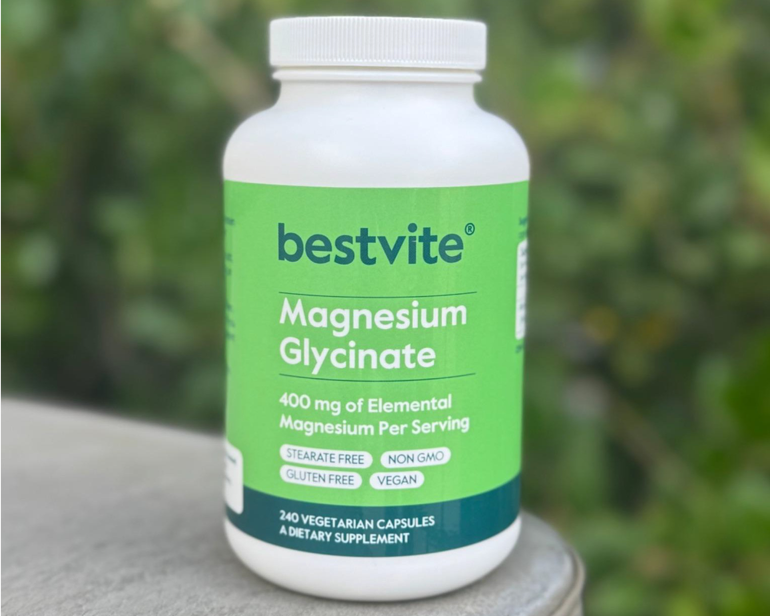
Give Your Body the Magnesium It Deserves
Magnesium supports nearly every system in the body: from restful sleep and muscle recovery to mood balance, heart health, and metabolic function. But getting enough magnesium each day isn’t always easy, especially with modern diets and stressors that can deplete your levels over time.
Bestvite’s Magnesium Glycinate delivers clean, effective support in a highly absorbable form. This unique filler-free formula is crafted without stearates or unnecessary additives, and undergoes rigorous third-party testing to ensure quality, purity, and consistency.
It is encapsulated in an NSF GMP-certified facility in the United States, independently verified to follow FDA-compliant Good Manufacturing Practices for safety, cleanliness, and quality control.
It’s everything your magnesium supplement should be: clean, gentle, and designed to work.
Start supporting your body with what it really needs and without compromise.
Save 20 percent on Bestvite Magnesium Glycinate with this code: Epoch20
Claim your exclusive offer here.
References
- 1. Workinger JL, Doyle RP, Bortz J. Challenges in the Diagnosis of Magnesium Status. Nutrients. 2018;10(9):1202. PMCID: PMC6163803
- 2. Volpe SL. Magnesium in disease prevention and overall health. Adv Nutr. 2013;4(3):378S–383S.
- 3. Gröber U, Schmidt J, Kisters K. Magnesium in prevention and therapy. Nutrients. 2015;7(9):8199–8226.
- 4. Firoz M, Graber M. Bioavailability of US commercial magnesium preparations. Magnes Res. 2001;14(4):257–262.
- 5. Ashmead HD. The absorption and metabolism of chelated minerals. Albion Labs. 2001.
- 6. Schuette SA, et al. Bioavailability of magnesium diglycinate vs magnesium oxide. J Am Coll Nutr. 1994;13(5):429–435.
- 7. Kawai N, et al. Glycine improves subjective sleep quality in human volunteers, correlating with polysomnographic changes. Sleep Biol Rhythms. 2007;5(2):126–131.
- 8. Wienecke T, et al. Magnesium and the central nervous system. Magnes Res. 2016;29(3):95–101.
- 9. Abbasi B, et al. The effect of magnesium supplementation on primary insomnia in elderly. J Res Med Sci. 2012;17(12):1161–1169.
- 10. Garrison SR, et al. Magnesium for skeletal muscle cramps. JAMA Intern Med. 2012;172(13):1166–1174.
- 11. Boyle NB, et al. Effects of magnesium supplementation on subjective anxiety and stress. Nutrients. 2017;9(5):429.
- 12. Eby GA, Eby KL. Rapid recovery from major depression using magnesium treatment. Med Hypotheses. 2006;67(2):362–370.
- 13. Houston M. The role of magnesium in hypertension and cardiovascular disease. J Clin Hypertens. 2011;13(11):843–847.
- 14. Barbagallo M, Dominguez LJ. Magnesium and type 2 diabetes. World J Diabetes. 2015;6(10):1152–1157.
- 15. Guerrero-Romero F, Rodríguez-Morán M. Magnesium improves insulin sensitivity in non-diabetic subjects. Diabetes Metab. 2004;30(3):253–258.
 Friends Read Free
Copy
Facebook
Tweet
Friends Read Free
Copy
Facebook
Tweet