Just how are people today actually trapped in mental prisons they’re not aware of?
Could this be the reason for a lot of today’s political and social discord?
What exactly is “loserthink,” as conceived by author and cartoonist Scott Adams?
And what strategies could be used to help people get out of their ideological bubbles?
This is American Thought Leaders ??, and I’m Jan Jekielek.
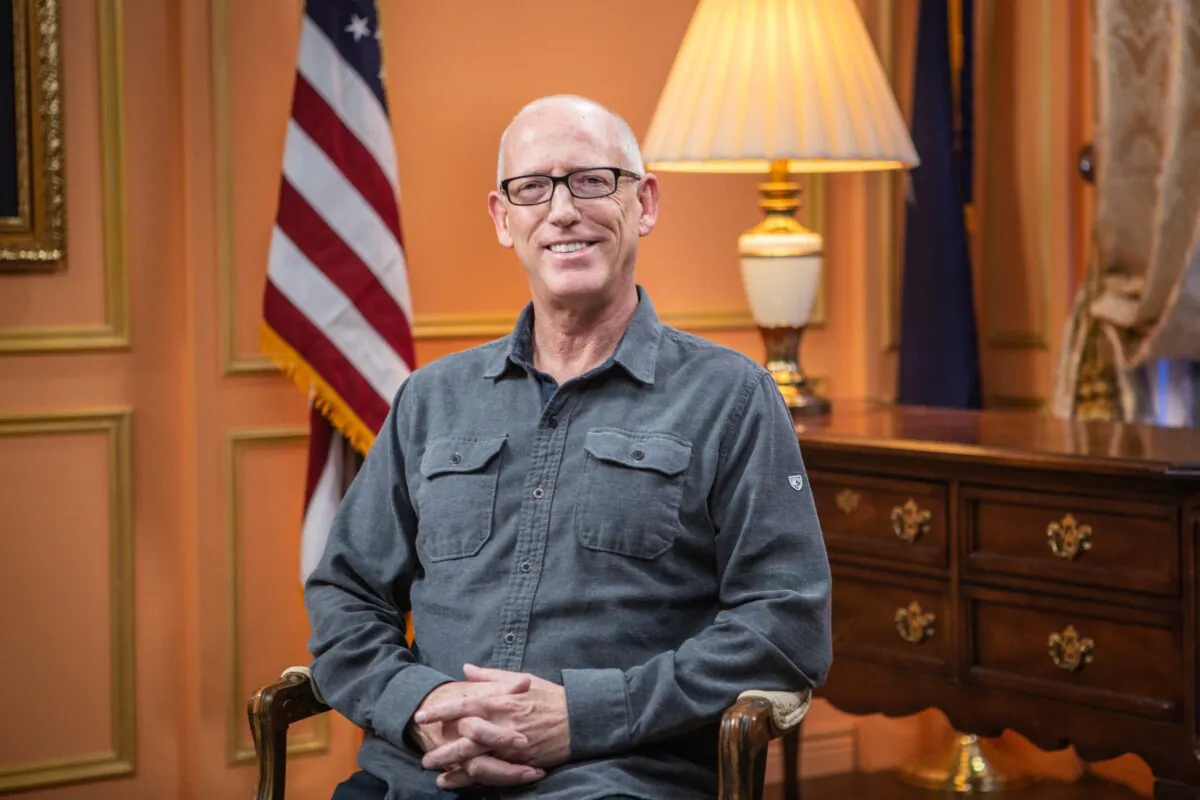
Today we sit down with Scott Adams, the creator of Dilbert. He’s also a trained hypnotist, student of persuasion, and author of a number of bestselling books including “Win Bigly.” His newest book is titled, “Loserthink: How Untrained Brains Are Ruining America.”
Jan Jekielek: Scott Adams, wonderful to have you on American Thought Leaders.
Scott Adams: Thanks for having me.
Jan Jekielek: So Scott, “Loserthink: How Untrained Brains Are Ruining America”–I finished reading your book. I’ve been listening to the audio which I think is pretty wonderful because you decided to do it yourself, unlike many of the books that I listened on audio. Before we dive into it, I wanted to ask you, aside from being a cartoonist, you’re actually an expert on the art of persuasion, I think that’s fair to say.
Scott Adams: I’d call myself a “student” of persuasion because I’m not sure where “expert” begins, but I’m a trained hypnotist, and as part of my job as a writer and a cartoonist, I’ve learned all the skills of persuasion as part of my writing skill stack.
Jan Jekielek: When I read the book, I found myself agreeing with so much that’s in there. “Oh, this makes a ton of sense,” or “oh this is good,” and I’m trying to figure out whether it’s because you’re right or rather because you’re very persuasive.
Scott Adams: It’s both. It’s because I’m right, and it’s persuasive. The way I explain things, especially in the recent books is: if it’s not obviously right when you read it, it probably isn’t right at all; you don’t need to do a lot of research. Often I’m just reframing things that you recognize into a different frame, and sometimes that’s all it takes to open up your mind about possibilities.
Jan Jekielek: You describe “mental prisons” that a lot of people find themselves in. You described some of the ones you’ve been in your life. … The book comes off as a guide, a toolkit, of all sorts of methods to escape “mental prison.”
Scott Adams: Exactly.
Jan Jekielek: Tell me more about why you decided to write about this.
Scott Adams: It came out of my observation when I’d be on Twitter, and I’d be debating people on Twitter, and I’d look at the responses. And I’d get these reasonable responses from some people. Even if I disagreed with them, I’d click on their profile and often it would be an economist or a lawyer, and I’d say, “Huh, these are people who know how to think, even if I disagree with their conclusions.” Then I get other comments that are just crazy… I don’t know–are they six years old? They never learned to think? … And then I click on the profile, it would be musician, artist, and it was very consistent. I said to myself, “Is there a self-selection process going here that the people who aren’t good at the traditional, (or) let’s say rational, kinds of jobs move over to these? Or is there something about the experience of being in those fields that blocks you off from the more productive ways of thinking?”
So I started compiling those productive ways of thinking into the book. If you have not been exposed to them–let’s say you have never been an economist, never been an entrepreneur, for example, or a psychologist–a few examples that you would see just a few of the techniques of how they think about the world. You don’t have to have all those skills that they would have. Just how do they see the world?
For example, just an easy example: if you’d never heard of science, it wouldn’t be completely obvious to you that you should have a controlled experiment, so you’ve got something to compare it to; if you have studied science, that’s obvious. You don’t need to be a scientist to understand why that matters.
Jan Jekielek: I’ve found myself relating to the thinking like a psychologist, (that) section. I think I probably do that the most, which is curious because my background is actually more being a scientist. It always, in fact, frustrated me very often that a lot of psychological studies would lack some very basic controls that we would have to have in biology–which was my field–which speaks to exactly what you’re trying to do. It’s expanding different, different methods of thinking to a broader swath of society.
Scott Adams: One of the things people commonly say is: All the scientists agree with whatever it is, so it must be true. But if you look at the number of scientific papers that were studied, and even though they had originally been accepted in some kind of publication, something like half of them don’t hold up. So there’s a ton of science that’s moving toward the right answer, but they’re wrong until they get there. And the problem with believing in any expert, especially in this case in science, is you’re never quite sure. Have they reached the point where now they know what’s happening, or are they still on the journey, and what they think now will be overturned? How would you know? You just know that the scientists believe it’s true.
Jan Jekielek: But that there’s a tendency to reward people for saying, “No, definitely, we definitely know the answer,” and there’s a penalty it seems for not saying that.
Scott Adams: Yeah. Another thing I talk about is to look for a financial incentive when you’re looking at anybody’s opinion. It’s more radically important in the financial field. If you’re getting your financial investment advice from someone who makes money no matter what you do–let’s say a financial advisor who’s taking 1% of your portfolio, whether it goes up or down, still they take a 1%–that person maybe is not who you want to trust because there’s a conflict of interest there.
Jan Jekielek: I find it very interesting. You use the example of climate change in the book… I find it fascinating how you look at this whole issue of climate change.
Scott Adams: Climate change is a lot of people on one side saying, “All the scientists agree, therefore we’ve got this problem.” But what they don’t do as well is break out the parts of climate change and put different levels of confidence in them. For example, scientists say that adding CO2 to the atmosphere, all things being equal, should cause more warming–probably true. It seems like exactly the sort of thing the scientists would be able to figure out. That’s the sort of thing that you could expect. That’s probably true.
Then they go to the next level where they do these complicated prediction models where they’re trying to predict eighty years of economic, social, technological change, plus the environment–which will be hard enough to model through next week, much less eighty years–and those are really for persuasion. If you see those as persuasion vehicles, not really a record of what’s going to happen in the future, then you can deal with it more productively and say, “Okay, do they really know what’s going to happen in eighty years?”
Simple example: Even if storms get worse, does that mean that more people will die? Probably not, because the trajectory of people dying from natural disasters has gone from a lot in recorded times, to trivial. We could have entire hurricanes taking out a state, and if we’re smart enough, nobody dies, because we can see it coming. So in all likelihood, the death and danger of climate change, we’ll figure it out. We will adjust. Eighty years is a long time.
Now another thing that they say is … “Oh, it will be a 10 percent hit to our GDP by the 80-year time.” If you’re not an economist, you’d say to yourself, “Wow! 10 percent! That’s trillions and trillions of dollars. This is a big deal.” If we had a 10 percent pullback in our GDP today, people would be massively laid off. It’d be a big deal.
But over eighty years, that’s 10 percent less than it would have been. If you started doing the compounding of normal growth of our economy, that 10 percent in eighty years, we literally wouldn’t notice. Nobody would know it was gone. They would say, “Well, is it 5 percent less than they should have been? Is it 15 percent less than it could have been?” All I know is that everything is better. Healthcare’s better, there’s less crime, (and) people are more educated because the path of history is that things get better. So on one hand, it’s being used as the scariest thing: “Look at this! Economy is going to be down 10 percent.” But if you understood how economics work and a little bit about math, you’d know, we’d never noticed that.
Jan Jekielek: It actually reminds me of one of the “Loserthink” rules. … Remember there’s a slow-motion catastrophe happening. How are you supposed to approach that?
Scott Adams: … I call it: The Adams Law of Slow-Moving Disasters. It has to do with the fact that if everybody can see a problem coming for years ahead of time, we’re really good at solving it.
For example, it looked like we were going to run out of food because the population would grow until we couldn’t get enough food, but we figured out how to make more food. It looked like we were going to run out of oil, but we started fracking and developing green sources, etc. Now it looks like we could have a climate change disaster of some type, whether it’s economic or just the environment, but we also have nuclear energy that’s being developed at a rapid pace in a number of different ways all over, and startups for new technologies that can’t melt down. The newest stuff on the drawing board is nuclear that can’t meltdown, and you don’t have to wait for fusion or anything. I’m talking about pretty normal engineering decisions, and it also eats the waste from existing plants.
So the stuff on the drawing board–this is Bill Gates’ company, TerraPower, and there are others like it–they’re looking to decrease nuclear waste, being economical, and once you get the model going, you can crank it up pretty fast. So probably climate change will be in that category where even if you didn’t believe it was a problem, nuclear energy will probably be such a big part of our energy solution that we’ll have clean energy anyway.
Jan Jekielek: So you don’t think the end is coming in twelve years?
Scott Adams: I think we will survive. Another thing I talk about in Loserthink is hyperbole. It’s important to distinguish when leaders are using hyperbole to get something done, because to get something done, you usually have to scare people. … This is why I’m a terrible leader, I’ve thought about, “Oh, maybe I should run for office or something,” and I thought, “No, because I’m only going to be able to stick to the facts.” I’m going to say, “Here’s the facts,” and people will go, “Oh, that’s not very interesting.”
But if you’re AOC [Alexandria Ocasio-Cortez], she’s a real leader. Say what you will, you might dislike her politics or whatever, but just in terms of leadership quality, nothing beats: “You’re going to be dead in twelve years.” You can’t top that. [Although] she didn’t quite say that; she said twelve years would be sort of the point where if you haven’t done something seriously, it might be too late. Her hyperbole was taken out of context and worsened, but it was certainly good form to use hyperbole because it gets people moving.
Jan Jekielek: Speaking of persuasion, I will tell you a little anecdote from my youth. I was a boy scout, and a Scoutmaster gave me the book, “How to Win Friends and Influence People” by Dale Carnegie. I look at this quite differently now but at the time, I was offended at the book. I thought, “Wow, this is a book on manipulating people. I don’t want to manipulate people.”
Scott Adams: Let me reframe that: It’s impossible to interact with people without influencing them. So you’re either doing it intentionally or unintentionally. Most of the time, we’re influencing people intentionally. You’re wearing a nice suit because you want people to watch you, to have a certain impression of you. I’m known as a cartoonist and an author, so I said, “Oh, no necktie”–that’s the image I’m projecting. We’re all influencing people all the time. Even if it’s just being nice, you’re influencing them by your niceness. Once you realize that you can’t turn off “influence”, then you learn, “Well, if I can’t turn it off, I might as well learn how to do it right.”
Jan Jekielek: So … you use it for good and not evil. That’s the conclusion that I get.
Scott Adams: It’s a tool! Yeah.
Jan Jekielek: It’s interesting. You have a chapter in there, I’ll just read it: “Things Pundits Say That You Should Not Copy.” I take that as an instruction manual for malicious persuasion, or “Don’t do this because this says you’re persuading people, but you don’t want to be persuading people this way”–
Scott Adams: … The first thing people have to understand that, amazingly, is not completely understood, is that the business model of the press has evolved. They’re not really in the business of giving you accurate information anymore because it’s much better to get you excited. The news is always exaggerated, and the pundits are the worst: They’re paid to make a case; they’re not paid to give you any kind of reality.
I’ll give you some examples of what you shouldn’t imitate. One of the things is, the pundits will say, “The president,” let’s say for example, “should not normalize that kind of behavior.” That’s making you think past the sale to the “don’t normalize,” as if that’s some sort of rule of nature that things shouldn’t be normalized. The sale, which they made you think past, is “what is the behavior.” If the behavior is that the press is doing a good responsible job, and the president is criticizing them anyway and de-legitimizing them, I would say, “Don’t normalize that. We need a free press.” But if the press has crossed the line into naked advocacy, and they’re no longer just an arbiter of what is true, then should the president criticize this thing, which is a legitimate danger to the republic? Of course. But if you say, “Don’t normalize it,” you’ve made us think past the question, “Is this okay? Is this something that should be stopped? Or is this something that should be normalized?”
You don’t want to skip that decision.
Jan Jekielek: So this is just another persuasion method, basically.
Scott Adams: Well, yes. People use words in replace of arguments. You see this all the time. People will say, “Hey! Can’t do that because you’re a communist, or you’re a racist, you’re a socialist, you’re something.” Or they’ll say, “It’s a slippery slope,” that’s another one. “A slippery slope” is one of the most meaningless phrases, but when people hear it, they get convinced by it. “Oh yeah, this could keep slipping, this is going to go in that direction,” but there’s no quality of things that makes them slippery. There are just causes and effects, and there’s either an obstacle or there’s not. When there’s not, people usually add one if it’s something they don’t want slipping.
If you’re saying that something has “a quality of slipperiness”, that’s just persuasion, because there’s no such thing as that “quality”. There’s something you can observe that will keep going in the same direction until something stops it. But that’s everything! Everything goes until there’s some reason for it to stop. Saying that it’s “a slippery slope” adds almost nothing, and yet it feels persuasive.
Jan Jekielek: That’s very interesting. Something that you highlighted in “Win Bigly”, which by the way, your previous book was very important to me. I think it actually helped me understand President Trump better, understand what he was doing. … It was your filter of persuasion essentially, explaining all sorts of things related to the election. You talk about it in this book as well that you have to understand human beings as fundamentally irrational, and explaining why they did things–in some cases, after the fact–just to justify the irrational decision ahead of time. Inherently I don’t want to believe that. I think there’s a lot of people that don’t want to believe that. How did you come to this understanding and why is it so important?
Scott Adams: First of all, if you’re trying to understand, are people mostly rational or mostly irrational, ask yourself which one predicts better. Assuming that people will act irrationally tends to be a good predictor, because there just aren’t that many rational people acting in rational ways.
I learned to think this way when I took hypnosis classes. The first thing that you have to learn in order to be a hypnotist is that people are irrational most of the time. Your normal view of the world is that, “Well, sometimes, 10 percent of the time, people might get a little crazy, but 90 percent of the time we’re just perfectly rational”–that’s the general view of the world. And you think maybe other people are rational a little bit more.
But to learn hypnosis, and in fact even to be able to do it, you have to understand that people are fundamentally irrational, and that they make decisions, and then they figure out why they made them after the fact, with rationalizations. Once you start seeing the world that way, you can’t go back because it’s so predictive.
Jan Jekielek: Fascinating. This is the hypnosis filter?
Scott Adams: Right. It’s actually a science filter too because it can be shown that decisions are made before the part of the brain that controls decisions is activated in some cases.
Jan Jekielek: Another thing that really struck me in this, and I am still trying to piece it together in my mind: In your book, you kind of distinguish systems and goals. People tend to operate in terms of goals, having goals, but you’re saying, “No, no, no, that’s the loserthink way. Operate in terms of systems.” Can you break that down for me?
Scott Adams: Goals have a few problems. One, is that if you have this long-term goal, and you’re working toward it every day, you’re in a state of failure until you achieve the goal, and that day you have to create a new goal because you have to do something new. So you create a new one, and then you go back into your state of failure. So first of all, psychologically, it’s sub-optimal because you feel, “Why have I not succeed yet?” So that’s problem number one.
The other problem is that the world is much more complicated than it used to be. It used to be: let’s say you’re a farmer, and you say, “I think I want to clear the trees from that thing because next year I’ll be able to plant.” That was pretty predictable. That was a perfectly good plan. But today there’s more complexity in your smartphone than the farmer had in this entire operation. The things are changing so quickly. If you had a goal, let’s say, of, “I’m going to be the best person at understanding blockchain.” That might be a great idea, or five years from now, it might not even be a thing anymore.
So your goals have to be more fluid now to take opportunities where you find them. The system approach is that you do something every day that gets you more odds of success without being too specific. For example, going to college is a system because you don’t know exactly where that goes, you just know that your odds of success went way up.
If you have a system for exercise or for diet, you don’t know exactly what weights you’re going to get to, you don’t know exactly what you’ll look like, but you know that these systems are making you healthy and making you more productive all the time. So find something you can do every day that you can say, “Today was a good day.”
Jan Jekielek: This is one of these entrepreneurial ways of thinking with … take the micro-steps, micro wins–
Scott Adams: Yes. So the idea with the entrepreneurial way of thinking is that people have trouble starting. They say, “I think I want to start this business, but it’s so big.” You think about all the work, and it just seems so big. And so you don’t do anything because you don’t want to take on something gigantic.
So what I recommend is micro-steps. You see serial entrepreneurs do this. They’ll say, “Well, I don’t know if I could start a business today, but I could Google this thing, I could call my friend who knows about this. I could do that one thing.” If you can’t even make a phone call, write down the phone number on a piece of paper because that’s less than a phone call.
Just do the smallest thing you can do and watch how that starts compounding, because after you get going on a project, it starts creating its own energy, and then it brings you along.
Jan Jekielek: I keep needing to remind myself of that approach actually. Come to think of it, this whole systems approach, just even starting at The Epoch Times back in 2005–I’ve been here for quite a few years, I didn’t know where I would end up. I just thought this was a great media doing something no one else was doing, and I think I’ve done a lot of different things. So I guess The Epoch Times has been my system.
Scott Adams: You’re a perfect example of what I call: building a good talent stack. You’ve got several different “lanes”–I think is a word you’ve used before–for parts of your life. You’ve learned science. Now you’ve learned a whole bunch of skills that go into doing what you’re doing right now. Communication, everything from the look of it, you’ve probably picked up the technology, the producing, the scheduling and all that. You don’t know exactly where that will take you, like you said, but that is a powerful bunch of stuff to put in one place. … I’ll leave out a whole bunch of other expertise that you’ve probably put together a little bit of, and together it’s a pretty powerful package. So you’ve got a lot of options now.
Jan Jekielek: I wanted to jump back to this business model of the press because we’re here at The Epoch Times and of course we’re trying to do something a bit different than what a lot of other media are doing. You have this concept of “political warming” that you ascribe to this business model … The business model is manipulating people–that’s kind of what you argue. Can you expand on that a bit?
Scott Adams: There was a key technological change that was so small that you wouldn’t even take note of it, but it has a huge ripple effect. And that was our ability to measure with precision what people were clicking on. The moment you knew what people were clicking on, you can know that this headline is better than this one, this story is better than this one, this approach is better than this one, and then you would just have to follow it because these are public companies. If you’re a public company, you’ve got to follow the profits, that means following the clicks.
So from the moment we could measure with precision what the audience was responding to in real-time, the old business model of the press was dead, because the old business model was to try to tell you what was happening, just to give you the facts. The new business model requires that they set your hair on fire. You’ve got to read the news and go, “Ah! I’ve got to do something about this. I’ve got to go to Twitter and complain”–
Jan Jekielek: Because you’ll click that?
Scott Adams: Yes, yes. The more worked up you are, the more likely you’re going to click on it. So you should assume that everything you see in the news that seems like it’s hair on fire, the “republic is over,” is attenuated by the fact that the business model requires that. You could take almost any story in the news and say, “Look, write down five new stories that looks like it’s doom, like we’re really in trouble.” There’s an impeachment, there’s global warming, five of them, and I’ll make you five bets, thousand dollars a piece, that all five of them turn into nothing. One of them might turn into something, but I’ll bet I’ll be right four out of five times. That’s just the way it’s reported that makes you worry about it. It’s fine.
Jan Jekielek: This is horrible because if I knew it was five out of five, okay, I could maybe work with that. But four out of five…
Scott Adams: Yeah, you never know. You never know which one it is, right?
Jan Jekielek: We were talking about forced organ harvesting in China. You’ve been talking about that on your podcast. The question is could it be real? “Probably isn’t,” that’s exactly how I thought. But when you start digging deeper, might be one of those I guess four out of five, or one out of a thousand.
Scott Adams: That might be the one that’s true, yeah. There’s a rule I heard from Scott Alexander. He’s a blogger who goes by a pen name, Scott Alexander, and he was talking about how if you see a story in the news, then you say to yourself, “Oh my God! I can’t believe it, this is amazing!” Almost always it’s not true. If you wait another week, they’ll say, “Ah, it turns out that a man did not eat a hundred cows in one day,” or whatever the story is. But the first time you read it, “Well, it’s in the news. This must be real.”
Jan Jekielek: Scott, one of the things we talked about in our interview is “cancel culture”, something that’s been on my mind a lot. In the past few months, there’s been some attempts to “cancel” us at The Epoch Times because of some of the work that we do. You’ve experienced it. A recent guest [on our show] Congressman Nunes has experienced it extensively. I understand it’s a complex thing, that’s what we were discussing, but I want to apply the Loserthink filter to this whole phenomenon which I’m just beginning to understand myself.
Scott Adams: I tried to do my little part to persuade it out of existence, and I’ve introduced two, what I’ll call “rules of manners,” to update our understanding of what is polite in polite society, and just what’s a good way to work with each other. And as technology and civilization changes, every now and then, somebody has to just invent a new rule. Until you had cell phones, nobody had to have a rule that you shouldn’t use it in the restaurant, right? So you need a new rule.
So here’s two rules that I think would help this whole cancel culture thing. … By the way, I’ve never met anybody who’s been offended. I’ve only met lots of people who are sure that somebody they know would be offended, but I’ve never met anybody who’s been offended in my whole life. It just doesn’t happen. Anyway, the “48-hour” rule says that if you’ve done something dumb–usually you’ve misspoken, or maybe you said exactly what you meant but it was a bad thing to say–you have 48 hours to clarify and/or apologize. If you hit that, [if] it’s a reasonable apology, has to be a pretty good one, or a reasonable clarification, [then] we as a society should say: 48 hours–[he] saw a problem. [He] did what he could do.
And even if you suspect that the apology is insincere, this is how manners work: If somebody says, “Ah, I’m late because I was caught in traffic,” and you’re thinking to yourself, “Probably not. You left late like you do every single time”–but you don’t say that. You say, “Well, I’m glad you got here.” So sometimes it’s better to let somebody have the apology because they’ve learned, they’ve signaled that they know it was wrong. Other people see them signaling it. That’s as good as you can do.
Now the other rule is the “20-year” rule. Years ago when I was in high school, I could do any dumb-ass thing in the world and nobody would ever know. There’s no recording of it. There’s no Snapchat, no social media. Now we can reach back into people’s youth, or even just who they were 20 years ago. … We’re all different people in 20 years. [And we can] find some mistake, and then bring it to the present, and crucify with it.
I suggest the “20-year” rule. If something happened more than 20 years ago–unless you’re a pedophile, or a murderer or something–that we let it go, because you’re just not the same person. It’s very close to blaming a different person for your crime because every cell in your body has been replaced. The way you think, the way you act, it’s almost certainly different over 20 years.
Jan Jekielek: What is your personal experience with this cancel culture? How has it affected your life?
Scott Adams: Some of it is professional, meaning that there are professional trolls on Twitter who come after you; some of it is professional journalists. I just canceled an interview this morning after I realized it was just a hit piece. And it’s fairly organized. The paid trolls on Twitter are obviously professionals who are getting the word to go after certain people on certain days. I activated them today accidentally. I sent a few tweets that were apparently, devastatingly good because they all came out. And they’re easy to identify, because they don’t act like regular people. And they all come after me personally. They don’t go after the argument; they just go after you to try to bully you off social media.
Jan Jekielek: Ad hominem…. Why don’t we discuss these tweets, actually? It’s a good idea.
Scott Adams: The tweet had to do with reframing the issue of the Ukraine phone call. I’m sure everybody’s familiar. The President called the president of Ukraine and asked him to look into the Bidens. Now the way the Democrats and the anti-Trumpers have framed it, and this is the clever part, an A+ for persuasion: They keep saying over and over again that he was digging for dirt on an opponent. If you accept that framing, there’s nothing else to talk about because nobody would be in favor of that. Nobody who supports the president would be in favor of that either.
But here’s a different way to frame it. There were two outcomes. Either Ukraine would look into the Bidens and find nothing, which would amount to nothing, or they’d find something that even the voters would care about because if it was really swampy or illegal … By the way, there was no evidence of anything illegal, but there was enough in the public about Biden’s connection to his son and his son’s connection to the oil company, that it was worth asking. And so the president asked.
The way to look at this is there were two outcomes: either there was nothing there, or there was something that the voters of the United States really needed to know. Which of those two things is impeachable? Finding nothing or finding something that voters really care about? And is it his job? It’s the job of the president to look into election interference and potential foreign interference in particular.
Now, his critics will say, “Yeah, yeah, yeah, Scott, don’t try that. You know that what he was thinking was, it was just for his reelection. And that’s the only reason he did it.” To which I say, “That’s how our system is designed.” All of the politicians should be working to do things that are purely, selfishly for reelection, so long as we can see it–it’s transparent. He released the transcript-y thing. He had lots of people on the call. He wasn’t trying to hide anything. As long as he’s not hiding it, and as long as it also is the job of the president to check into foreign interference, you could argue he’s doing a good job at it or a bad job—but it is his job–and it is one of the top priorities in the country. Maybe the top. Making sure that we don’t have foreign interference. So if he’s doing something that’s nakedly for self-interest to get reelected, to hurt Biden, but also unambiguously—it’s his job—that’s okay because the system is designed for that.
We want our politicians to go out and try to solve all of our problems and do a good job, and do it while we’re watching, and then we say, “Oh, well, you did that just to get reelected. But I love it because those are all the things I wanted you to do anyway. So yeah, you’ve got reelected.” Our system requires that they follow their self-interest to get something that’s good for everybody, and it’s doing it while everybody’s watching–this is the key part. If any of this didn’t have plenty of witnesses, if you didn’t want to give us the transcript-y thing–not technically a transcript–then you’d have a lot more to be concerned about.
But the framing of it as “digging for dirt” has just been devastatingly effective and the White House hasn’t pushed back effectively.
Jan Jekielek: Right. You’ve been very critical of the responses to it.
Scott Adams: Yeah, just terrible responses because they seem to be undecided about whether they should say it’s no big deal or was there no quid pro quo? I would go further and I would say, if the president of the United States is on a scheduled call with a leader of another country and there isn’t any quid pro quo–
Jan Jekielek: That would be weird.
Scott Adams: He should be impeached for not doing his job. Well, impeachment’s too much, but every one of those calls should be at least an implied, “but we expect you to vote for us in the UN, don’t we.” You don’t have to say the words. You know that if you’re giving somebody a big pile of money, you’re going to expect some flexibility in the future. Every call, every time.
Jan Jekielek: Right. The argument, of course, being that … if it’s in your naked political interest, that would be the problem, but you’re saying something different.
Scott Adams: Yeah. It’s the same as saying that “an entrepreneur is only doing things to make money.” Well yeah! That’s how the whole system is supported: Everybody pursuing what’s good for them. That’s a good system. If you have a system where they can do what’s good for them in public, and it’s bad for the rest of the public, that’s a terrible system–you need to replace it. But we don’t have that system. Politics and the economy, as long as it’s above board, you’re watching, people can pursue their self-interest as hard as they want. And the only way that they can pursue their self interest is by doing things that are good for the rest of the world.
Jan Jekielek: Very, very interesting framing, and I can’t say I’ve heard that elsewhere frankly.
Scott Adams: And why not?
Jan Jekielek: Actually, one of the rules that you have in “Loserthink” is that, around the media, if both the left-leaning media and the right-leaning media … agree on the same thing, that something happened, you can generally assume it’s the truth.
Scott Adams: Right. One of the ways to discern reality is if the left-leaning group reports something as a fact, and the right says it’s not, or the reverse. If only one side says it’s a fact and the other side says it’s not, almost never is it a fact. I can’t say that that’s 100 percent, but you’ll see that’s pretty reliable. They get the big stuff right, the big facts: There’s a hurricane, there’s a war, names and dates, and that stuff. But when they start putting their opinion on it … What was somebody’s motivation? Why did they do it? What do we predict is going to happen about it? All that stuff–if you see it on one side but not the other, it’s probably not real.
Jan Jekielek: One area where there seems to be a bipartisan consensus, and I actually just saw a very stark example of that: Susan Rice, national security advisor under Obama on the NSC, she was giving an interview to CBC explaining why Huawei, the Chinese telecom giant, shouldn’t be allowed to work on Canadian 5G networks. It was a really bad idea. And I was thinking to myself, this is Steve Bannon’s perspective, who obviously was also on the NSC (National Security Council) under President Trump. Very, very different approach to the world. But they both agree, right? Now we’re not talking about media, we’re talking about politicians here.
Scott Adams: I would say the media probably agrees with that as a statement. I haven’t seen anybody on left or right says it’s a good idea to have Chinese technology that can read all of our communication. I don’t think anybody thinks that’s a good idea.
Jan Jekielek: It’s amazing because this seems almost like the one area in politics and in the media where there’s some kind of bipartisan consensus.
Scott Adams: I think one of the amazing things that Trump has pulled off is: I used to be watching all the anti-China stuff and frankly, I thought it was overblown. I thought, “Yeah, yeah, yeah, it’s just something you say because you want to be ‘America’s great,’ and you were pushing against the other team. And it was just sort of a team sport. But because he pushed on us so hard, it made the news sort of dig in, and you got more interested. And you started focusing. And the stuff you find is so disturbing that I’ve actually said, “We should decouple entirely.”
In fact, I’ll probably change support of the president if he signs a trade deal because there’s so much evil coming out of China right now that we should not even contemplate having any kind of constructive arrangement with them. We don’t have to spit in their faces. We can wind down slowly, but we should not be moving in new business over there at all.
You are familiar of course, my stepson died a year ago from a fentanyl overdose. When I watch the fact that fentanyl is coming from China, it goes through Mexico, and then shipped into the United States, killing what? 50,000 Americans a year? And we know the name–meaning our government knows the name of the guy in China who is behind it all. We know his name; China knows his address. They said they would do something about it–they just didn’t.
Now when I watched that, I think there’s no interpretation you can put on that. There’s no charitable explanation for that. That has to be intentional because obviously they have the capability to stop it.
Jan Jekielek: It’s interesting. You’ve described it as “chemical warfare”, right? I just saw a recent piece by the Ohio attorney general. [Inaudible] twenty kilos of fentanyl. I don’t know how many people that can kill, but it’s–
Scott Adams: A whole state.
Jan Jekielek: Basically, yeah, he was saying, “This is chemical warfare.” This is basically a weapon of mass destruction. Perhaps some of your persuasion here is having an impact. We’ve also described it that way. I don’t know who came first. I’d have to look in the archives.
Scott Adams: It’s a chemical coming from a nation that’s not as friendly as it should be, and it’s killing tens of thousands of people. And they could stop it, but they don’t. So that fits weapons of mass destruction pretty well.
Jan Jekielek: How is it that this issue suddenly became the bipartisan issue? I truly don’t know of another one at the moment. Maybe the criminal justice reform was somewhat–
Scott Adams: There are a few things that people will organize around. One is a foreign threat, and the other is anything happening to children. People can differ about the right thing to do, but there’s not too much question about what the right thing to do is if drugs are coming into this country and causing that much havoc. I think because it’s such a simple, uncomplicated situation, and children are involved–not just children but a lot more. That’s a good organizing principle. People will organize around external threats and protecting children.
Jan Jekielek: Scott, I picked up this wonderful saying from you a while ago, and it just keeps applying. I’ve used it in a number of interviews. It’s this idea of Americans or maybe people in general watching two different movies on the same screen, looking at the same thing, but having a completely, wildly different interpretation.
Scott Adams: Yeah. The first time you hear that, people respond, “Well, how can you be looking at two movies on one screen?” But then you see it. The perfect example is that transcript-like thing from the “Ukraine call”. We’re looking at the same page. And some people are saying, “Well, there’s quid pro quo. It’s right there.” And other people are saying, “I don’t see it. I’m looking at the same page.” I don’t have to pick which one’s right and which one’s wrong to make the point that we’re looking at the same information, and having radically different worldviews.
The hypnotist and the psychologist would say, “That’s the way it works, that our reality is just so wildly subjective that we’re creating worlds in our head, and your world and mine are just different.” And introducing facts that would disprove your world doesn’t work because they just bounce off. I can throw facts at you all day, and you just say, “Nope. Where did that come from? Uncredible source.”
So facts don’t persuade. So if you need to get somebody out of their movie, or out of their bubble, if you will, I suggest a number of techniques in “Loserthink.”
One of them is the idea of making sure that you see the same news on two different sides; the other is simply making sure that you have a process for guaranteeing (that) you’re seeing what the other side is saying, whichever the other side is.
When I meet people who have incomplete opinions, you can almost always tell which news they’re watching, because one of the other illusions of life is that people get information and form opinions about the news. [It] doesn’t happen. What does happen is that the news assigns your opinion to you because the voters are somewhat unsophisticated. But if they hear somebody else say that the president was digging for dirt from an opponent, they’re just going to repeat that. They’ll think it’s their opinion, and they’ll think, “Well, I looked at the same facts as that guy on the news that said it, and I came to the same conclusion.” But that’s kind of an illusion. Our opinions are largely assigned.
The way you can tell is, just go on the street, pick anybody, doesn’t matter if they’re left-leaning or right-leaning, and say, “Tell me your opinion on this topic,” and it’ll come right off of the talking points from the last pundit who was on TV.
Jan Jekielek: How do we bridge the divide? Let’s go a little deeper.
Scott Adams: Besides monitoring both sides so you know what’s going on, there are a couple of techniques. You’ll run into people debating their side, and they’ll often say, “Well, there are ten reasons for my opinion.” And you can’t really play whack-a-mole with ten reasons because as soon as you whack all ten–this experience I’ve had so many times–I’ll debunk all of the reasons. Instead of saying, “Well, wow! I had ten reasons, you just debunked them all, I changed to your opinion.” You could almost guess what happens: they start back with their first opinion, like it never happened. And you go, “Well, okay,” and you debunk all nine again, and they’ll loop back to the first opinion, like it never happened again. You actually can’t get there.
So I’ve developed this technique. Tell me the best reason on your list, just the best one, your strongest, most bulletproof reason [and] would you agree that if I can debunk that one, we don’t need to talk about the ones that are less than that? Because I already debunked the strongest one. You can get people to agree with that. They’ll fight, but you can usually get them to agree. Then you debunk that one thing, and here’s the trick, walk away, because they’re going to throw the other nine at you, and you just say, “Well, it was your strongest point. Maybe you should rethink this.”
So the best you can do is to chip at somebody’s confidence that they understand the situation, that they’ve got a good grasp of it. If you chip at the individual reasons, they’ll just dig in and argue the reasons, and nothing happens. But you want to say, “Here’s some doubt. I just took out the biggest pillar of your belief. You’ve got those other lesser pillars, but I just took out the big one. Now I’m going to leave you to think about it.”
Because people will talk themselves out of things, in ways that you can’t talk about things. You have to give them freedom to convince themselves.
Jan Jekielek: There’s also, I’m just remembering right now, the “magic question”.
Scott Adams: The “magic question” came about because I noticed that nearly 100 percent of the people who argued with me online would misstate my opinion, and then attack the artificially misstated opinion because, of course, that one would have a flaw, because it came from them–not my actual opinion. It was impossible to get them to stop doing that. They would just invent a new opinion, and a new opinion, and attack it.
So I started with what I call, the “magic question.”
I would say, “Instead of arguing it this way, why don’t you just tell me something that you believe [I] believe” … Without working through an actual example, it’s hard to believe how powerful that is. But what will happen is somebody will say, “Well, you believe that a wall will stop 100% of drugs coming into the country,” and then I’ll say, “I don’t believe that. Do another one.” And they’ll say, “Well, you believe that you need a wall on every inch of the border,” and I’ll say, “Nope, don’t believe that. Try another one.”
You can exhaust them until they realize that they don’t even know what your opinion is. And then you’ve weakened them to the point where maybe they can hear it for the first time.
Jan Jekielek: I’ll do one: You believe that we live in a giant simulation.
Scott Adams: This is based on the percentages, based on the odds, and it goes like this: “We can be fairly certain that our own civilization is either at the point or nearing the point where we could create a computer simulation of a world inhabited with people, who the simulated people would believe were real, and then would act as though they’re real.” Most people would agree. Most scientists, most computer people, would agree that we’re either there or almost there. If it’s true that we could ever achieve it, and once we get there, we’re not going to create one. We’ll probably do lots of them. If we do it well, the simulations will be smart enough to create their own simulations, because they’ll think they’re real, and they’ll think they’re doing what we’re doing.
The odds of that happening only once are almost none. The odds of it happening hundreds or billions or trillions of times, are very high, because if it happens once, it’s just going to go [way up], and there’ll be trillions of them. Maybe the same day. Actually the singularity would suggest that it could happen almost instantly.
But given that, what are the odds that you’re the first species, the original? Because under this model, there is one original, or at least one original, and then trillions of copies–what are the odds that you’re the one in a trillion? Because remember: all the other trillion think they’re the one too. It’s just math.
Jan Jekielek: I had to ask because I found that’s a fascinating perspective that you brought up.
Scott Adams: By the way, I like to throw in that Elon Musk says the same thing, so there’s at least one smart person on my side.
Jan Jekielek: To finish up, Scott, [for] people who want to pick up the book, what can they expect to get out of it? What is your hope for them?
Scott Adams: The observation that people have holes in their thinking, and don’t know they have holes, is the major key. If you read the book, you can see some ideas that you say, “Oh yeah, I already knew that.” But other people will see those ideas, and it will be new to them. But it’s a way to fill in your holes. So if you haven’t experienced, (or) don’t have much experience in psychology, economics, business, entrepreneurship, a number of others, I give you just the simple ways of thinking that are common to those domains.
Jan Jekielek: Scott Adams, so wonderful to have you here.
Scott Adams: Thank you so much for having me.
This interview has been edited for clarity and brevity.
American Thought Leaders is an Epoch Times show available on Facebook and YouTube.
 Friends Read Free
Copy
Facebook
Tweet
Friends Read Free
Copy
Facebook
Tweet