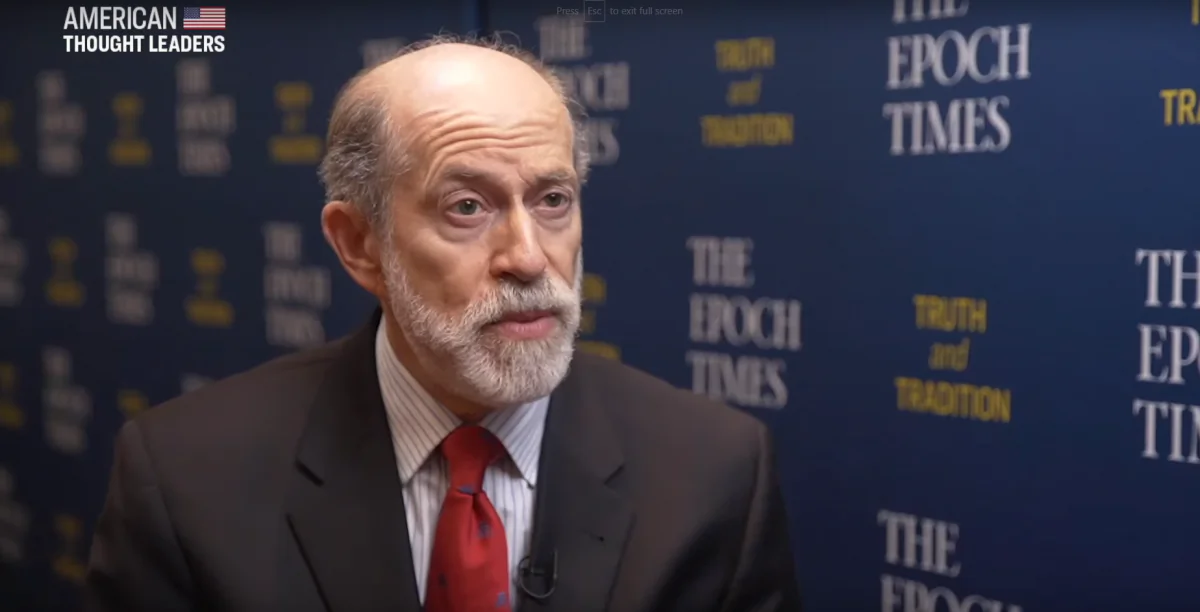
At the Western Conservative Summit, we sit down with Frank Gaffney, the Founder and President of the Center for Security Policy and vice-chair of the Committee on the Present Danger: China. We discuss the threat posed by China’s communist regime, Trump’s stance on China in contrast to previous administrations, and how some Western companies have inadvertently abetted the regime, including giving it the technology to install its nationwide surveillance system.
Jan Jekielek: Frank Gaffney, wonderful to have you on American Thought Leaders.
Frank Gaffney: It’s great to be with you. Thank you very much.
Mr. Jekielek: Frank, people have been telling me there’s this incredible new group, Committee on the Present Danger: China, that was formed not a few months ago to advise on the China threat. Much in the line of what was done with respect to the Soviet Union back in the day. And you’re one of the key folks behind the creation of this. Tell me a little bit more about Committee on the Present Danger: China.
Mr. Gaffney: I’m the vice chairman of it. The chairman is a colleague of mine, Brian Kennedy, president of the Claremont Institute.
Mr. Jekielek: He’s been on the show.
Mr. Gaffney: He’s been on the show. We, and probably now seventy or so others, have come together in the hopes that we’ll be able to do for our government in this moment what, as you say, the previous committee did in the 1970s with President Reagan. First, before he became president, he was a member of the committee itself, as a matter of fact. And it helped him articulate and then promote the alternative to what was then known as detente with the Soviet Union—a program of engagement, if you will, that we hear a lot about these days.
He didn’t believe it for a minute. He realized that the Soviet Union was not going to honor any commitments. It was simply going to be propped up by whatever trade benefits or other concessions we made to them. He ran for president basically on a platform that was largely articulated and, as I say, amplified by the Committee on the Present Danger, an informal group of people. Many of them were national security professionals, experts on the Soviet Union, business leaders, and the like. And they all shared this view that we needed a different approach, and it came to be called “peace through strength” under the Reagan presidency. He picked up 31 of those members of the committee and made them part of his administration to actually execute the strategy that they helped devise.
Flash forward, when you see how successful that effort was in eliminating this mortal threat to the United States from a totalitarian communist regime, it’s pretty good inspiration for what we know we need to do today. And this group, which I’m very proud to be part of, is standing with Donald Trump and his efforts to define a different approach to China to reverse the damage that has been done by decades of engagement with China, on basically its terms. We hope, ultimately, to have a salutary effect with respect to this totalitarian communist threat as Ronald Reagan and his team did with the Soviet Union back in the day.
Mr. Jekielek: Frank, tell me, why is China in your view a truly existential threat for this nation.
Mr. Gaffney: I’d start by saying that’s what Xi Jinping says it is, that it is going to displace the United States as the dominant power of the world. In the process, I think it’s pretty clear. It has in mind not simply eliminating us as a competitor for that distinction, but really taking us out. When you look at what it’s done over the past few decades of unrestricted warfare against our economy, you’ll realize that what it’s done there and what it is preparing to do now with its military is, ultimately, an existential threat to this republic and the freedoms that it protects and enshrines for its people. The Chinese Communist Party has no interest in freedom as you know, not for its own people, not for its clients, not for the others that it hopes to ultimately dominate, and most especially not for us.
Mr. Jekielek: Epoch Times was originally begun by Chinese-Americans to try to tell the truth when there are very few voices that were telling the truth about China. It was mostly Chinese Communist Party fake news, as they call it these days. We called it disinformation and propaganda back in the day.
Mr. Gaffney: You deserve great credit both for what you did back when nobody else was talking about it, or just a few of us, [and] what you’re doing today. It is of signal importance to helping clarify what are the stakes for this country in dealing with, specifically, the Chinese threat and a whole lot of other things that you cover as well.
Mr. Jekielek: There’s a couple of things that came to my attention recently that we’ve been writing about. One of them is huge investment by IBM and Google into Chinese AI startups. SenseTime is one that comes to mind. It sounds like a bad idea. There’s also CalPERS, huge investment funds. Steve Bannon, one of the folks in the committee has talked about how Wall Street can be considered the investment relations arm of the Communist party.
Mr. Gaffney: Customer relations.
Mr. Jekielek: Something like that. Again, huge amounts of capital being invested into Chinese companies at this time, when we are the most cognizant of the current realities. What do you make of this?
Mr. Gaffney: The bottom line is what could possibly go wrong? That we’re providing some of the best minds and capabilities in this country to help the Chinese with one of the key components of their police-state apparatus—artificial intelligence, the technology that they’re using along with surveillance systems and facial recognition and so on to ensure it’ll have absolute control over its own people and others that it’s exporting this kind of technology and system to. That’s one thing.
On the other hand, we’re also underwriting a lot of these activities. I spoke today with a colleague of mine, Roger Robinson, who’s been raising alarm about this a lot. And he pointed out that we are looking at a moment when American investors, by the millions, probably tens of millions, are unwittingly being drawn into investing in China, and specifically in companies that are doing things like that police state apparatus business. The trouble is that if you have tens of millions of Americans that are unwittingly being drawn into investing in China, in companies that are doing things like this police-state build-out and the concentration camps for the Uyghurs and the fortified islands in the South China Sea and other threats to us, including submarines and aircraft carriers and the like.
And they don’t have a clue that they’re doing it. They don’t have a clue of the material risks that are associated with doing it, and they become more or less suborned by the fact that their pension funds are now tied up in good relations with China. It turns this whole thing into not just a cash cow for the enemies of our country, but a lobby for their interests at the expense of ours.
This is a mortal peril. As Roger has said, we need people in places like the Securities and Exchange Commission to take seriously their duty to ensure that investors in this country know what the risks are of doing business with these Chinese concerns on exactly the same level as material risk is identified by American companies. That’s just common sense and long overdue.
Mr. Jekielek: Recently a number of prominent intellectuals on China have spoken out and said something to the contrary. Actually, the way I read it, anyway, it’s kind of a bit of America’s fault. We need to go back to engagement. I know you’re against this. Given what we know today, why would people advocate for re-engaging when it seems like those policies of engagement haven’t really worked for us?
Mr. Gaffney: Well, that’s being charitable. The policies of engagement towards China have been a catastrophic failure. And the most obvious reason that I can think of that people are still trying to promote this crazy, dangerous, reckless policy approach and criticizing Donald Trump for not wanting to do it is they’re on the payroll. I don’t know that to be the case in every instance.
But there’s another way that they can be induced to play ball with the Chinese — and that is, let’s be clear, what they’re doing — and that is many of those are people who want to go back to China. They study China, they are interested in relationships with Chinese government officials and the like. You don’t get a visa if you’re not on the team, the Chinese. So those are a couple of reasons why people would want to do it. The reason that certainly isn’t applicable is that it’s a good idea. And I think you’re going to be hearing shortly from a bunch of us about why Donald Trump’s got this right. We need a policy that is the antithesis of engagement and that is going to protect our country against the Chinese threat. It’s long overdue.
Mr. Jekielek: Frank Gaffney, powerful place to end. Wonderful to have you on American Thought Leaders.
Mr. Gaffney: Thank you. My pleasure.
This interview has been edited for clarity and brevity.
American Thought Leaders is a new Epoch Times show available on Facebook and YouTube.
 Friends Read Free
Copy
Facebook
Tweet
Friends Read Free
Copy
Facebook
Tweet


![[WCS Special] With Failures of Engagement, Trump Offers New Policy on China—Frank Gaffney](https://img.theepochtimes.com/assets/uploads/2019/07/25/Frank-Gaffney-205x123.png.webp)