
Commentary
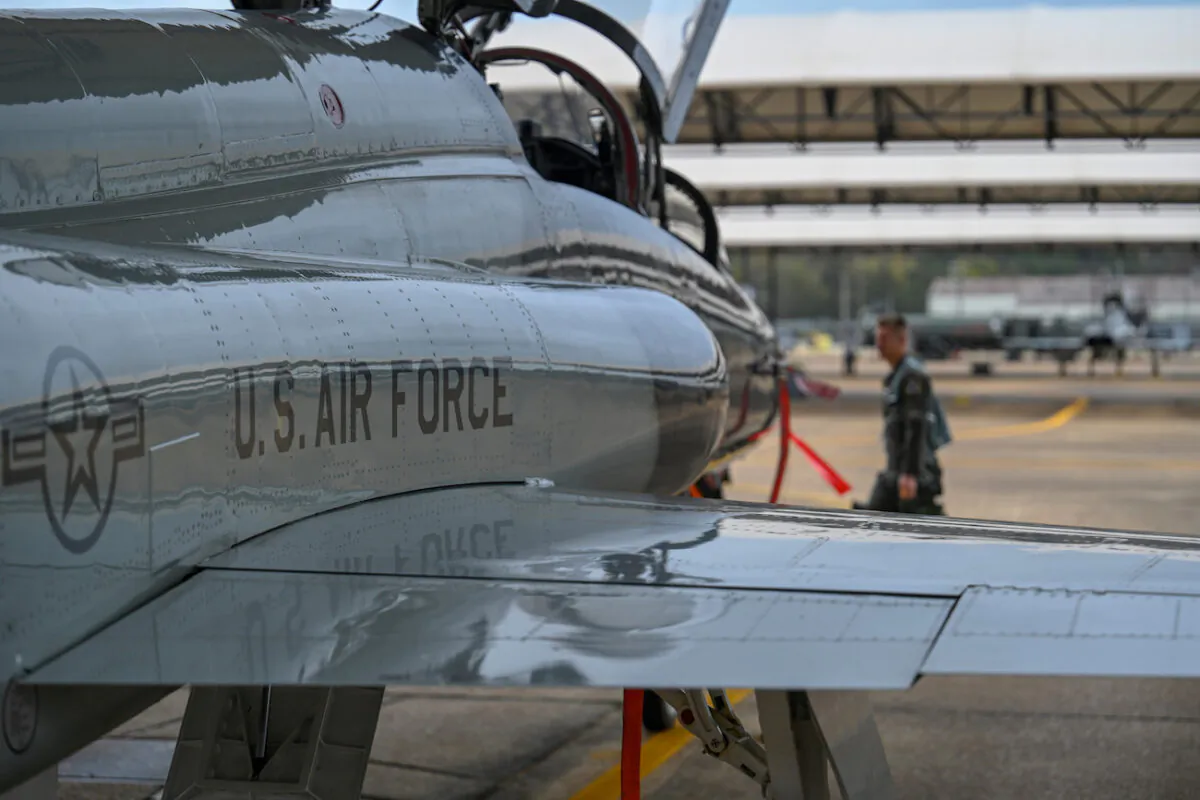
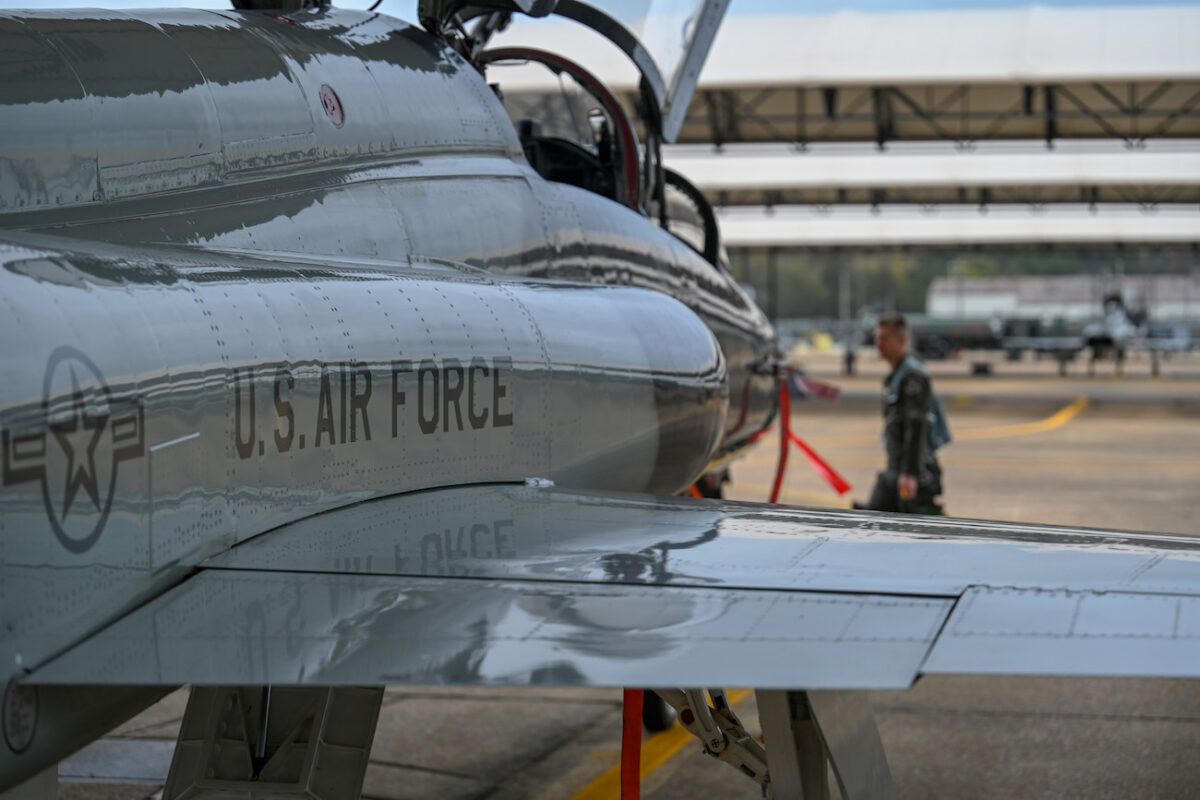
The U.S. Air Force’s (USAF’s) legendary T-38 Talon is slated to be replaced, but it won’t happen overnight. After more than six decades as the backbone of advanced jet training, the world’s first supersonic trainer is receiving one final round of heavy structural overhauls and avionics sustainment. That will ensure that it can continue to do its job over a phase-in period for the new jet trainer that could easily extend to 10 years.
This extended farewell was not part of the original plan. Delays in the program for the Air Force’s new jet trainer, the T-7A Red Hawk, forced the Air Force to implement a far more extensive and expensive T-38 sustainment effort than originally anticipated. But given just how good the T-38 is, the delay won’t be much of a hardship.
The T-38 story began as a private venture in the 1950s, when Northrop engineers identified the opportunity to replace the Air Force’s subsonic T-33 trainer with a supersonic one. So convinced were they of the need, they bet their own money on designing and building the T-38’s prototype, the YT-38. The first YT-38 prototype lifted off from Edwards Air Force Base on April 10, 1959, and just two years later, on March 17, 1961, the Talon entered USAF service on time and at or a bit below its promised cost. It was an immediate hit and a reminder that you don’t need 10 to 20 years to field a new plane.
Air Force pilots and NASA astronauts loved its sleek lines, fast climb rate, and forgiving yet demanding handling. Astronauts like Buzz Aldrin and Neil Armstrong used the T-38 to keep their reflexes sharp and to practice split-second decision-making. The T-38 often performed the role of chase plane for experimental aircraft and spacecraft like the shuttle. T-38 Production ran from 1961 to 1972, with Northrop delivering a whopping 1,187 of them. More than 1,100 went to the U.S. Air Force, with the rest going to NASA and a select group of U.S. allies. To date, it has trained between 50,000 and 72,000 military aviators, as well as NASA pilots and astronauts, and given its successor’s teething problems, it will likely train thousands more before it is finally retired.
What made the Talon legendary was its balance. It made it easy for pilots to learn the basics of flying, but truly mastering how to get the most out of the aircraft turned out to be the kind of challenge that was excellent at preparing pilots to fly jets like the F-4 Phantom, the F-16, the F-15, the F-22, and even the F-35. Its twin J85 engines could push it to Mach 1.3 and take it from sea level to nearly 30,000 feet in one minute. It was easy to maintain, with a low operating cost and an excellent safety record. Pilots who flew it still speak of it with affection: “easy plane to fly, but hard to fly well.”
Over its long life, the Air Force kept it current through smart, incremental upgrades. The biggest came in the late 1990s and early 2000s with the Avionics Upgrade Program that created the T-38C glass cockpit (video displays and so forth). A propulsion modernization program added more thrust, while the Pacer Classic series reinforced the airframe. These upgrades kept the fleet viable well past its original design life.
But the upgrades necessary to keep it current were increasing in cost, and the cost of keeping the airframe safe was steadily increasing. This led to the Air Force awarding Boeing a contract for the T-7 in 2018, and early versions were rolled out with fanfare in 2022.
The Air Force and Boeing officials hailed its digital design as being revolutionary. Yet issues with wing rock, ejection seats, and faulty parts have slowed its rollout. Making a long story short, the T-38 was supposed to be phased out by early 2032 at the latest, but T-7 program problems have pushed this out to the mid to late 2030s. This delay necessitated additional hundreds of millions of dollars in sustainment costs to ensure that the T-38 can continue to perform its roles safely and effectively while T-7 problems are ironed out.
With T-7 problems and issues pushing initial operational capability (IOC) out to at least November 2027, the T-7 rollout has been much slower than originally planned. The first small batch of operational jets arrived at Joint Base San Antonio-Randolph in late 2025, with full replacement stretching into the mid-2030s across bases like Columbus (2028), Laughlin (2032), Vance (2034), and Sheppard (2035). So the T-7s are coming, but for another decade or so, they will be flying alongside the T-38.
The T-38’s legacy is secure. It delivered exactly what the United States needed: a reliable, supersonic trainer that safely produced generations of skilled combat pilots on time and at a reasonable cost. Few defense programs can match its success. Hopefully, the T-7 Red Hawk will overcome its current crop of issues so that our pilots can continue to get the kind of training they need to excel—the kind of training the T-38 will have provided for over 70 years by the time it is finally retired.
Views expressed in this article are the opinions of the author and do not necessarily reflect the views of The Epoch Times.
 Friends Read Free
Copy
Facebook
Tweet
Friends Read Free
Copy
Facebook
Tweet