
Commentary
China’s Fourth Plenum, which runs from Oct. 20 to 23, is expected to shape the country’s future policy direction and may signal shifts in the top leadership.
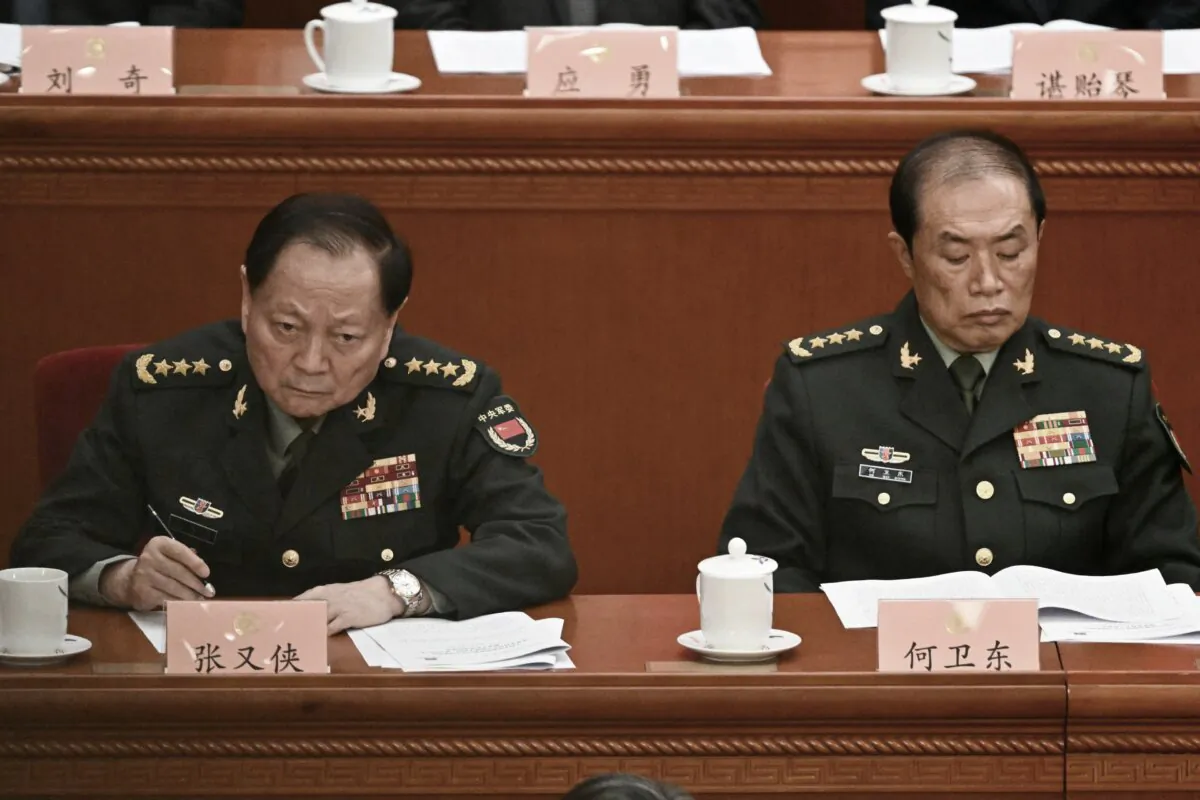
Before the meeting, the People’s Liberation Army (PLA) abruptly announced on Oct. 17 disciplinary actions against nine top-ranking generals, including Central Military Commission (CMC) Vice Chairman He Weidong and former CMC Political Work Department head Miao Hua. These generals were stripped of their Chinese Communist Party (CCP) memberships and military positions and transferred to military prosecutors for potential criminal charges.
The announcement fueled widespread speculation. He and Miao were widely considered to be among the closest military allies of CCP leader Xi Jinping, and the other seven were also regarded as trusted loyalists of Xi. Their downfall has fueled talk that Xi may be preparing—or under pressure—to voluntarily step down from his posts as CMC chairman and top leader of the CCP during the plenum. If this is the case, the CCP officials behind these moves—possibly CMC First Vice Chairman Zhang Youxia and former CCP leader Hu Jintao—are likely demanding Xi’s cooperation.
According to a recent leak by a Chinese whistleblower living overseas, Zhang—who is believed to currently hold de facto military control—had a secret meeting with Hu and former Premier Wen Jiabao, as well as Wang Yang and Hu Chunhua. Both Wang and Hu now serve in advisory roles within the Chinese People’s Political Consultative Conference.
Zhang allegedly briefed them on a series of unusual developments ahead of the Fourth Plenum, including irregular changes in the Central Guard Bureau, the frequent appearances of top Xi loyalists Cai Qi and Wang Xiaohong at the plenum venue, and the numerous changes to security arrangements—all of which raised fears that Xi’s faction might attempt a last-minute move during the meeting, the whistleblower said in his YouTube channel. Moreover, Zhang allegedly sought advice from retired leaders on how to respond.
The leak implied that Xi has no intention of stepping aside quietly and may be planning a last-ditch maneuver to reverse his declining position at the plenum.
Although these claims aren’t verified, a key question arises: Without military support, could Xi realistically succeed in disrupting the plenum relying solely on his non-military allies such as Cai Qi and Wang Xiaohong?
In my view, it is unlikely that Xi will get his way. The senior Party elders and Zhang Youxia, who are confronting Xi, have spent decades navigating the CCP’s nefarious inner workings—they know every trick in the book. Would they not take precautions?
On Oct. 18, just a day after He Weidong and Miao Hua were officially expelled from the Party, the PLA Daily published an editorial titled “Resolutely Carry the Military’s Anti-Corruption Campaign Through to the End,” signaling a deliberate effort to distance Xi from the dismissed generals.
The editorial emphasizes that the removal and prosecution of the nine generals demonstrated the CCP and military leadership’s “unwavering commitment” to eradicating corruption and claimed this as a “major victory” in the anti-corruption campaign. It explicitly states that no one is immune, using phrases such as “no untouchable princelings.” In other words, their punishment is purely due to corruption, not politics.
This narrative serves a single purpose: to distance Xi from the wrongdoings of the purged generals. To some extent, the editorial even took the opportunity to praise Xi’s resolve to fight corruption. Although most of the generals were promoted or endorsed by him, their corruption is portrayed as a personal failing. At worst, their misconduct reflects poorly on Xi’s judgment rather than his integrity. The editorial states that the generals “seriously betrayed the trust of the Party Central Committee and CMC,” reinforcing the idea that they acted alone and misused Xi’s trust.
In China’s political environment, if these generals’ transgressions were treated as political crimes, the Party would be forced to identify ringleaders—a dangerous move for Xi.
It appears as if the editorial was intended to convey to observers that Xi is blameless—the blame lies with He Weidong, Miao Hua, and others for betraying him. However, this does not suggest that Xi is regaining power. Instead, it seems to lay the groundwork for a peaceful power transition at the Fourth Plenum, while also warning those still in Xi’s political camp to consider their own future.
Regarding Xi’s current situation, I see two possible interpretations of the PLA editorial.
First, Xi may have agreed to cooperate with Zhang Youxia and other officials who have restrained him, prompting Zhang to spare him from harsh punishment. This is reflected in the editorial, which signals that if Xi steps down, he will not be held accountable.
Second, Xi’s intentions may remain unclear. Still, the CCP leadership has preemptively cut ties anyway—a message to Xi that, as long as he cooperates with a smooth power transfer at the plenum, he will be spared further consequences.
Either way, CCP elders and figures such as Zhang may see this as the least disruptive option for preserving the Party.
The editorial further suggests that significant personnel changes are imminent at the Fourth Plenum. Most likely, Xi will step down as the CCP’s general secretary and CMC chairman, while retaining the largely ceremonial title of chairman of China until the rubber-stamp legislature, National People’s Congress, holds its meeting next spring.
On Oct. 17, U.S. President Donald Trump confirmed that he would meet with Xi in South Korea in a few weeks, but Beijing has yet to confirm the meeting. Since Xi often uses the title chairman instead of general secretary of the CCP in high-level meetings, the potential upcoming meeting of the two leaders further suggests that Xi is likely to retain the title of chairman of China, at least until after the plenum.
Overall, there is good reason to speculate that China’s state media is laying out the script in advance for what will unfold at the Fourth Plenum.
Views expressed in this article are the opinions of the author and do not necessarily reflect the views of The Epoch Times.
 Friends Read Free
Copy
Facebook
Tweet
Friends Read Free
Copy
Facebook
Tweet