
Commentary
The renaming of the U.S. Department of Defense as the Department of War is open to misinterpretation.
The Department of War was one of the original cabinet departments established with the government of the United States of America in 1789. This was just six years after the end of the American Revolutionary War, which established the country. It was 26 years after the end of the Seven Years’ War, generally known in the United States as the French and Indian War. There was frequent skirmishing with the natives as the frontier moved west across the Appalachian Mountains and on to the Great Plains.
The French Revolutionary and Napoleonic Wars would begin in four years and continue with two brief interruptions for 23 years. The United States was exposed to reciprocal trade embargoes, and its ships were frequently boarded on the high seas by the British who abused their maritime preeminence by seizing and “impressing” (conscripting) American sailors. This finally escalated into the War of 1812 between Britain and America and continued into 1815.
Wars were frequent—one had given birth to the country—and War was a logical name for the place where soldiers were employed. In the 19th century, there were frequent Indian wars until about 1880, and the Mexican War, undertaken on a flimsy pretext, added about 500,000 square miles to U.S. territory, almost as much as the Louisiana Purchase. And, of course, in the terrible Civil War (1861–1865), 750,000 Americans perished and large parts of nine states were scorched to ashes and mashed to rubble by what became the Grand Army of the Republic, commanded by Generals Ulysses S. Grant and William Tecumseh Sherman.
It was Sherman who said that “War is hell” and that the only people who do not realize that are those who have never “heard the cries of the wounded and the groans of the dying.” General Abner Doubleday described the decisive turning point of the Battle of Gettysburg in 1863, immortalized by Abraham Lincoln at the dedication of the military cemetery there several months later in perhaps the most famous speech in the history of the English language. Doubleday said: “Each house, barn, church and hovel is filled with the wounded of both armies. The ground is littered with the dead.”
The century ended with what Theodore Roosevelt called the “splendid little war” with Spain in which the United States picked up Cuba, Puerto Rico, and the Philippines. The insane misjudgment of war as glorious, dashing, and even fun finally perished in the hecatomb of World War I. Twenty million people died in that war, 20 million more were wounded, and another 20–40 million died in the so-called Spanish Flu, which began with the war and was spread by it.
France, a country of 40 million, suffered 1.4 million dead and over 4 million wounded. When the French had their backs to the Marne River and the German Army was only 30 miles from the Arc de Triomphe, the order of Ferdinand Foch, the French commander of the Allied forces, was for all units of all Allied armies to fight to the last man and the last cartridge: “There will be no retreat and no surrender.” Even at that, he and the premier, Georges Clemenceau, aptly known as “The Tiger,” vowed to fight “before Paris, within Paris, and beyond Paris.”
In the aftermath of the Great War’s unprecedented bloodbath, typified by prodigious courage on a mass scale on both sides, a horror of war settled on the world, and all but the most deranged lovers of violence, like the brave but mad Austro-German Corporal Adolf Hitler, were fearful of a general war and were determined to avoid another one. Hitler in particular, once he became the German leader, played upon and exploited the desire for peace of the British and French leaders in the 1930s.
World War II, in which at least 70 million people died, vastly exceeded even World War I, and was made more horrifying by the discovery that more than 11 million people had been murdered in the Nazi death camps, and by the fact that the war was ended by recourse to two hostile detonations of atomic bombs on Japan, each killing approximately 100,000 people. It was generally believed that if there were another Great War between the leading powers, especially after the development of the hydrogen bomb by the United States and the Soviet Union, all life on earth could be destroyed.
It was at this point, in 1949, when the War and Navy departments (the Navy Department was established in 1798) were merged, the Air Force was removed from the Army and the Marines from the Navy, and all were grouped together in the Department of Defense. It was assumed, probably correctly, that various efficiencies could be realized and a lot of duplicative work eliminated, though the main services competed with each other in missile and other weapon development for some time. It was probably thought to be worth emphasizing—though this is surmise—that the United States would not be initiating wars and that in the nuclear era, defense would be the military’s preoccupation, and retention of the title Department of War might imply that the United States seriously considered that it would be unleashing nuclear hostilities.
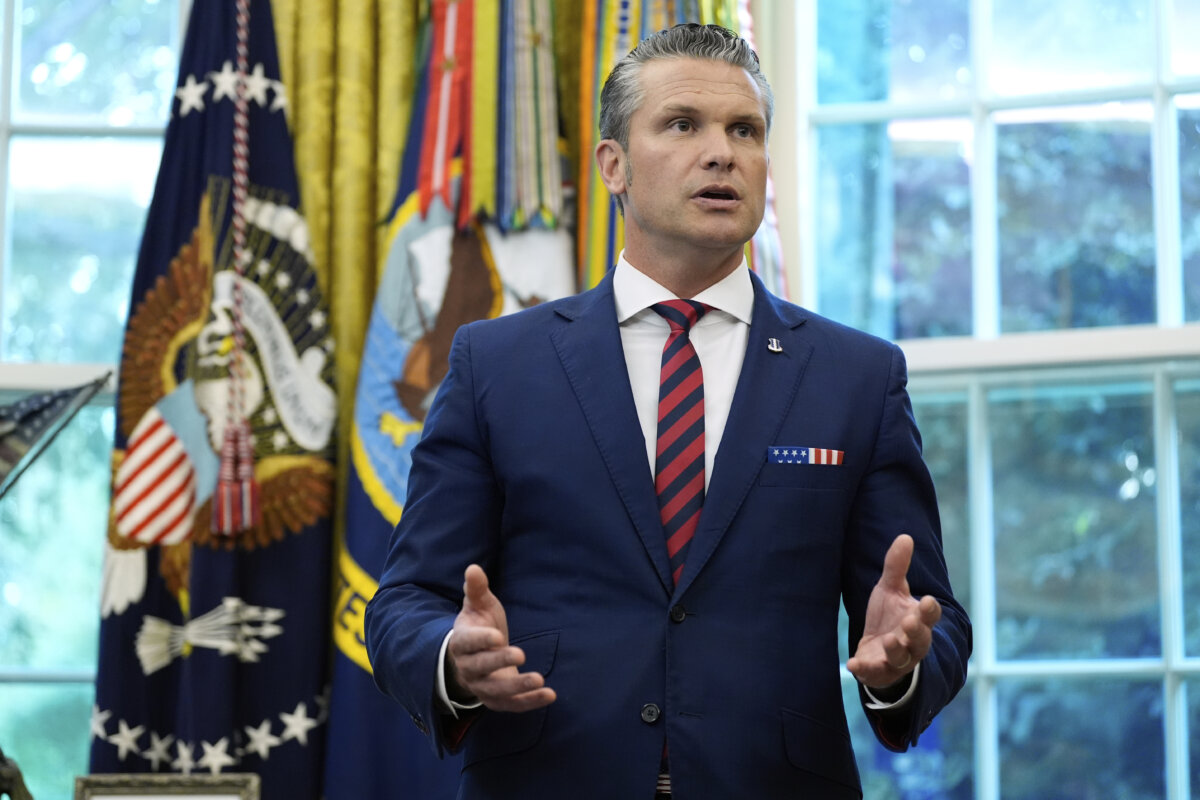
President Trump and Secretary Hegseth have stated that the previous administration’s introduction of critical race theory and transgender officers and other assaults on military tradition had dangerously lowered recruitment (which is undoubtedly true), and that the proposed name change will instantly reinvigorate the forces. Recruitment was already back to healthy levels. Trump also believes that Joe Biden’s humiliating withdrawal of U.S. troops from Afghanistan and other missteps encouraged the Chinese and the Russians to think that the United States had become a complacent and irresolute rival, a soft touch.
There also appears to be an element of competitive gamesmanship in progress: the U.S. administration seems to believe that the imposing military parade in Beijing on the 80th anniversary of the end of World War II—attended by the Russian and Indian leaders as well as a ragtag of client states such as North Korea, Iran, Belarus, and several of the former Islamic republics of the old Soviet Union—was an attempt to impress the United States. It is likely that changing the name of the Defense Department to the Department of War is another moment of one-upmanship in this same process.
I imagine most employees of that department, whatever its name, prefer to deter war rather than make it. Modern American strategic policy was set by President Franklin D. Roosevelt in two famous addresses to Congress at the beginning and the end of 1941. In his State of the Union message in January he warned of the evils of appeasement, and in his war message following the attack on Pearl Harbor on Dec. 8, 1941, he said that “We will make very certain that this form of treachery never again endangers us.”
All of the 14 presidents since that time have essentially maintained America’s deterrent strength and have generally avoided appeasing potential enemies. This is what has driven America’s enemies to have recourse to terrorist acts that cannot easily be traced to sovereign governments, complicating the task of retaliation.
If Trump and Hegseth believe that the morale of the forces will be raised by this name change, I suppose we owe them some credulity, though I doubt if a departmental name change will have much impact one way or another.
Views expressed in this article are the opinions of the author and do not necessarily reflect the views of The Epoch Times.
 Friends Read Free
Copy
Facebook
Tweet
Friends Read Free
Copy
Facebook
Tweet