
Commentary
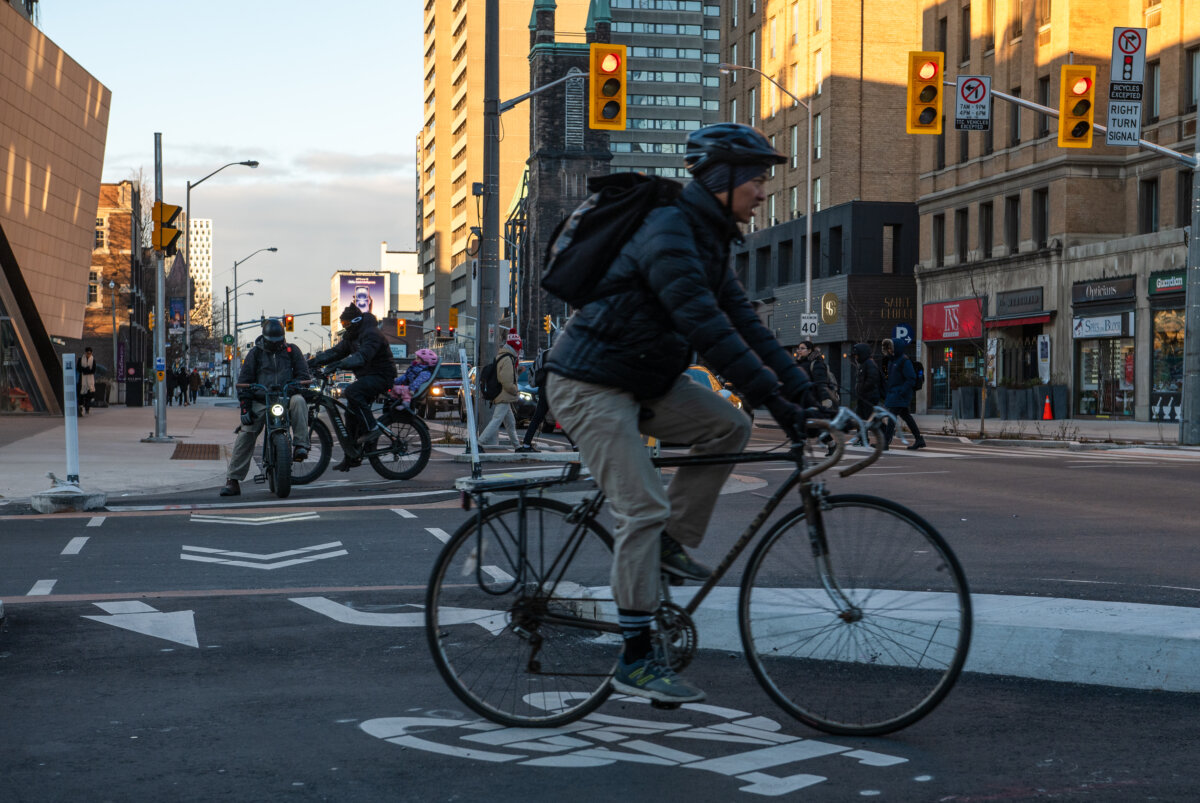
Bicycle lanes have been a contentious issue in municipal politics for years. Activists advocate for the lanes to boost bike use, while commuters and businesses fight against the roadway congestion created by the bike lanes. In Edmonton, a bike lane was removed in recent years, while in Toronto, businesses are suing the city for lost commerce due to several lanes downtown.
Civic politicians campaign on both sides of the issue, and it appears the back and forth may never end. At least, it seemed that way until now. In a bizarre ruling on July 30, an Ontario court has declared that removing bike lanes would violate the Canadian Charter of Rights. If the ruling survives the appeal filed by the Province of Ontario, bicycle lanes will become an enshrined constitutional right, and it will become illegal for elected politicians to remove them.
We can hope the next level of courts realizes the dangers of considering bicycle lanes to be a Charter-protected right and rule out the lower court’s ruling. This strange case highlights a bigger issue, as it has exposed how blurry the intent and the extent of Canada’s Charter of Rights and Freedoms have become.
The COVID-19 pandemic exposed a serious weakness in the Canadian Charter. Section 1 of the Charter “guarantees the rights and freedoms set out in it subject only to such reasonable limits prescribed by law as can be demonstrably justified in a free and democratic society.”
Having the document begin with the term “reasonable limits” builds in an ambiguity, assuring that rights can be selectively applied, and they are. During the pandemic, governments at the civic, provincial, and federal levels infringed on Charter rights. The rights to mobility, association, and religion were all suppressed as people were banned from travel and gathering even for religious functions. The courts of the time determined these were reasonable limits to fundamental rights.
When the truckers’ Freedom Convoy protest took over Ottawa streets, then-Prime Minister Justin Trudeau’s invocation of the Emergencies Act suspended Charter rights further and allowed the government to seize property and to detain people without charges. The Emergencies Act even allowed the government to compel labour by forcing tow truck drivers to work against their will.
The public inquiry established to assess whether the government’s use of the Emergencies Act was justified concluded that it was, following extensive hearings. However, two years after the Freedom Convoy protests, a Federal Court judge ruled that the Trudeau government’s invocation of the Emergencies Act violated the Charter of Rights and Freedoms. Justice Richard Mosley went further and said the move was “unreasonable” and outside of the scope of the law.
But so what?
No sanctions were brought against the government or the leaders within it. No laws were changed, and nothing was done to prevent a future government from violating the Charter rights of Canadian citizens again. If the worst punishment a government may face for infringing upon the rights of citizens is a finger wagging from a judge years after the offence, what’s to discourage governments from violating civil liberties?
The government is selective in protecting the civil rights of people and groups when it wants to be. Currently, Christian musician Sean Feucht is having concert venues and permits revoked by municipal governments across the country. A church in Montreal was even fined for hosting him. It is a blatant and gross violation of free expression and free religion, yet officials are turning a blind eye. Could you imagine the government standing by if a municipal government blocked an Islamic performer and tried to fine a mosque for hosting him?
The hardest part of protecting rights is stepping up to protect the rights of those you disagree with.
Canada’s Charter of Rights and Freedoms has been abused, and it is losing its power. It should be one of the most inviolate and authoritative documents in Canada, but it is becoming one of our weakest. The principles held by the Charter are being ignored and neglected by citizens and governments alike, and this bodes poorly for a nation that ostensibly cherishes personal freedoms.
Apathy has allowed people to forget the value of individual rights, and respect for the Charter has declined.
How can a person take the Charter seriously when it is used to entrench something as petty as bicycle lanes as a protected right, while the fundamental right to free expression for peaceful performers isn’t?
Surely the creators of Canada’s Charter didn’t envision it coming to this when they enshrined it into the Constitution in 1982.
It’s time for a national discussion on the Charter and on freedoms in Canada in general.
Views expressed in this article are the opinions of the author and do not necessarily reflect the views of The Epoch Times.
 Friends Read Free
Copy
Facebook
Tweet
Friends Read Free
Copy
Facebook
Tweet