
Commentary
There has been growing awareness of the problem of the overuse of technology among young people, but alongside this discussion should be a deeper examination of what technology has replaced culturally. What did children used to do with all of their time before tablets, phones, and video games? The addiction is one problem, but the loss of the substance of childhood is another.
In addition to the loss of unstructured play time outdoors, one of the major losses in our modern, screen-dependent society is oral traditions. Folk songs and folktales were once the heart of a young child’s education. Before the invention of television and technology, day care and preschool, young children learned about the world through traditional stories and songs handed down through the generations. The lyrical, textured language of popular tales gave children their first lessons not only in the art of language and rhythm, but also through a sense of their local and national identity.
These tales preserved the historical memory of a particular people. Silly-sounding nursery rhymes would actually be allegories for historical events, allowing children to enjoy their simple message while adults appreciated the historical significance. English parents told the story of “Humpty Dumpty,” for example, as a jibe at King Richard III, who could never “be put together again” after he was killed in the Battle of Bosworth Field despite his great army. This rhyme goes back to the 15th century. Or take “Old King Cole,” a rhyme about a third-century Celtic king, probably Coel Hen, who is said to be the father of St. Helena and grandfather of Emperor Constantine.
Folk songs, too, had their role in nourishing the historical imagination while at the same time strengthening the social fabric. I was once in France on Bastille Day and, much as I dislike everything about the French Revolution, I was envious of their joyful singing of “La Marseillaise.” Sure, most adult Americans know “The Star-Spangled Banner,” but you won’t hear it riotously sung in restaurants all night long on the Fourth of July. And are we even passing this one on in America? I doubt that even this American patriotic song is taught in most public schools today.
Nursery rhymes are a part of the folk story genre, and it is a beautiful thing to see the differences as well as the distinct similarities among these little stories across the globe. In the old series “My Book House,” first published in 1920, editor Olive Beaupré Miller collected nursery rhymes from dozens of different countries and included bright illustrations to accompany them. For the American child reading this volume (the first of a dozen that grow with the child), the pictures, rhymes, and songs illustrate what variety there is in the world. Differences in climate, dress, and appearance are the spice of life in the child’s eyes.
When children become aware of local differences in this way, paradoxically they value their own particular culture while also admiring the cultures of others. My young children are fascinated by other countries and long to go abroad one day to visit these exotic places, whether Italy or Russia. But if the images they saw were simply of children dressed exactly as they are—featuring McDonald’s restaurants, or televisions with Bluey in the background—there would not be much allure.
The homogeneity of the uniculture is as depressing as it is stifling. One of the actual causes of depression may lie in forcing children to create their own identities from scratch. Instead of learning from all the richness of their culture that precedes them, young people are frantic to try to understand who they are and where they came from—all in order to know where they might be going. Yet they are severed from the traditions that would give them guidance.
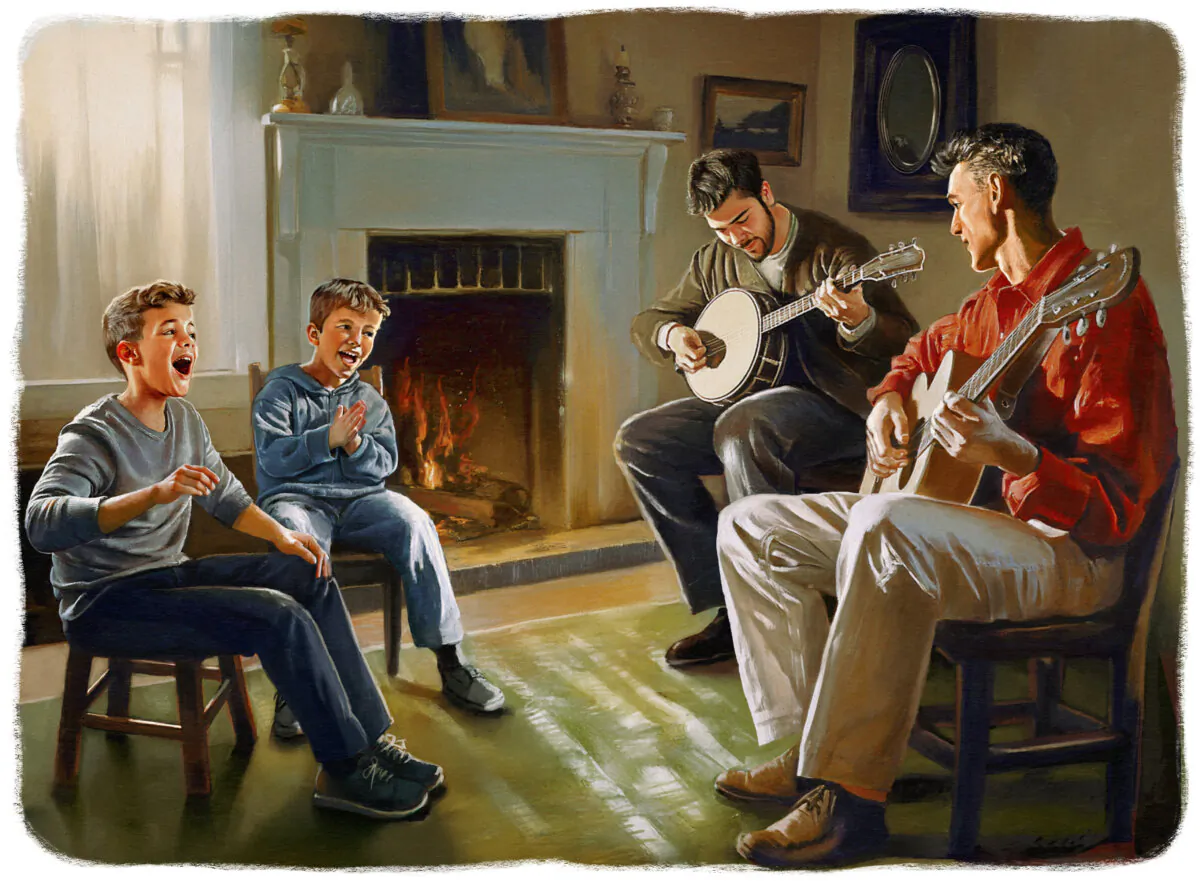
The value of local, oral folk traditions is that they ground children, right from the start, in a particular time and place and history. They root them. And it is something that the community shares and that bridges the generations. Few things are as fun as singing a hilarious folk song together—no matter how badly sung!
Many readers are probably thinking, yes, this sounds well and good, but is it not a romantic dream? The days of oral folktales and songs are gone. Technology is here to stay. I would challenge that assumption and argue that this is possible for anyone who wants it. Begin with a folk song from the country or region in which you live. “When the Ice Worms Nest Again” is a funny, catchy song from the Yukon; “Barbara Allen” is a popular old song from England, dating to at least the 1600s; “Dixieland” is a song that I remember my Southern family singing; and then there are songs that are great for very young children, such as “Frog Went-a-Courtin’,” which can be found on the CD “Wee Sing Fun ‘n’ Folk,” another great place to start with simple little folk songs.
Our homeschool curriculum focuses heavily on the imagination, and storytelling is a big part of it. Grimm’s folktales are on the menu and so are the fairy tales of Hans Christian Andersen and George MacDonald.
It is possible to reject Paw Patrol, screens, and the uniculture. The best part is that as adults we can taste the beauty and wonder of childhood that we may not have experienced ourselves.
Views expressed in this article are the opinions of the author and do not necessarily reflect the views of The Epoch Times.
 Friends Read Free
Copy
Facebook
Tweet
Friends Read Free
Copy
Facebook
Tweet