
Commentary
For over thirty years, the United States could live with a growing Chinese surface fleet it could see, and earlier Chinese nuclear submarines were loud. Distinct machinery tonals made those hulls trackable by Allied hydrophones and U.S. attack submarines once they put to sea. That was the West’s undersea insurance policy: if Beijing moved on Taiwan or tried to push a ballistic-missile submarine into the open Pacific, Washington still held the quiet side of the fight.
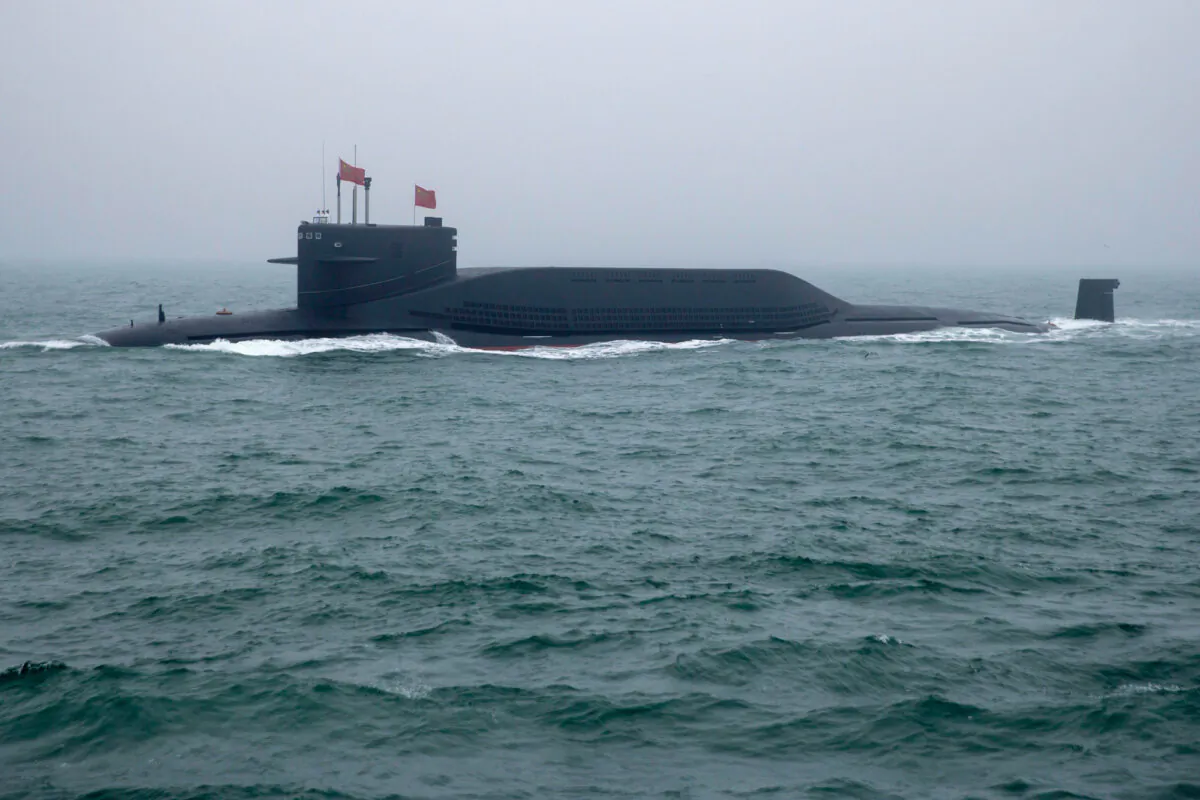
A 2009 Office of Naval Intelligence assessment placed the Type 094 Jin-class ballistic-missile submarine as noisier than Soviet Delta III boats built in the 1970s; the older Type 091 Han-class attack boats were widely nicknamed “underwater tractors.” Even the later Type 093 improved on that record without closing the gap with American Virginia-class boats.
This is crucial, as in modern military doctrine across the land, air, and sea surface, the fog of war is dissolving into real-time data feeds. But the ocean still remains an opaque physical void. Radar cannot penetrate water well; satellite sensors are useless at depth. Undersea warfare is governed mostly by acoustic physics. In this domain, silence is the only armor that matters.
However, the American technological buffer is increasingly in danger of eroding.
How Acoustic Stealth Works
To understand why closing this gap could reshape global security, one must first appreciate the engineering difficulty of submarine quieting. A nuclear submarine is essentially a city powered by a nuclear reactor, packed into a hollow steel cylinder. Every rotating pump, turbine shaft, reduction gear, and coolant valve generates kinetic vibrations. Because steel transfers vibrational energy into water with high efficiency, any internal mechanical defect acts as an underwater broadcast tower.
True acoustic stealth requires solving three interdependent challenges:
1. Mechanical Isolation and Reactor Dynamics: Heavy turbines and auxiliary machinery must be completely decoupled from the hull using isolated, suspended deck rafts resting on elastomeric shock mounts. Simultaneously, the reactor core must be engineered for natural circulation, allowing convective thermal buoyancy where hot water naturally rises and cold water sinks, to cool the reactor at patrol speeds without running loud coolant pumps.
2. Propulsion and Cavitation: Traditional open propellers generate localized pressure drops that boil seawater at the blade tips, producing a crackle of imploding vacuum bubbles (cavitation). Delaying cavitation requires shrouded pump-jet propulsors or multi-axis, highly skewed blades milled with sub-millimeter tolerances.
3. Viscoelastic Polymer Chemistry: Hulls must be clad in thick anechoic (free from echoes) rubber tiles that absorb active sonar pings and convert internal vibrations into microscopic heat. One materials constraint is the polymer’s glass transition temperature. Below that point the rubber stiffens; in cold or deep water a poorly formulated tile can crack or de-bond, strip off at speed, and leave bare steel. Tile adhesion is only one of several quieting problems. Machinery isolation, shafting quality, and propulsor machining matter at least as much.
Because these disciplines have to work together, Western analysts long treated acoustic parity as a slow grind. History suggests shortcuts exist when manufacturing recipes and design data cross borders.
The 1980s Toshiba Precedent
Undersea acoustic parity is sometimes achieved through incremental domestic research; but it can also occur in leaps when critical manufacturing recipes cross borders.
In 1984, Tom Clancy published “The Hunt for Red October,” capturing a terrifying Cold War nightmare: a Soviet submarine so acoustically silent that it could bypass Atlantic early-warning networks and park undetected off the American coast, becoming a nuclear first-strike weapon.
While readers treated the story as fiction, something quite real was happening behind closed doors. Between 1982 and 1984, Japan’s Toshiba Machine and Norway’s Kongsberg illegally exported nine-axis computer-controlled milling machines and numerical software to the Soviet Union. Soviet naval architects had long understood the mathematics of quiet propellers but lacked the machine tools to carve the complex curves without microscopic surface flaws.
The illicit transfer was one piece of a broader Soviet quieting program that produced the Project 971 Akula-class attack submarine. Pentagon assessments at the time credited the machines with a multi-year leap in propeller manufacturing. Combined with better isolation and coatings, later Akulas became far harder for the Atlantic SOSUS network to hold.
Recovering the tracking edge required a large, expensive U.S. anti-submarine warfare effort—though the often-cited thirty-billion-dollar figure is a popular estimate, not a declassified number.
CCP Closing the Gap
Today, that dynamic has returned on a massive scale. China is closing the acoustic gap through a three-part strategy:
-
The Sovereign Russian Swap: Cut off from Western components during its war in Ukraine, Moscow seems to be trading away crown jewels of its naval secrets in exchange for Chinese machine tools, semiconductors, and dual-use industrial aid. U.S. officials began saying so in public in 2024. Then-Deputy Secretary of State Kurt Campbell said Russia was providing support in areas it had previously been reluctant to share, including submarine operations, stealth-related aeronautical design, and missiles. Adm. Samuel Paparo, then head of U.S. Indo-Pacific Command, said he expected Moscow to give Beijing submarine technology “that has the potential of closing American undersea dominance.” Later officers have also spoken of “potentially submarine quieting help.”
-
Targeted Western IP: For micro-materials and sensors, Chinese programs targeted specific Western research nodes. Federal cases, such as the 2020 conviction of Shan Shi, exposed the theft of trade secrets for deep-sea syntactic foam—a high-strength, low-density composite used in buoyancy modules for offshore drilling and underwater vehicles, with dual-use naval applications. It is not the same material as anechoic hull tiles, but it is an example of the kind of Western process knowledge Chinese programs have targeted. At the same time, state-backed recruitment has also pursued Western academic work on acoustic metamaterials and phononic crystals—the laboratory side of making hull treatments absorb or cancel sonar more efficiently.
-
Industrial Scale: At the Bohai shipyard in Huludao, China built large covered assembly halls capable of assembling multiple nuclear submarines at once, sheltering modular construction from satellite view.
Geopolitical Fallout
If the upcoming batch of new Chinese submarines (Type 095 attack, and Type 096 ballistic missile) are as quiet as their design features imply, the operational consequences could alter deterrence across the Indo-Pacific.
First, the First Island Chain becomes a sieve instead of a wall. If Chinese attack submarines can operate below oceanic thermoclines without radiating telltale narrowband tonals, they could transit the Miyako and Luzon straits with a much lower chance of detection (between Taiwan and Okinawa, and Taiwan and the Philippines, respectively). That would enable them, for example, to threaten the logistical sea lanes connecting Hawaii, Guam, and Australia.
Second, the conventional defense of Taiwan becomes contested. In a cross-strait battle, open-source reconstructions of U.S. planning have long given American attack submarines a central role inside the shallow waters between China and Taiwan: interdicting amphibious transports. If the PLA Navy fields genuinely quiet Type 095 hunter-killers, American submarines inside those waters would no longer operate as unopposed hunters. They would have to assume they might also be prey.
Finally, a quieter SSBN would strengthen the sea-based leg of China’s nuclear deterrent. The JL-3 (‘Giant Wave-3’) missile has an assessed range of more than 6,000 miles—enough, U.S. commanders have warned, for China to threaten parts of the American homeland from waters closer to home. A Type 096 patrolling under land-based air and missile cover in the South China Sea or the Bohai would be a more survivable second-strike platform than today’s relatively noisy Type 094 submarines. That is a threatening prospect, though not an untraceable force already in place.
The strategic balance of the twenty-first century will not be decided solely by who builds the most hulls on the surface. Who owns the silence beneath the waves matters greatly—and American dominance in the deep is now being contested.
Views expressed in this article are the opinions of the author and do not necessarily reflect the views of The Epoch Times.
 Friends Read Free
Copy
Facebook
Tweet
Friends Read Free
Copy
Facebook
Tweet