
Commentary
Anyone who has done much computer gaming, especially role-playing games, is familiar with the concept of the “glass cannon.” For those who haven’t, a glass cannon is a person who has a lot of offensive power but is relatively fragile. They can deal a lot of damage, but are weak when it comes to resisting or absorbing damage, and when hit can crumble or shatter.
Iran’s warships are a real-life embodiment of this: lots of firepower, but not able to take much damage before being sunk or destroyed. And U.S. forces have capitalized on this vulnerability. As of March 12, U.S. Central Command reports that more than 60 Iranian naval vessels (boats and ships) have been destroyed or put out of action during Operation Epic Fury, effectively neutralizing Iran’s conventional naval combat power.
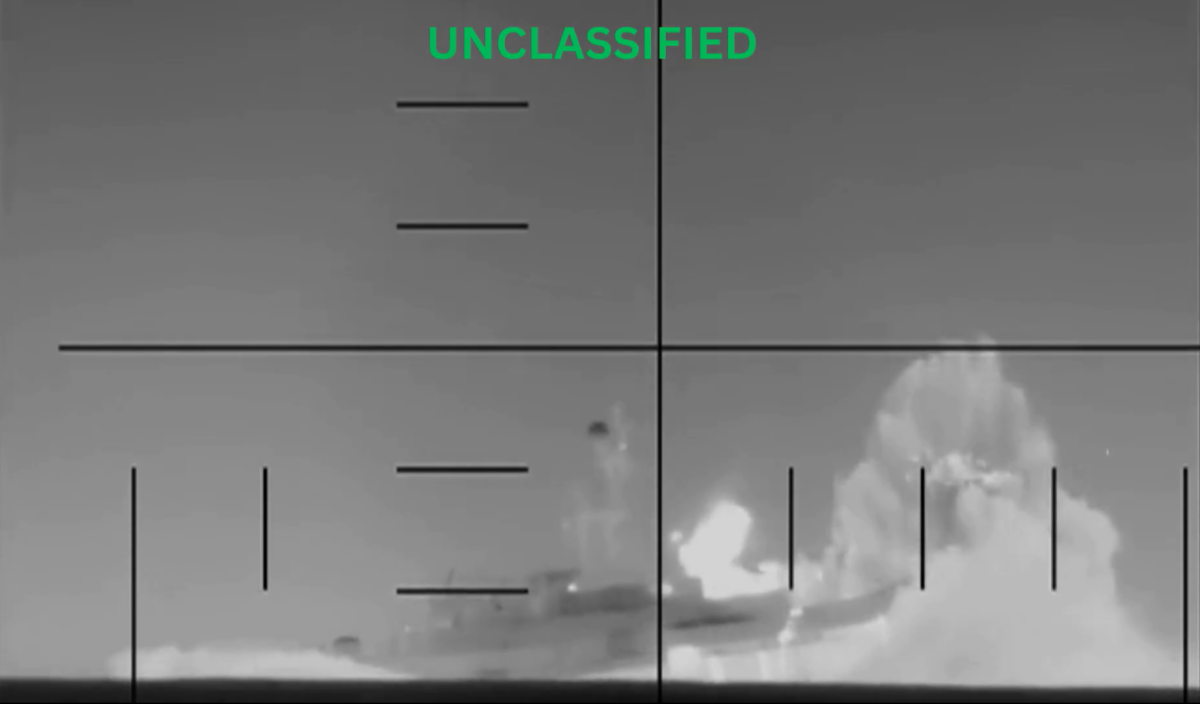
For their size, Iran’s fleet of corvettes and frigates sported a whole lot of offensive power, but collectively had very little ability to survive any significant damage, much less take damage and stay in the fight. A dramatic example of a glass cannon ship was Iran’s Shahid Soleimani. The first of four Shahid Soleimani-class corvettes, it displaced about 600 tons, about one-fifteenth that of an Arleigh Burke destroyer, yet it carried six powerful anti-ship cruise missiles (ASCMs), 16 surface-to-air missiles, six surface-to-surface missiles, six 20 mm Gatling guns, and a single 30 mm autocannon.
This level of weapon density far exceeds that of any U.S. Navy vessel. And if given the chance to fire its full complement of its ASCMs at one of our Burke destroyers, it would be a real threat to mission kill or even sink it. But it didn’t have the chance, being destroyed while at anchor by a combination of drones and other strike weapons. The other three ships of its class met similar fates over a period of a couple of days.
Even if the ships had been much larger, they still could have been sunk. But if they had been as large and sturdily constructed as one of our Burke destroyers, it would have taken a whole lot more strikes by bigger weapons to sink them. Factors such as displacement, effective compartmentalization designed to isolate damage, fire control, and a crew large enough to practice ship-saving damage control all contribute to a ship’s “staying power.”
Armor can also greatly contribute to a ship’s staying power, but modern warships largely forgo armor in favor of loading up with active defenses. However, when active defenses fail to stop an attack, the ship’s staying power becomes critical. At 600 tons, with a thin aluminum hull and composite structure, the Soleimani’s staying power was just plain pitiful, and its active defenses failed to protect it.
With surface combatants maxing out at just 1,500 tons, Iran had a small conventional navy full of glass cannons with very little staying power. Indeed, the combined weight of its surface combatants, frigates, and corvettes is about the same as just two of the U.S. Navy’s Arleigh Burke destroyers.
Its biggest so-called “warship,” a 40,000-ton container ship converted into a drone carrier, certainly has more staying power than the smaller ships due to its much larger displacement. But being a freighter, it was not built to military standards and does not have the compartmentalization and damage control systems of comparably sized real warships such as the USS Lexington, an Essex class carrier decommissioned in 1991. Bottom line: A converted container ship has nowhere near the staying power of a comparably sized World War II era carrier.
Iran’s 12 to 14 corvettes and frigates were designed to provide the presence and prestige of real warships, and they had the potential to pose a threat to much larger ships if allowed to execute an alpha strike/first strike. However, the U.S. Navy’s vastly superior situational awareness and ability to strike from much greater distances ensured they never had that chance.
Nonetheless, it would be a mistake to say that Iran’s navy is completely destroyed, as much of its offensive power is in the form of hundreds of small attack boats, including missile boats, that could still pose a threat to U.S. naval vessels that stray too close to Iran’s coast.
Individually, these 1,500 or so smaller naval assets, fast attack craft, and missile boats, stored in numerous hidden locations along Iran’s coast, have almost zero staying power, but collectively, they do provide a staying power of sorts. And with the support of Russian and Chinese electronic and satellite surveillance, they have the potential to deal a lot of damage. To date, they have been used to attack civilian ships, and their mere presence contributes to Iran’s ability to control the Strait of Hormuz. Further, whether or not they actually are successful in damaging or sinking any U.S. Navy ships, their presence and potential threat make them a legitimate “fleet in being” that must be factored into U.S. naval operations.
While the jury is out on what Iran’s asymmetrically oriented fleet of fast attack craft may or may not ultimately accomplish in the current conflict, its “larger” surface warship, comprising frigates and corvettes averaging far less than 1,500 tons per ship, never had a chance. And it’s fair to say that any smaller navy relying on such ships would have met the same fate when going up against the United States Navy.
Views expressed in this article are the opinions of the author and do not necessarily reflect the views of The Epoch Times.
 Friends Read Free
Copy
Facebook
Tweet
Friends Read Free
Copy
Facebook
Tweet