Commentary
“It will be a terrible night for the soldiers who have no shoes,” John Fitzgerald wrote in his journal. “Some of them have tied old rags around their feet, but I have not heard a man complain.”
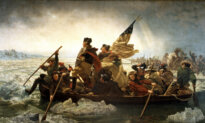
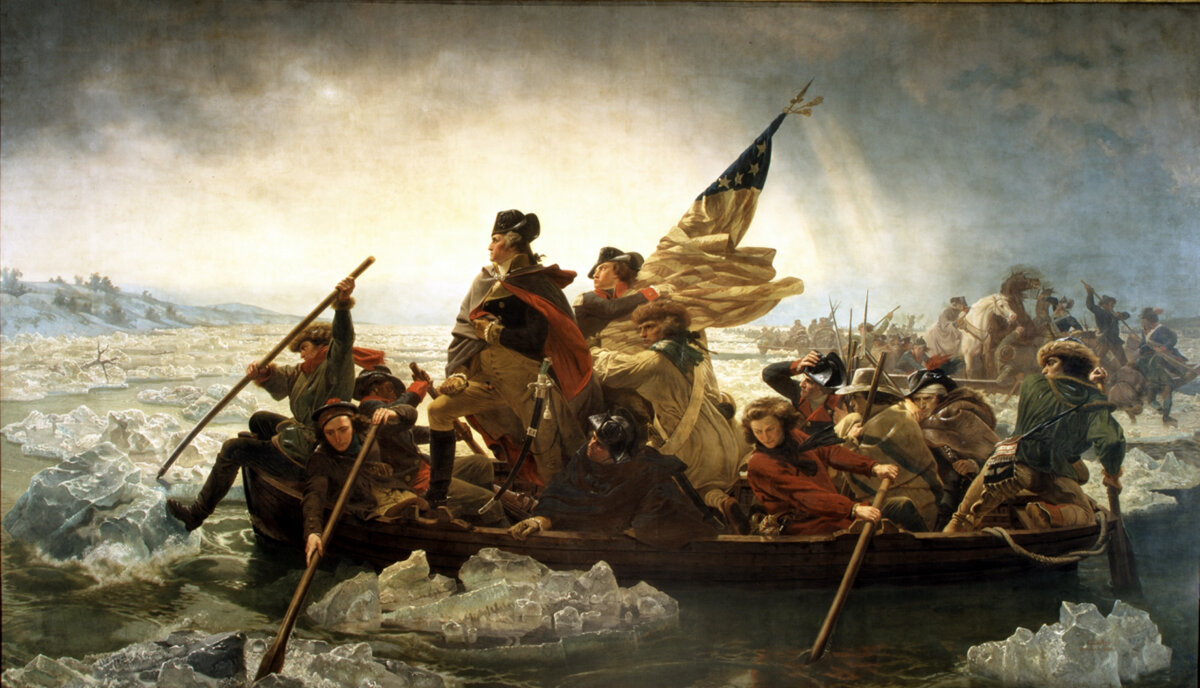
The night was Dec. 25, 1776, arguably the most important night in the history of the United States military. Gen. George Washington had split up his army into three groups along the Delaware River, as part of an elaborate plan of attack. The weather, however, would not cooperate. A blizzard had swept through New Jersey. Additionally, as referenced by Fitzgerald, many soldiers were ill-prepared for the river crossing, let alone the planned attack. Considering how the war had been going, those soldiers who survived the night and the assault would most likely return home, as their enlistment was set to expire on Dec. 31. For Washington, it was a last-ditch effort to end the year with a victory in hopes of convincing his soldiers to continue the fight into the new year.
Washington was at the helm of 2,400 men. His other contingent of approximately 2,200 soldiers—divided into two forces—was placed south of him, preparing for the three-pronged attack against what was believed to be an army of Hessian mercenaries 2,000 to 3,000 strong (there were actually 1,500). He had hoped for a night attack, but Washington’s plan was behind schedule, thus forcing them to pursue the enemy under the glow of the morning sun. To make matters worse, Washington’s three-pronged attack would be whittled down to one prong, as the blizzard kept the soldiers south of him from crossing. Lastly, many of the soldiers who made it across could not fire their muskets because of moisture.
In his masterful book “1776,” David McCullough reflected on this pivotal morning attack, stating, “For those who had been with Washington and who knew what a close call it was at the beginning—how often circumstance, storms, contrary winds, the oddities or strengths of individual character had made the difference—the outcome [of the Revolution] seemed little short of a miracle.”
The Miracle and the Miraculous
“Miracle.”
That is the last word in McCullough’s book, and it sums up much of America. This country is undoubtedly a miracle. It is a miracle we defeated the British—the greatest military power at the time. It was a miracle that our Founders thought it wise to enshrine the phrase “we are endowed by our Creator with certain inalienable rights.” It was a miracle that 11 years after that phrase was approved, our Founders were convinced America would not succeed as a confederation but required a “republican form of government.”
And as we celebrate our nation’s 250th birthday, is it not a miracle that our Constitution is the longest lasting in history? Furthermore, before we ever considered declaring independence, we were provided 150 years to practice self-government, ensuring that we would be fully prepared to become our own nation. No other nation has ever had that opportunity—and I hardly think that if one had, it would have likewise become the freest, most prosperous, and most powerful nation the world has ever witnessed.
Yes, America is in itself a miracle, but this collective miracle is merely a reflection of our long-held individual belief in the miraculous.
The possibility of divine intervention. Our Founders identified it as Providence. The first Americans under the banner of the Betsy Ross flag were witness to what was a timely, if inconsistent, war of miracles.
Inconsistent? Certainly. Miracles are themselves inconsistent with nature, and thus rare and unpredictable. Henceforth, the belief in miracles requires the belief in a Miracle Worker. In a word, faith. Without faith, there is not even the hope for a miracle. Therefore, the faithless can never appreciate a miracle when it arrives. It becomes a singular event to be explained away by natural means, resulting in mere mental exercises in futility.
Religion, Liberty, and Morality
The belief in the miraculous, and therefore in Providence, requires that our faith be rightly placed. It must remain placed where our Founders had it—in a creator who is good. A bad creator would not set aside inalienable rights of life, liberty, and the pursuit of happiness. Thus, if our faith is in a good creator, then it only follows that our fights must be for the good.
When Alexis de Tocqueville visited America in 1831, he noted: “The character of Anglo-American civilization in its true light … is the result … which in other places have been in frequent hostility, but which in America have been admirably incorporated and combined with one another. I allude to the spirit of Religion and the spirit of Liberty.”
The much-beloved Frenchman, who arguably described America better than any American ever has, echoed the sentiments of the Founding Fathers, and quite certainly the words of Washington upon his final farewell from public office.
“Of all the dispositions and habits which lead to political prosperity, religion and morality are indispensable supports,” Washington stated.
“And let us with caution indulge the supposition that morality can be maintained without religion. Whatever may be conceded to the influence of refined education on minds of peculiar structure, reason and experience both forbid us to expect that national morality can prevail in exclusion of religious principle.”
Certainly these “indispensable supports” have held America together even in times when we have taken the miraculous for granted or, in our folly, disregarded it, as if being the recipient of world-altering miracles made us impervious to error and curses. In a state of rash foolishness, and hardly a decade removed from providentially doubling the size of the country, we declared war on Great Britain, and the nation’s capital burned for it—the miracle being our most important founding documents were rescued. Upon defeating the Mexicans and signing the Treaty of Guadalupe Hidalgo on Feb. 2, 1848, we increased the size of the nation by a third, and by unmistakable divine Providence, gold was discovered in California a mere 11 days before signing the treaty.
The continent was ours, our enemies vanquished or appeased, and our streets flooded with gold and silver. Yet we lost sight of the miraculous.
Spreading the Miraculous
When President Abraham Lincoln appealed to us to adhere to “the better angels of our nature,” the appeal went unheeded.
Lincoln nonetheless pointed America toward the miraculous for better or for worse, stating, “If God wills that [the war] continue until all the wealth piled by the bondsman’s two hundred and fifty years of unrequited toil shall be sunk, and until every drop of blood drawn with the lash shall be paid by another drawn with the sword, as was said three thousand years ago, so still it must be said ‘the judgments of the Lord are true and righteous altogether.’”
“The better angels of our nature” slowly triumphed. It was Lincoln’s hope that Americans would “do all which may achieve and cherish a just and lasting peace among ourselves and with all nations.” The miracle of our internal peace has continued, even with the addition of 16 more states since then, not including the 11 that had seceded.
More so, we have allowed “all nations” to embrace the miracle that is America by maintaining peace throughout the world after World War II. Fighting a war we had hoped to avoid, we finished what we had not started. Yet, it was the vision of great Americans who understood that not all dragons had been slain and that Europe required an Americanized miracle. We paid for and rebuilt Europe from the ashes while keeping at bay what President Ronald Reagan succinctly identified as an “evil empire.”
Holding to the Miraculous
The Cold War with the Soviet Union pitted us against an ideology that dispensed with the miraculous, along with any semblance of liberty, much less the pursuit of happiness. Communism had engulfed the once God-fearing Russia. But how had such a thing happened?
Aleksandr Solzhenitsyn, the Nobel laureate who had endured the Soviet Gulag, claimed, “Men have forgotten God; that’s why all this has happened.”
But he added, “If I were called upon to identify briefly the principal trait of the entire twentieth century, here too, I would be unable to find anything more precise and pithy than to repeat once again: ‘Men have forgotten God.’”
The Cold War ended in 1989 with the fall of the Berlin Wall. Or perhaps it was 1991 with the dissolution of the Soviet Union. Regardless, another Cold War began shortly after, with a nemesis made in the same image of the former Soviets.
If the first Cold War taught us anything, indeed if the past 250 years have taught us anything, it is that America must continue to look to Providence, the divine. We must continue to anticipate and appreciate the miraculous, and therefore maintain the faith in God that has secured us through our triumphs and failures, our wisdom and our foolishness.
Washington has been gone since the 18th century, Lincoln since the 19th. Our Russian friend, Solzhenitsyn, and our dear McCullough died in this century. But here you and I remain, commissioned to maintain those “indispensable supports” of religion and morality—ordered by our forebears to herald the miracle when it happens, and to be in constant prayer for the next one.
America is not short on miracles. The search of a downed American pilot in Iran during this past Easter—a period that testifies to God’s greatest miracle—exemplified our reliance on religion. We openly prayed and requested prayer, indicating clearly that we had not forgotten God. That we needed him in that moment just as we needed him Christmas night 250 years ago.
In this instance, as in countless others before—and hopefully countless others to come, we received what David McCullough described as something “little short of a miracle.”
Views expressed in this article are the opinions of the author and do not necessarily reflect the views of The Epoch Times.
 Friends Read Free
Copy
Facebook
Tweet
Friends Read Free
Copy
Facebook
Tweet