Commentary
Chinese state-run media on Aug. 17 published coordinated centenary tributes to former Chinese leader Jiang Zemin. Global Times, China Daily, and Xinhua reproduced a eulogy calling Jiang a “long-tested communist fighter” of “rock-solid conviction” with “profound love for the people.”
What’s missing: Jiang owed his career to the Tiananmen Square massacre, personally began the persecution of Falun Gong, ran “Strike Hard” campaigns that built today’s Xinjiang security state, laid the legal groundwork for Hong Kong’s loss of autonomy, and extracted World Trade Organization (WTO) membership from the West on promises he never kept. What follows sets the propaganda against the record.
A ‘Long-Tested Communist Fighter’ or the Ultimate Survivor?
Chinese Communist Party’s Coverage: Xi Jinping, the current leader of the Chinese Communist Party (CCP), called Jiang “unswervingly firm in communist ideals” since joining the Party in 1946 at age 20.
Counterpoint: Jiang was a Soviet-trained “bourgeois” engineer who should have been a Cultural Revolution target yet was never purged and quietly climbed the technical ranks to Shanghai’s mayoralty by 1985. One sinologist called him “a slippery and devious politician,” while contemporaries nicknamed him a “weather vane” and “flowerpot.”
Foreign Affairs notes he built power by “showering” every faction—party, military, security—with resources rather than committing to any program. He never deviated from the Party line because he never had one of his own. In fact, he was the line, whatever it was that year.
Tiananmen: The Massacre That Made Jiang
CCP’s Coverage: No centenary piece mentions Tiananmen; all the Chinese state-run pieces cited above jump straight to his 1989 promotion.
Counterpoint: Jiang became general secretary in June 1989 precisely because, as Shanghai’s party chief, he’d shut down a newspaper sympathetic to the protesters and contained protests without gunfire—a “success” noted by then-Chinese leader Deng Xiaoping.
CCP General Secretary Zhao Ziyang was purged for refusing to endorse martial law; Jiang was appointed for the opposite reason. The Beijing massacre on June 3–4, 1989—which left as many as 10,000 dead—is the direct cause of Jiang’s rise. He never once publicly criticized it during his 14 subsequent years in power.
Falun Gong: A Persecution Started by Jiang Personally
CCP’s Coverage: This was not mentioned anywhere in the state-run outlets’ centenary coverage.
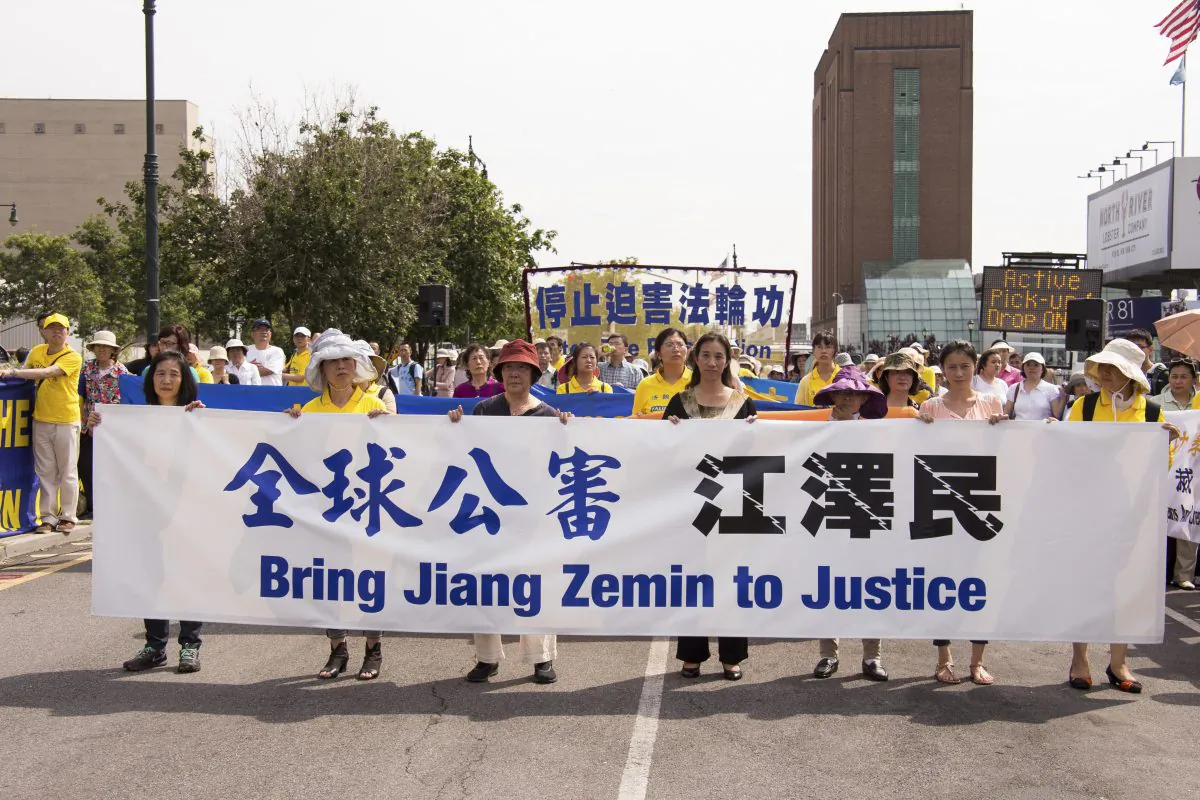
Counterpoint: On July 20, 1999, Jiang began a nationwide suppression of Falun Gong, a meditation discipline with millions of practitioners. Tribunal-compiled documents trace an April-to-July escalation that culminated in an order to create the extralegal 610 Office, which coordinated the persecution campaign.
China analyst Heng He told Radio Free Asia that “nobody in the Politburo Standing Committee supported [Jiang] at the time—it was his decision alone” to start the persecution. What followed was mass detention, forced labor, torture, and forced organ harvesting. Some estimates place the number of casualties at more than the Tiananmen massacre’s body count.
Tibet, Xinjiang, and the ‘Strike Hard’ Template
CCP’s Coverage: Absent from centenary coverage. South China Morning Post reported that a People’s Liberation Army general praised Jiang for keeping the army loyal to the Party against “hostile forces.”
Counterpoint: Jiang’s “Strike Hard” campaigns (beginning in 1996) targeted “splittism” in Tibet and Xinjiang, credibly causing approximately 20,000 executions and mass detentions. These were the institutional seeds of today’s Uyghur reeducation camps. Restrictions on Uyghur religious practice triggered the 1997 Ghulja massacre. Official sources say 10 died, while exile sources claim far more.
In 1995, authorities abducted 6-year-old Gedhun Choekyi Nyima days after the Dalai Lama named him the reincarnated Panchen Lama, making him one of history’s youngest political prisoners. He has not been seen since.
Hong Kong: Laying the Groundwork for Lost Autonomy
CCP’s Coverage: Articles by Chinese state-run media outlets credit Jiang with “advancing reform and opening up,” while the 1997 handover of Hong Kong to communist China is framed as an uncomplicated triumph.
Counterpoint: The handover itself was Deng’s deal, but Jiang governed the critical first decade of the “one country, two systems” policy. His regime pushed early for Article 23 security legislation and normalized Beijing’s power to reinterpret the Basic Law over Hong Kong courts—the same tools Xi’s regime later used for the 2020 national security law.
Jiang didn’t absorb Hong Kong overnight; he laid the bricks his successors used to finish the job.
‘Led China Into the WTO’: Beijing’s Proudest Claim
CCP’s Coverage: Global Times articles cite WTO accession among Jiang’s “indelible contributions,” while China Daily credits him with welding China to global demand.
Counterpoint: Under Jiang, China won permanent trade relations and WTO access largely on promises of reform and intellectual property protection that it didn’t keep. Washington’s 1994 delinking of most-favored nation status from human rights removed its chief leverage just as Jiang ran the Falun Gong persecution and Strike Hard campaigns.
The 1999 Cox Report documented Chinese espionage against U.S. nuclear and military technology during the same engagement years.
Two decades of U.S. trade representative Section 301 findings confirm a persistent gap between China’s WTO commitments and its practices regarding technology transfer and intellectual property protection.
The pattern—promise liberalization, extract preferential access—was Jiang’s, not a later aberration.
What the Puff Pieces Say, and What They Leave Out
Set side by side, the Chinese state outlets’ own words expose the method. Global Times, Xinhua, and China Daily praise “extraordinary courage and vision” and “profound love for the people” without ever bringing up Tiananmen, Falun Gong, the Panchen Lama, Ghulja, or the Strike Hard executions.
China Daily’s feature humanizes Jiang with anecdotes about him secretly studying Spanish while roughly 20,000 executions proceeded in the same years.
South China Morning Post’s report on a PLA general invoking Jiang to demand “absolute Party leadership” over the military inadvertently confirms the real throughline: Institutional loyalty enforcement was Jiang’s bread and butter, not the economic-technocrat image sold abroad.
And every piece credits Jiang with WTO accession and “moderate prosperity” during his rule without ever mentioning what was promised to the West to get there, or what was withheld afterward. Real economic achievements are foregrounded and inflated into character testimonials; the repression running in parallel is simply erased.
Jiang was no rigid ideologue; by most accounts, he was more approachable and, in effect, appeared to be less brutal than Mao Zedong or Xi. However, Jiang owed his career to a massacre he never criticized. He personally started a persecution that plausibly has killed more people than the Tiananmen massacre. He ran campaigns responsible for about 20,000 executions and the machinery behind today’s Uyghur camps. His regime disappeared a 6-year-old to block the Dalai Lama’s chosen line of succession. And he set the pattern of treating both Hong Kong’s autonomy and China’s WTO commitments as negotiable.
None of this required fanaticism, only the trait his eulogists now call principle: an unfailing instinct for which way the Party’s power was moving and moving with it, whatever the human cost.
Views expressed in this article are the opinions of the author and do not necessarily reflect the views of The Epoch Times.
 Friends Read Free
Copy
Facebook
Tweet
Friends Read Free
Copy
Facebook
Tweet