
Commentary
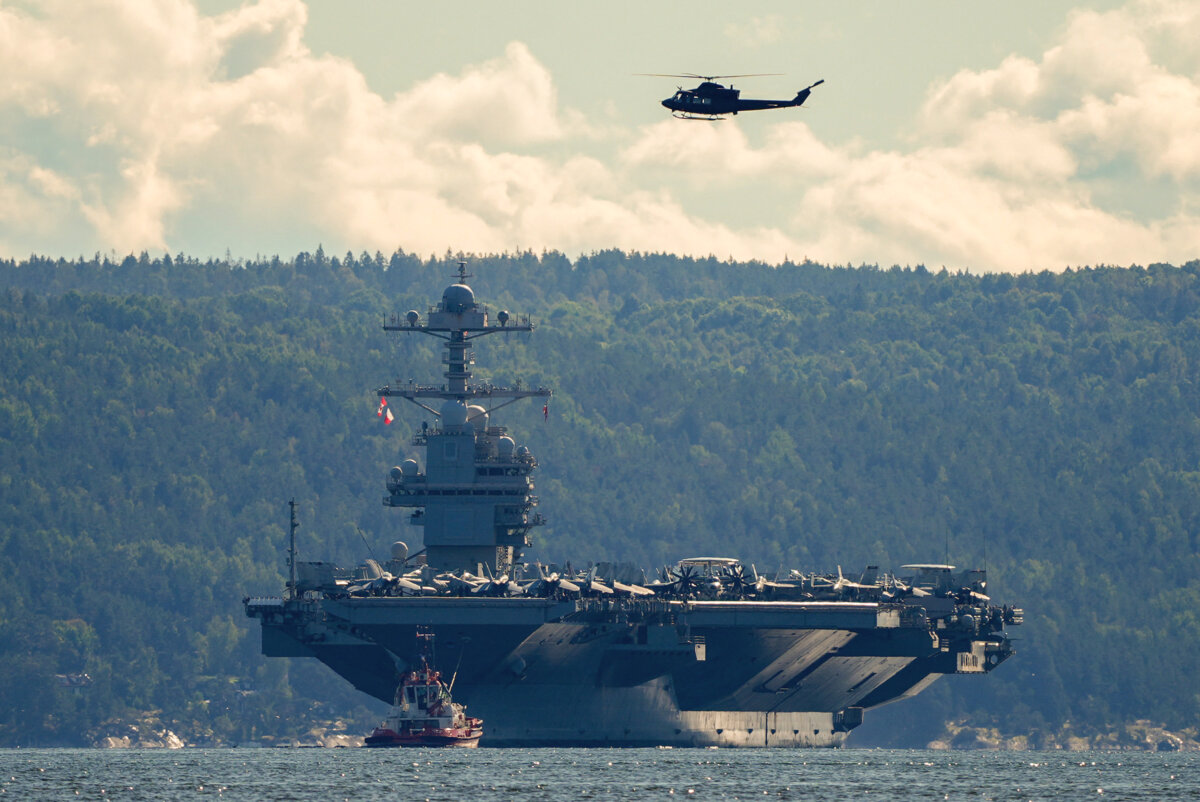
As Washington unveils a $65.8 billion naval rebuilding plan aimed at expanding the fleet from 291 to 450 vessels by 2031 and secures key defense pacts around global sea lanes, its strategy to contain China is running up against Beijing’s vast overland bypass network.
Here is an assessment of the geopolitical tug-of-war between American sea power and China’s continental counterstrategy.
US Maritime Strategy Based on Controlling Choke Points
Since World War II, U.S. maritime choke point strategy has aimed to secure freedom of navigation and ensure access through critical sea lanes and narrow waterways—such as the Straits of Hormuz and Malacca—to protect American and allied prosperity, supply chains, and military mobility while deterring adversaries, especially China’s efforts to control or disrupt these points.
The intellectual foundation is Alfred Thayer Mahan (1840–1914), whose 1890 work “The Influence of Sea Power upon History” remains highly influential. Mahan argued that national greatness rests on control of the seas, achieved by dominating the narrow passages through which commerce and naval forces must pass.
He held that commerce is the lifeblood of modern states, so whoever can protect or interrupt trade shapes national fates; that a concentrated, superior battle fleet is the essential instrument of global power; and that choke points are the decisive lever—a relatively small force at a strait or canal can threaten an adversary’s entire commerce and logistics.
The US Choke Point Strategy
The Trump administration’s 2025 National Security Strategy centers on great-power competition with China as the pacing threat, with control of maritime choke points forming a persistent, if sometimes unspoken, thread.
The U.S. maintains forward bases and access arrangements in Japan, Guam, the Philippines, Singapore, Diego Garcia, Bahrain, Djibouti, and the Mediterranean to keep forces near critical passages such as the Taiwan Strait, the Strait of Malacca, the Strait of Hormuz, and the Bab-el-Mandeb.
Taiwan is treated as the decisive theater: Its loss would let China dominate the First Island Chain, threaten Japanese sea lines of communication, and ease Chinese submarine access to the Pacific, which is why initiatives such as AUKUS—a defense pact among Australia, the UK, and the United States—are oriented toward that contingency.
Parallel efforts through the Quad—the United States, Japan, India, and Australia—and a new Major Defense Cooperation Partnership with Indonesia aim to share surveillance and denial capabilities around the Malacca Strait, through which the bulk of China’s oil imports must pass—the strategic vulnerability the United States seeks to keep under pressure.
Economic and commercial tools reinforce the same logic. The 2025 tariff regime, whatever its domestic costs, exploits the fact that Chinese manufacturing relies on global supply chains that themselves transit these maritime bottlenecks, treating economic and maritime coercion as complementary instruments.
At the same time, heightened scrutiny of Chinese investments in ports from Europe to the Indian Ocean reflects the recognition that commercial footholds could one day enable a Chinese navy to sustain forward presence near the world’s most vital choke points.
Execution of the U.S. choke point strategy involves a robust interdiction capability: the ability to threaten or physically close a strait to enemy shipping and warships, typically through naval forces, submarines, mines, and land-based missiles.
This boils down to choke-and-envelop: The full Mahanian logic is not just to hold one choke point, but to create a global network of overlapping choke point control so that an adversary has no viable maritime escape route. The U.S. alliance network is explicitly designed this way.
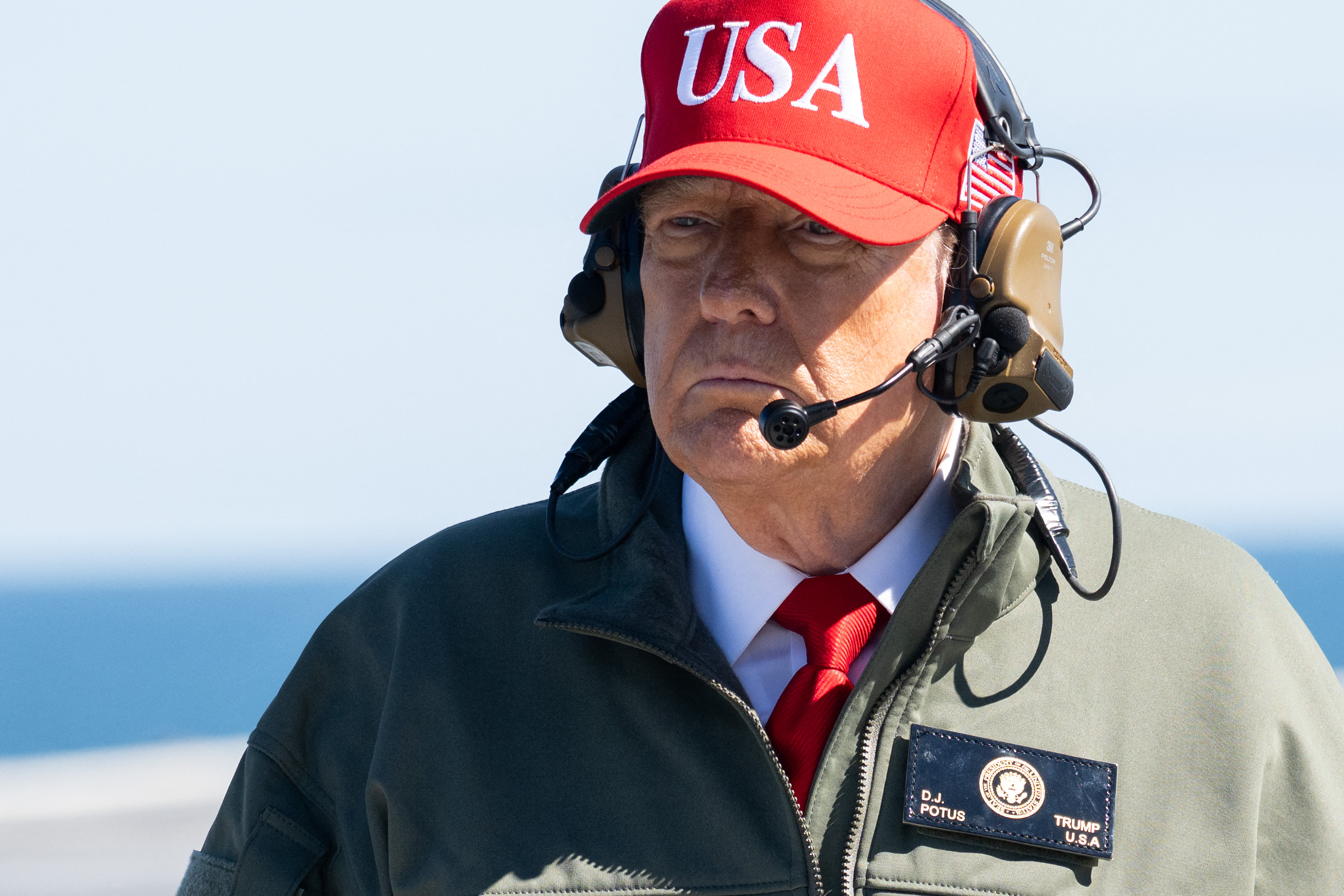 U.S. President Donald Trump visits the USS George H.W. Bush aircraft carrier, which is out at sea near Norfolk, Virginia, on Oct. 5, 2025. The visit is part of the U.S. Navy’s 250th anniversary celebration, “America’s Navy 250: Titans of the Sea—A Salute to the Fleet”. (Saul Loeb/AFP via Getty Images)
China’s Counter-Strategy
The Chinese regime, acutely aware of the Malacca dilemma—in which 75 to 80 percent of its oil imports transit the strait—has pursued a Mackinderian strategy to reduce dependence on sea lanes the U.S. can threaten.
Sir Halford Mackinder’s Heartland Theory held that control of Eurasia’s vast interior, unreachable by navies, offered the decisive strategic prize; any power that consolidated it would command resources and a defensible position that no maritime coalition could indefinitely contain.
Viewed through this lens, China’s Belt and Road Initiative functions as a choke point-bypass strategy: overland infrastructure that lessens reliance on maritime passages dominated by the outer crescent, including the United States.
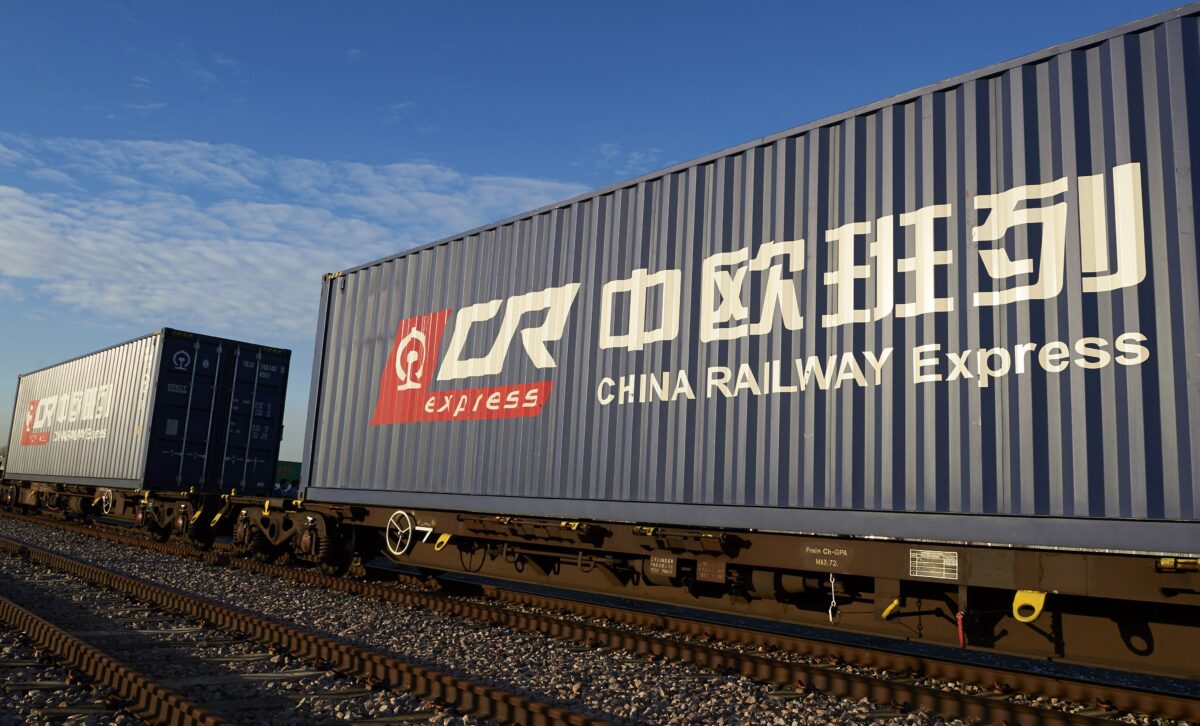 The logo of China Railway Express, a unit of China’s state-run China Railway Corporation, is pictured on the side of shipping containers at DB Cargo’s London Eurohub rail freight depot in Barking, East London, after the freight train arrived from Yiwu in Zhejiang Province, China, on Jan. 18, 2017. (Niklas Halle’n/AFP via Getty Images)
This is a grand scheme, but whether China can deliver on all its Belt and Road promises remains to be seen, as some nations are becoming wise to Beijing’s debt-trap diplomacy.
That said, China is not purely a land power; its navy has expanded faster than any other in history, fielding more hulls than the U.S. Navy and developing carriers, overseas bases, and long-range anti-ship missiles to raise the cost of American sea control near the First Island Chain.
China’s dual approach seeks economic arteries that run overland beyond U.S. interdiction, a navy that contests Western Pacific choke points, and leverage over states astride critical passages.
Concluding Thoughts
The U.S.–China competition is the first great power rivalry since the Cold War in which the challenger has a coherent dual strategy: a Mackinderian land bypass (Belt and Road) to reduce vulnerability to the sea power dominance the United States has built, paired with a rapidly growing naval capability designed to eventually contest the choke points themselves.
The Trump administration’s interest in Greenland (GIUK Gap), hostility toward Chinese port access in Panama, pressure on the Philippines to host more U.S. forces, the Major Defense Cooperation Partnership with Indonesia, and renewed focus on Taiwan reflect a coherent, if sometimes chaotically expressed, awareness that the United States’ strategic inheritance—the Mahanian network of choke point control—is under pressure for the first time since World War II.
Whether the U.S. response is sufficient remains to be seen, as U.S. shipbuilding capacity trails that of communist China, and the U.S. maritime choke point strategy is dead in the water if the ships needed to enforce it are not delivered quickly. Furthermore, trade and tariff disputes could be straining the very foreign alliances essential to this naval strategy. Foreign investment in U.S. shipbuilding capabilities could help address both concerns.
Views expressed in this article are the opinions of the author and do not necessarily reflect the views of The Epoch Times.
 Friends Read Free
Copy
Facebook
Tweet
Friends Read Free
Copy
Facebook
Tweet