
NASA has given the public a never-before-heard account of the Artemis II mission six months after its historic moon flight.
In an unprecedented move to share more than 800 gigabytes of lunar science data with the world, NASA has released 521 minutes of audio between the Artemis II crew and the lunar science team on the ground, recorded in real time as the Orion spacecraft flew around the moon.
This was the first time in NASA’s history that astronauts spoke directly to the lunar science team during a mission, and a rare moment when they spoke to anybody other than mission control’s designated Capsule Communicator (CapCom).
Those four astronauts—NASA’s Reid Wiseman, Victor Glover, and Christina Koch, along with Jeremy Hansen of the Canadian Space Agency—saw things no other human eyes have seen without the aid of robots and telescopes.
Kelsey Young, Artemis II’s lunar science lead, shared some clips of this audio at the 77th International Astronautical Congress in Antalya, Türkiye, on Oct. 7.
The first was Koch describing a feature on the moon called the Aristarchus Plateau and mentioning colors that cameras couldn’t pick up before. A color-stretched version of a picture of that plateau was made based on Koch’s descriptions and was included in the data.
The second clip was the crew’s reaction to seeing the sun’s rays pulsating from behind the moon during an eclipse, which Young said demonstrated the crew’s more human reactions. That clip opens with one crewmember saying, “This is the most ridiculous thing I’ve ever seen in my entire life.”
The third clip captures the crew’s excitement as they observe impact flashes on the lunar surface.
That audio is available on NASA’s website with nearly 12,000 high-resolution images taken by the astronauts, cameras mounted on the spacecraft’s exterior, complementary robotic missions like the Lunar Reconnaissance Orbiter, and annotated sketches.
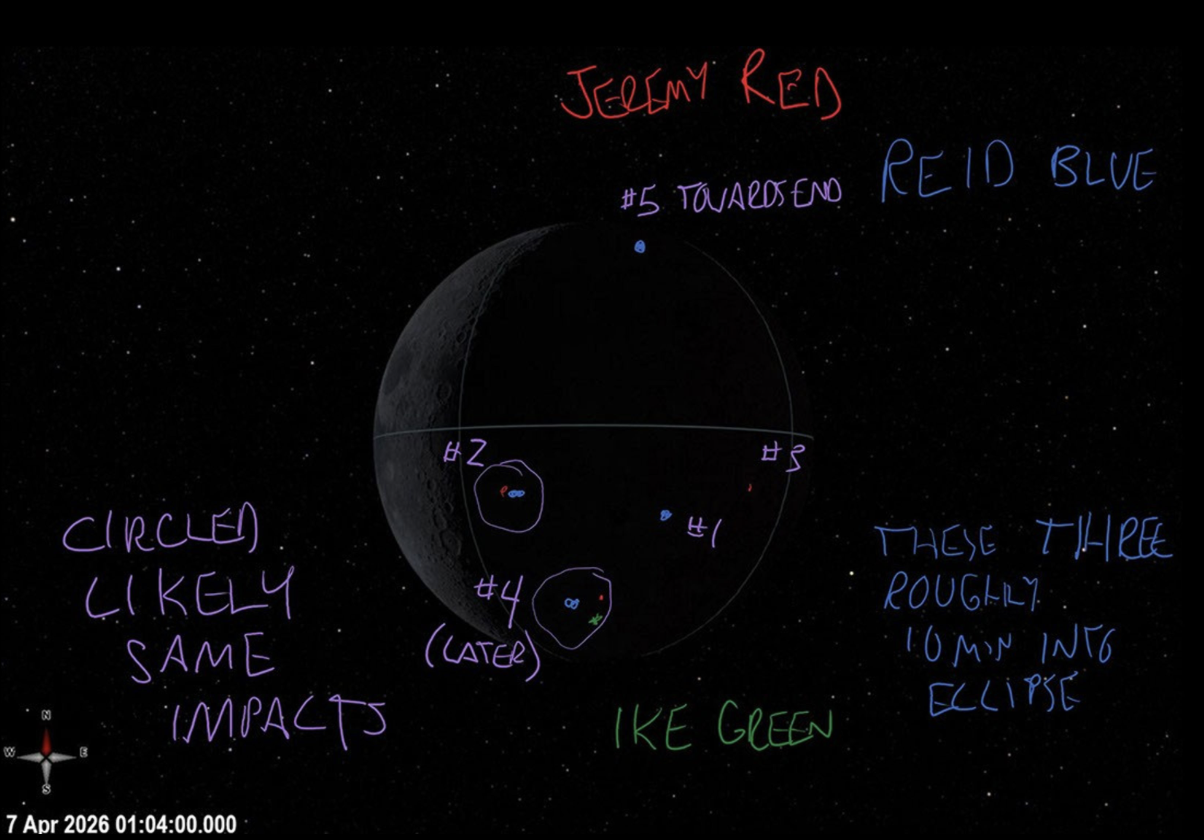 A screenshot of a crewmember’s iPad showing annotations during the flyby. This one marked impact flashes the astronauts observed in the early hours of April 7, 2026. (NASA/CSA).
“Reid, Victor, Christina, and Jeremy were the most powerful science instruments that we’ve ever flown,” she said. “They personified the craters, the Terminator, the impact flashes, and they whooped over that incredible eclipse.”
A Lunar Science Operations Report was also published, outlining how the lunar science team and astronauts pulled off the feat, revealing pre-mission and mid-mission structure and operations.
“Artemis II demonstrated in real time how science can successfully be integrated into human spaceflight to help inform science operations and exploration for future Artemis missions,” Fox said.
“This is especially true for training how future astronauts can use their eyes and their brain to make really quick decisions, especially in some very, very limited exploration time,” she said, adding that this could help in finding water resources.
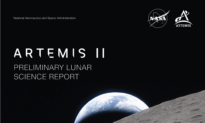
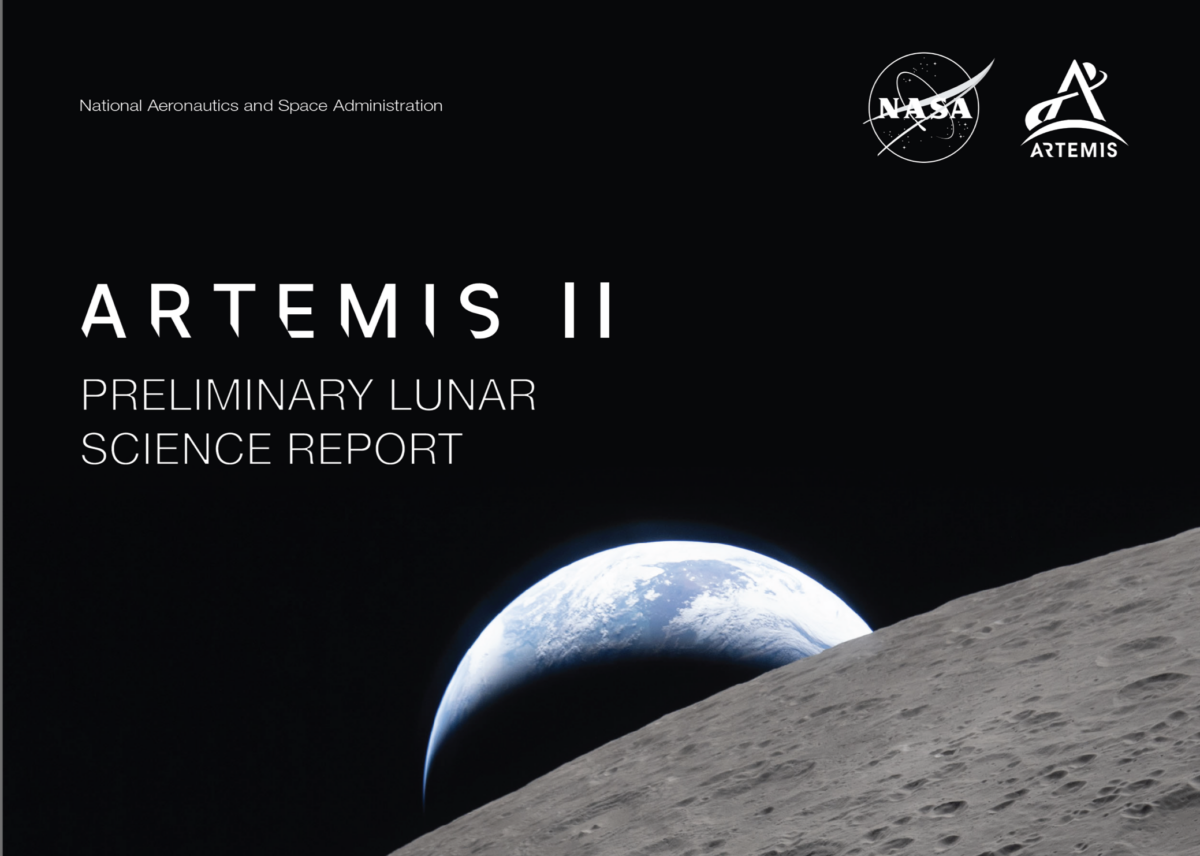
NASA released all of these data with a preliminary Lunar Science Report and a Lunar Science Data User Guide.
While their work has only just begun, NASA’s science leaders said they were ready to share their findings with the world.
“This represents our passing the torch to you—passing the baton to you, as we like to say in Artemis—to pick up where we left off,” Young said.
“We try to highlight the types of science we think can be done with these data. But honestly, I hope that you discover many, many more ways to use these exciting datasets.”
 Friends Read Free
Copy
Facebook
Tweet
Friends Read Free
Copy
Facebook
Tweet