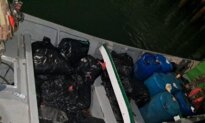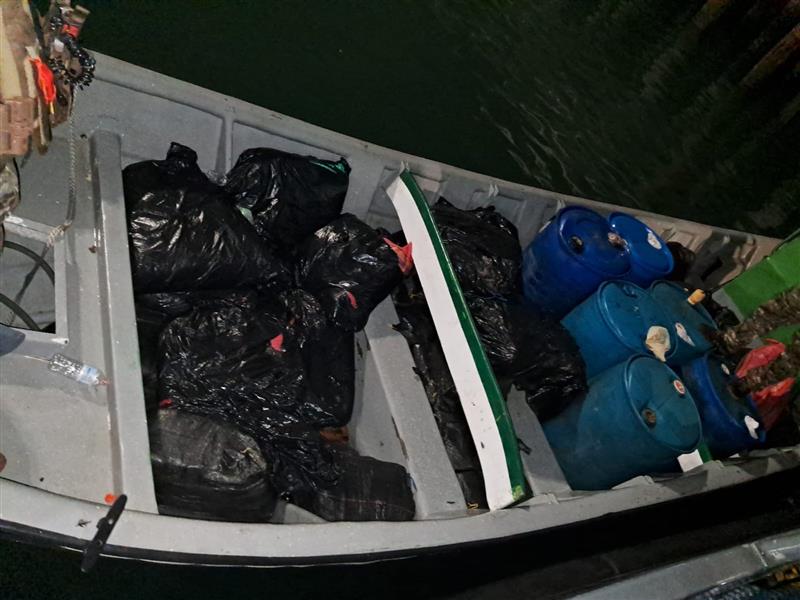

The United States and foreign partners stopped a go-fast vessel in the Eastern Pacific Ocean and seized 359 kilograms (roughly 792 pounds) of cocaine and 886 pounds of marijuana.
In addition, authorities apprehended two individuals, the Joint Interagency Task Force (JIATF) South said in an April 22 post on X. The vessel was seized by Panama’s National Aeronaval Service, which is responsible for conducting the country’s naval and air operations. U.S. Customs and Border Protection’s Air and Marine Operations and authorities from Colombia were also part of the operation.
“Together, we stop illicit drugs threatening our homes,” JIATF South said.
JIATF leverages the capabilities of its member nations to detect and monitor illicit drug traffic in maritime and air domains. The task force aims to interdict and seize drugs to disrupt the flow of illicit narcotics and degrade or dismantle transnational criminal organizations.
In an April 14 post on X, JIATF South announced another drug-busting operation that involved law enforcement from the Central American country of Belize intercepting a drug-laden aircraft, with the task force providing real-time intelligence. In total, 551 kilograms (around 1,215 pounds) of cocaine were seized.
In an April 7 X post, JIATF South said that more than two metric tons of cocaine being shipped via Eastern Pacific was intercepted in cooperation with the U.S. Coast Guard Cutter Escanaba, Homeland Security Investigations, and partners in Ecuador and Colombia.
“A Go-Fast vessel ditched its load, but our crews recovered 2,046 kg—keeping it off our streets,” the post said.
During a March 17 testimony at a House Committee on Armed Services hearing, Joseph M. Humire, performing the duties of the assistant secretary of war for homeland defense and Americas security affairs, explained how Washington was countering the drug menace facing the United States.
In March, 17 nations from the Western Hemisphere signed a joint security declaration to tackle the drug issue. U.S. President Donald Trump formally announced the joint effort at a summit on March 7, launching the Americas Counter-Cartel Coalition.
The coalition is “a combined military and law enforcement approach to deter, degrade, and ultimately destroy narcotics and terrorist-related threats in the hemisphere, including those that threaten the U.S. Homeland,” Humire said.
The official also detailed the success of Operation Southern Spear, which was launched last year by the Trump administration to restore robust deterrence against narco-terrorists.
As of March 10, authorities have carried out 45 kinetic strikes against narco-trafficking vessels, killing 157 members or affiliates of drug trafficking organizations and destroying 47 trafficking vessels, according to Humire.
A recent strike under Operation Southern Spear took place on April 19, with the U.S. military killing three people identified as drug traffickers.
An earlier strike on April 13 targeted a vessel transiting along known narco-trafficking routes in the Eastern Pacific and was suspected of engaging in drug trafficking operations. Two individuals were killed in the strike.
In 2024, there were 79,384 drug overdose deaths in the United States, according to data from the Centers for Disease Control and Prevention. Drug overdoses are one of the “leading causes of injury death in adults,” the agency states.
Criticism of Strikes
Human Rights Watch has criticized the U.S. strikes on drug vessels, calling them an “unlawful use of lethal force” in a March 31 statement.
“International law draws a clear line between armed conflict and law enforcement. There is no armed conflict in the Caribbean or Pacific between the U.S. and any drug-trafficking organization, and so there is no group of people who are a legitimate military target,” the organization said.
“The U.S. government should immediately end this campaign of lethal strikes. It should also ensure accountability for these unlawful killings, properly assess the harm caused to victims and their families, and provide redress for that harm.”
During a Dec. 2 press briefing, Pentagon press secretary Kingsley Wilson said that the vessel strikes are “lawful under both U.S. and international law, with all actions in compliance with the Law of Armed Conflict.”
In an October 2025 speech on the Senate floor, Sen. Jim Risch (R-Idaho) announced his support for drug boat strikes, arguing that it was a necessary measure to protect Americans from the influx of drugs.
“The facts of that are obviously well-known, well-reported. The people carrying those drugs were terrorists, plain and simple. They were trafficking drugs that finance a designated foreign terrorist organization,” Risch said.
“These strikes were fully compliant and fully justified under the president’s Article II constitutional authority, and not only authority but duty as commander in chief of our Armed Forces to defend this country, and he took an oath to do so.”
 Friends Read Free
Copy
Facebook
Tweet
Friends Read Free
Copy
Facebook
Tweet