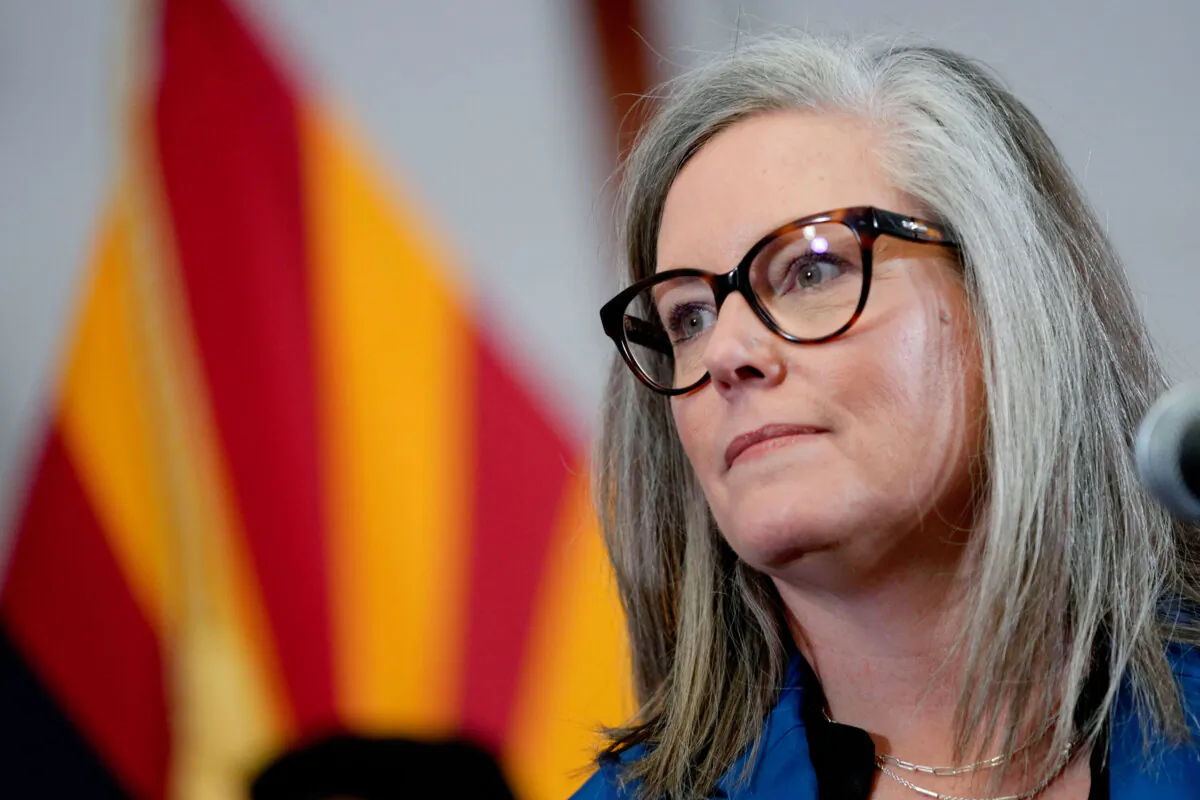

Arizona Gov. Katie Hobbs has vetoed legislation that would have required commercial pornography websites to verify the age and consent of individuals depicted in sexual material before publication.
Hobbs rejected HB2133, the Protect Act, on June 19.
The decision drew criticism from the bill’s sponsor, state Rep. Nick Kupper, a Republican, who said the measure was intended to prevent child pornography and nonconsensual sexual content from being posted online.
Only two Democrats voted in favor of the bill.
“Governor Hobbs and nearly every Democrat in the Legislature chose party politics over children and victims,” Kupper said in a June 22 statement.
“The Protect Act required commercial porn sites to verify two basic facts before publishing sexual material: everyone shown was an adult, and everyone consented. Apparently, that was too much to ask.”
Kupper said existing laws typically address harmful content only after it has already been published and widely distributed.
“My bill would have stopped unverified material before it went online and spread beyond a victim’s control. Hobbs can hide behind a free-speech excuse, but the bill expressly protected satire, comedy, art, news, and political criticism.”
Under HB2133, commercial websites publishing sexual material would have been required to verify that every person depicted was at least 18 years old.
They also would have had to confirm that each person explicitly consented to the material’s creation, distribution, and publication.
The bill also would have required websites to maintain verification records. Operators would have been required to take reasonable steps to prevent unverified uploads.
Violators could have faced civil penalties of $10,000 per day, and fines could have reached $250,000 if the material involved a minor.
The legislation also would have authorized civil lawsuits by victims and the Arizona attorney general.
In her veto letter to state House Speaker Steve Montenegro, Hobbs said the legislation could have a “chilling effect” on free speech. She also argued that federal and Arizona laws already address artificial intelligence-generated sexual imagery, including so-called revenge porn.
Hobbs noted that Kupper stated during a committee hearing that the bill’s intent was to require an elected official’s consent before they are “satirized on a show like South Park.”
The governor said her office sought changes that would strengthen protections for victims. She said those changes would have avoided limiting political speech.
“Although the sponsor rebuffed those efforts in favor of a partisan approach that attempts to make political satire illegal, I remain committed to finding real bipartisan solutions to protecting Arizonans.”
Kupper disputed that characterization. He said consent is “not optional” and that protecting children “shouldn’t be partisan.”
He said the current law often leaves victims seeking the removal of harmful content only after it has been posted online.
By then, he said, the material may have been downloaded, copied, and reposted across multiple platforms.
Kupper also noted that Meta, Google, and the Free Speech Coalition did not oppose the final version of the legislation.
He pledged to reintroduce the Protect Act after the 2026 midterm elections.
 Friends Read Free
Copy
Facebook
Tweet
Friends Read Free
Copy
Facebook
Tweet