
LOS ANGELES—After two weeks of evidence and more than three dozen witnesses, attorneys in a federal trial accusing Jonathan Rinderknecht of setting a blaze in the Santa Monica Mountains that would, days later, lead to the catastrophic Palisades Fire, on Tuesday offered their final pleas to a jury.
“On Jan. 1, 2025, the defendant started a fire on a hill In the Pacific Palisades. After months of stewing in frustration and resentment toward the rich and powerful, he was angry—all the time,” Assistant U.S. Attorney Danbee Kim told the jury.
“He believed he was enslaved by the wealthy, and couldn’t understand how he, someone he self-identified as a genius, could be so alone and powerless,” Kim said of the 29-year-old Uber driver.
Seeking release from those escalating fixations, she said, Rinderknecht climbed a hiking trail he’d traversed often, to a lookout point just above the wealthy neighborhood where he had once lived a better life.
“Of course he was aware of the destructive consequences of a wildfire. He just didn’t care. Or,” she ventured, “he was interested in it. It was part of the thrill.”
Rinderknecht faces three counts of arson related to destruction of federal property in the Palisades Fire, which investigators say was a “holdover” or continuation of the Lachman Fire, a smaller blaze they claim he ignited in the early hours of Jan. 1, 2025.
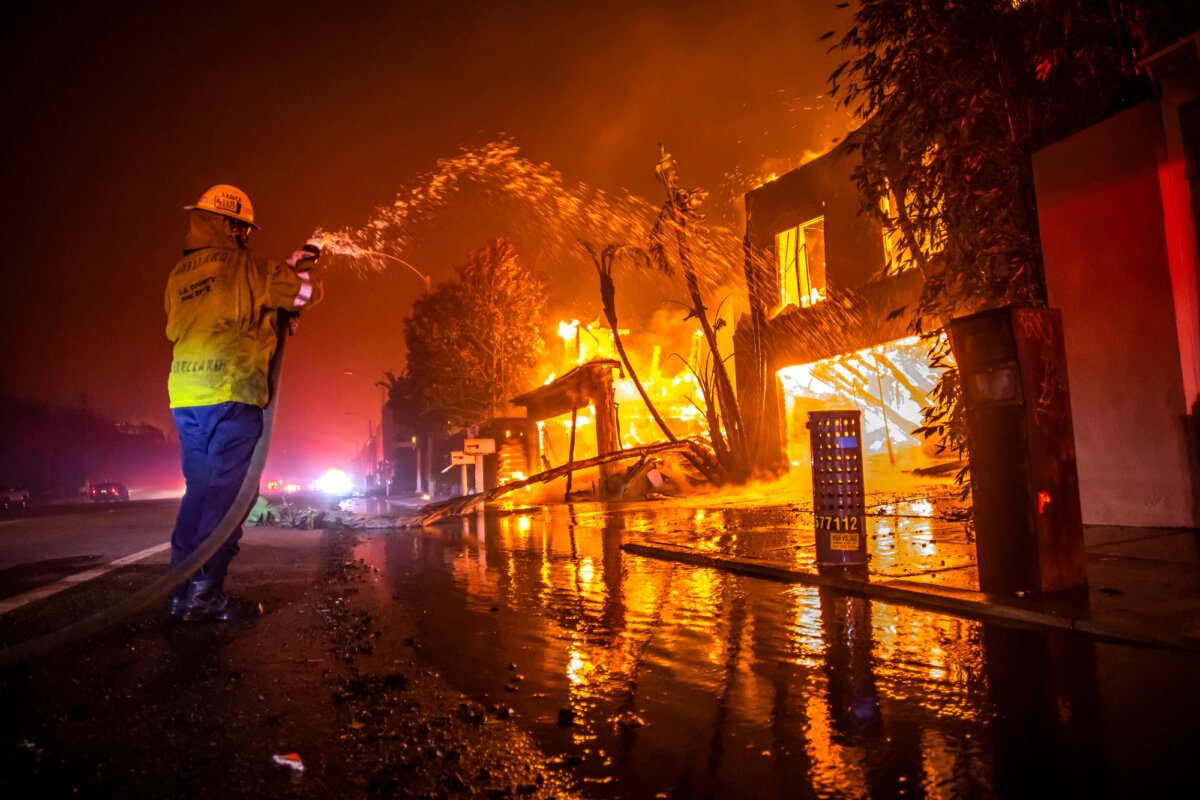
That fire, investigators say, smoldered underground for a week until emerging, through a single shrub, before hurricane-force Santa Ana winds picked it up on Jan. 7 and drove it through the surrounding canyons, killing 12 and razing more than 6,000 homes in the wealthy coastal enclave of Pacific Palisades.
Rinderknecht has pleaded not guilty, and his attorneys argue prosecutors have presented a case heavy with motive and light on the reliable evidence needed to prove guilt beyond a reasonable doubt.
“Most investigations begin with a crime, then follow the evidence to a suspect,” Steve Haney, attorney for Rinderknecht, told the jury Tuesday. “This investigation moved … in an opposite direction. It began with a man who called 911 on a hill. Then over time the theories changed to fit him. But the evidence never did.“
Haney pointed to testimony from multiple witnesses who testified that the fire scene was disrupted or contaminated in the 12 days between when the Lachman Fire was observed and when investigators arrived on scene Jan. 13–by weather, fire suppression, public access, and the second fire that tore through on Jan. 7.
“Can you convict a man based on a crime scene that was destroyed—stripped of all evidence, evidence that can prove his innocence?” Haney asked.
Jurors are left to contend with competing narratives. In one, Rinderknecht is an angry, socially isolated young man whose escalating emotional instability drove him to set fire to a place that symbolized an abstracted villain—the “rich and powerful.”
In the other, he is a convenient scapegoat, trapped in a biased and corrupted investigation that is desperately trying to pin the catastrophe on someone.
“When the government can’t prove what a man did, they go to work on who he is,” Haney said. “They get to work on him so you don’t like him.”
Being mad at the rich is not a crime, he added. “Half of America hates the rich. Ugly thoughts can’t be prosecuted.”
The government’s case, he said, “is backwards and biased by design,” aimed at a “convenient scapegoat: The lone Uber driver on a hill.”
At the heart of the government’s case is a technical investigation that eliminates other potential causes of the fire–and a cache of evidence it says proves Rinderknecht was motivated by a desire for revenge on society.
Prosecutors argue Rinderknecht’s anger and frustration “festered,” fed by social isolation and compulsive use of ChatGPT.
Investigators in the case testified about more than 8,000 interactions with the AI chatbot, including dozens of prompts about dystopian tableaus in which forest fires consume the earth while its rich and powerful enjoy themselves in comfort.
Uber passengers who rode with Rinderknecht around the time of the fire testified about his vitriolic, threatening rants and erratic behavior.
“It was in this headspace,” Kim said, “when on [New Year’s Eve he] didn’t have any plans, and was rejected by multiple people in his life and was ignored. He went up a hill … in a neighborhood he associated in his personal history with wealth and rejection.”
Fire investigation experts for the defense earlier in the week testified that the government’s focus on motive and behavioral analysis underscoring that narrative had gotten ahead of forensic evidence in the case, and amounted to little more than “background noise.”
Haney suggested a contradiction at the heart of prosecutors’ case was the idea that Rinderknecht was somehow both a mastermind who covered his own tracks and lied to investigators about his whereabouts—and then sabotaged himself by repeatedly calling 911 to report the fire shortly after it allegedly began.
Witnesses, including local residents, a firefighter stationed a few miles away, and security guard on patrol in the neighborhood, told the jury they heard fireworks coming from the area shortly before the Lachman Fire was reported.
“Each one was describing the government’s initial theory in this case—fireworks,” Haney said, referring to an early hypothesis noted in search warrants by investigators.
“The fact that someone did not see the fireworks did not erase what they heard,” he said.
U.S. Attorney Mark Williams argued investigators had rightly eliminated fireworks as a potential cause because they weren’t seen on surveillance cameras or by eye-witnesses that night—including the defendant, who repeatedly told investigators he saw neither fireworks nor other people when he was in the clearing that night.
Investigators from the Bureau of Alcohol, Tobacco, Firearms, and Explosives also ruled out other potential causes such as lightning, campfires, utility lines, or cigarettes.
“When you look at the data, you’ll see the only person on the hill that night was the defendant, down in the gulley,” Williams said, referring to a spot just south of the clearing where investigators believe Rinderknecht lit the fire with a Bic lighter.
“The only reason he would be down there is to light this fire,” Williams said.
Expert witnesses for the defense earlier in the week criticized the government’s determination of cause and origin, alleging its investigation was corrupted by confirmation bias and a compromised scene; they also suggested the fire could have started days or weeks before Rinderknecht arrived in the area.
Despite “isolated fragments dressed up as proof” and cherrypicked to make the defendant look bad, Haney said, major holes in the case remained—including missing cellular geolocation data that could have identified other suspects, time lapses in video surveillance, and a crime scene that had gone unprotected for nearly two weeks before investigators began searching it for clues about where and how the fire started.
“This is a case about arson and the government put on no evidence of when the fire started,” Haney said. “There were no photographs, no witnesses, no video. No evidence at all that we know when the fire started.”
During the government’s rebuttal, Williams responded, “No video? Of course not. He didn’t take a selfie of himself lighting a bush on fire. That’s not what criminals do.”
Uncertainty, Haney told the jury, “is not a technicality.”
“Everyone is guessing. A man is on trial, and we don’t know when the fire started? Does that give you a doubt? And is it a reasonable one?”
The jury will begin deliberations Wednesday morning at 8 a.m.
If convicted, Rinderknecht faces up to 45 years in prison.
 Friends Read Free
Copy
Facebook
Tweet
Friends Read Free
Copy
Facebook
Tweet