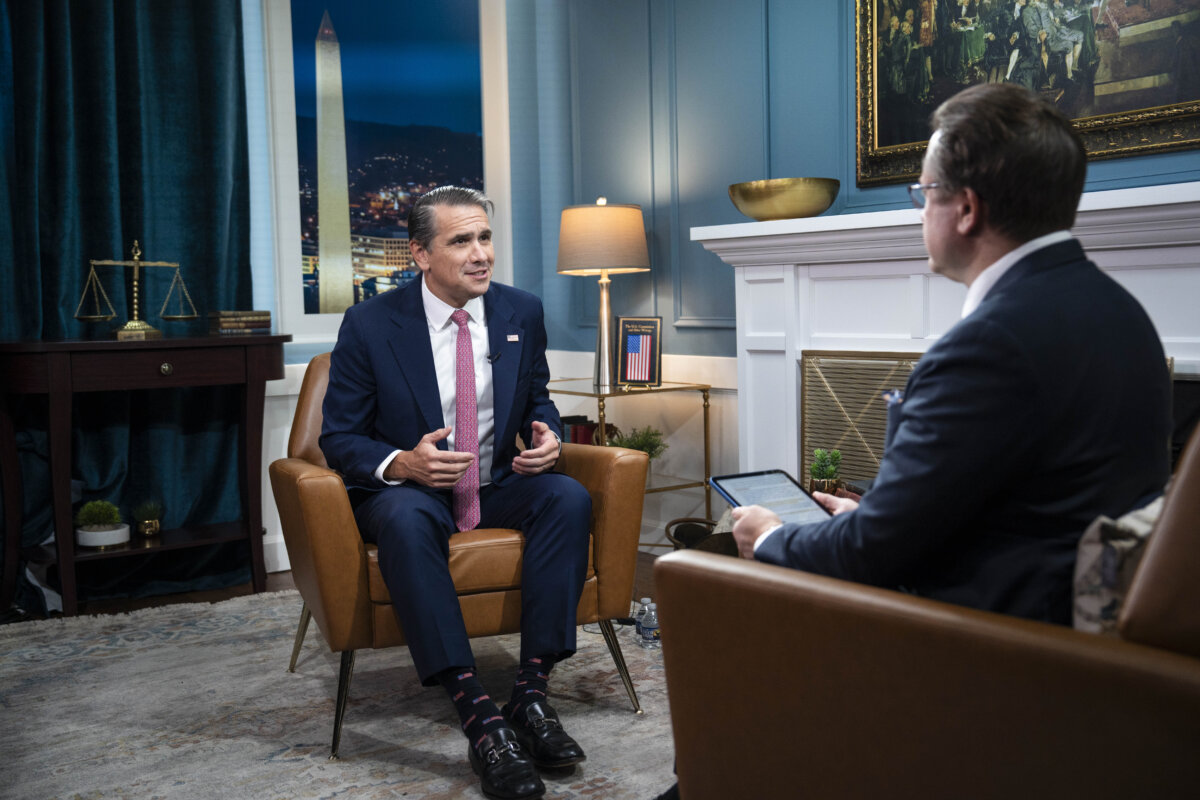

Attorney General Todd Blanche said that the Department of Justice will be monitoring the upcoming midterm elections closely—as it has since the 1960s—but pushed back on allegations that armed federal agents would be present to intimidate voters and seize uncounted ballots.
That idea “comes from a certain pocket of mostly people on the left trying to scare Americans,” Blanche told The Epoch Times’ Jan Jekielek in an interview airing at 9 p.m. ET on Oct. 6.
“Every single election is monitored by DOJ, and we’re not monitoring Republicans. We’re not monitoring Democrats. We’re monitoring elections in every state, and what do we do? We’re there to make sure that federal law is followed.”
Assistant Attorney General Harmeet Dhillon said in September that the DOJ plans to send 1,000 election monitors to select locations around the United States, marking “the largest monitoring effort” in the Justice Department’s history.
What is the DOJ watching out for? Blanche said the biggest vulnerability in U.S. elections is obvious.
“It’s making sure that the only people voting are eligible to vote, and that we have assurance that that’s happening.”
The DOJ recently indicted nearly 100 people as part of a broader effort to weed out noncitizen voting, and Blanche pointed out that the arrests have been made across 15 states, so it isn’t an isolated problem.
Blanche also pushed back on criticisms that the limited number of indictments indicates it isn’t a real problem.
“Just think about the rationale there,” he said, pointing to a report by New Jersey Gov. Mikie Sherill that found 6,600 noncitizens were registered to vote in her state. Less than 400 of those individuals voted illegally, an investigation found.
Sherrill said the registration came from a software error within the New Jersey Motor Vehicle System, but the company that makes the software told The Epoch Times that the individuals in question answered “Yes” when asked if they wanted to register to vote.
“At some point, even the critics have to say, ‘Okay,’” Blanche said.
“For months and months, it was ‘There’s no proof there’s anybody voting illegally,’ and then it was ‘Well, okay, there’s a little bit of proof,’ and then we keep on coming up with more and more examples of it happening,” he added.
“At some point, the critics have to accept the fact that we have a problem, that we have to fix it. … It’s not a hard fix.”
A simple voter ID law would go a long way toward solving the problem, he said, and would give the DOJ and the Department of Homeland Security “a lot less to investigate” since there would at least be a minimum protocol to check that a voter is eligible.
“That’s pretty basic,” he said.
President Donald Trump has been pushing Congress to pass the SAVE Act, which would make voter ID mandatory. The legislation passed the House in July as part of a broader funding package, but hasn’t made it through the Senate.
Meanwhile, some plaintiffs have argued that the federal law against noncitizen voting is unconstitutional. On Oct. 2, a federal judge in Florida tossed out a case against a Jamaican woman who voted illegally, ruling that “Congress has no power to say who can vote or who cannot vote in federal elections—that foundational power is reserved for the States, and limits Congress.”
Whatever the outcome of this year’s hotly contested midterms, Blanche said his department is expecting legal pushback; that’s nothing new, he said.
“There hasn’t been an election since at least the ’60s where some lawsuit hasn’t been filed in some jurisdiction. Whether it’s a polling place closes early, whether it didn’t have enough workers there. … That’s okay. That’s democracy. That’s what we’re there for.”
 Friends Read Free
Copy
Facebook
Tweet
Friends Read Free
Copy
Facebook
Tweet