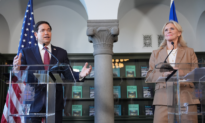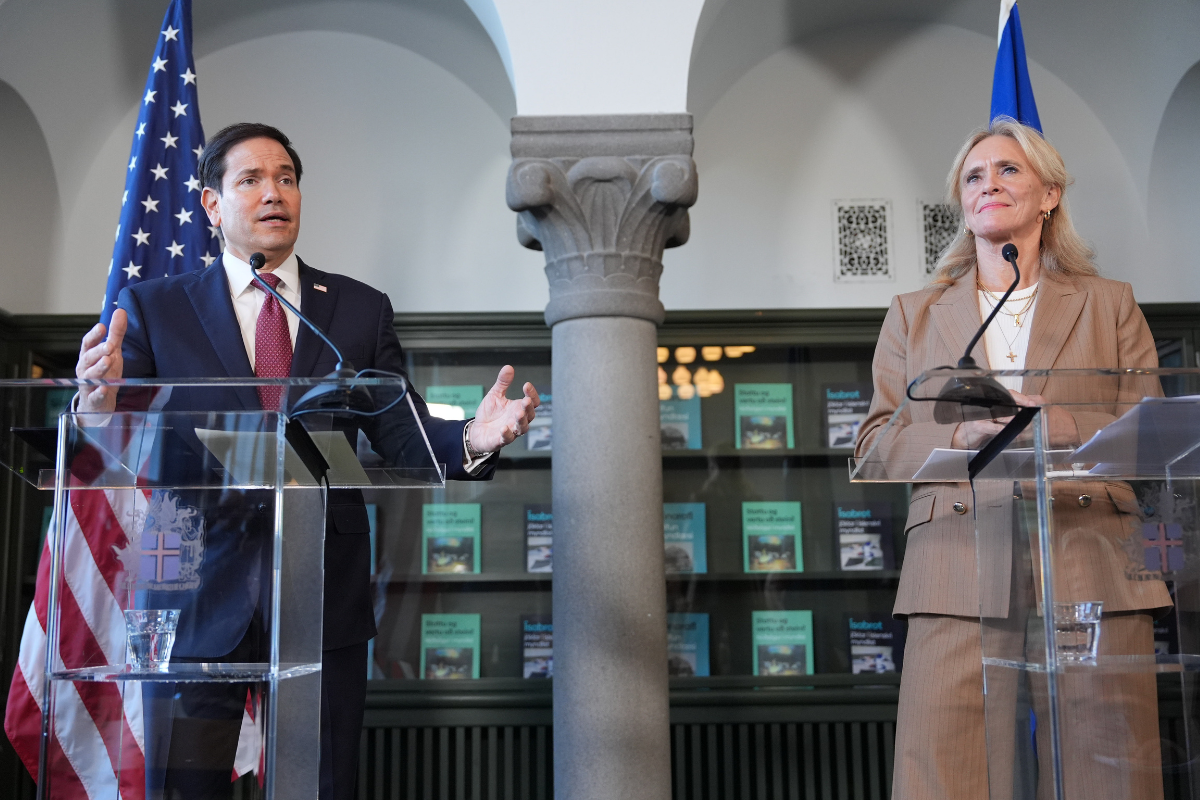

Iceland is a key ally for regional security, Secretary of State Marco Rubio said at the beginning of a multination tour of NATO allies that also includes Greece and Portugal.
Speaking alongside his Icelandic counterpart, Thorgerdur Katrin Gunnarsdottir, in Reykjavik on Tuesday, Rubio said that while the world’s focus had drifted in the past 20 years, geography remains important.
“Iceland has occupied a critical strategic position for our collective security, and that remains true today more than ever before,” Rubio said.
He said that Iceland’s strategic position between the United States, Europe, and the High North means that it sits at the center of questions around shared defense and security.
“Which is why this focus on the Arctic in general—Iceland in particular—is so critical,” he said.
Iceland is a founding member of NATO but has no standing army and relies on the alliance and a bilateral defense agreement—the 1951 U.S.–Iceland Defense Agreement—for security.
Rubio acknowledged that while Iceland does not have its own army, it has been open to NATO forces coming to the island and operating within its territory.
“We want to continue to build upon that as a way to prevent conflict—not as a way to encourage conflict or provoke conflict, but prevent it,” he said.
Rubio added that this year marks the 75th anniversary of the bilateral U.S.–Iceland Defense Agreement.
“I’m proud to say that our military and our Icelandic partners continue to work together to secure this land and the waters that surround it,” he said.
Visits to Greece, Portugal
Rubio also met with Icelandic Prime Minister Kristrun Frostadottir on Oct. 6, writing in a post on X that they discussed the United States and Iceland’s security partnership.
“We talked about new opportunities for energy and economic collaboration both areas where our two countries can continue to build a strong and prosperous future together,” the secretary of state wrote.
Reykjavik is the first leg of Rubio’s limited tour of NATO allies, taking place Oct. 5–8, which also covers Greece and Portugal.
Outlining the schedule of the tour last week, the U.S. Department of State said that after Iceland, the secretary of state will travel to Greece, where he and partners in Athens will discuss further defense cooperation, as well as regional and energy security.
Rubio will then travel to Lisbon, Portugal, to meet with officials to discuss defense, economic, and technology cooperation, the Oct. 1 statement said.
In remarks to reporters on Monday before departing Washington, Rubio described Iceland as “a good friend of the United States.”
“In the case of Portugal, they’ve been a strong ally, again, and we have an opportunity to go there and visit with them,” Rubio said. “And of course Greece is a very important U.S. ally. It’s a place that we have not just a military presence but strong economic ties, so it’s an opportunity to go there and see them.”
Arctic Security
Arctic security has become a focus of security concerns in recent months for the Trump administration, particularly the Danish territory of Greenland.
U.S. President Donald Trump had previously said he wanted to annex Greenland, calling it essential to securing the region.
NATO has been placing greater emphasis on demonstrating its presence and defensive capabilities in the Arctic region in response to Trump’s security concerns and his push to acquire Greenland.
Earlier this year, NATO launched the Arctic Sentry military command, amid growing concerns about potential security threats in the Arctic and High North posed by regional adversaries—specifically China and Russia. The military command allows NATO allies to complete drills to improve their ability to work together in tough Arctic conditions.
Then on Sept. 22, Trump signed a national security agreement with Danish Prime Minister Mette Frederiksen and Greenlandic Prime Minister Jens-Frederik Nielsen at the U.N. General Assembly in New York City.
It allows the United States to expand its military presence and control security for the key Arctic territory. Trump announced during his address to the General Assembly that the United States will build two major military bases on the island, with one being in the south and the other on the eastern coast.
Currently, U.S. military forces are stationed at Pituffik Space Base in northwest Greenland. At the height of the Cold War, the United States maintained 17 installations and had more than 10,000 personnel stationed there.
“No U.S. adversary will ever be permitted to establish a military presence in Greenland anymore, or make sensitive investments there without our express written approval,” Trump said during his address.
 Friends Read Free
Copy
Facebook
Tweet
Friends Read Free
Copy
Facebook
Tweet