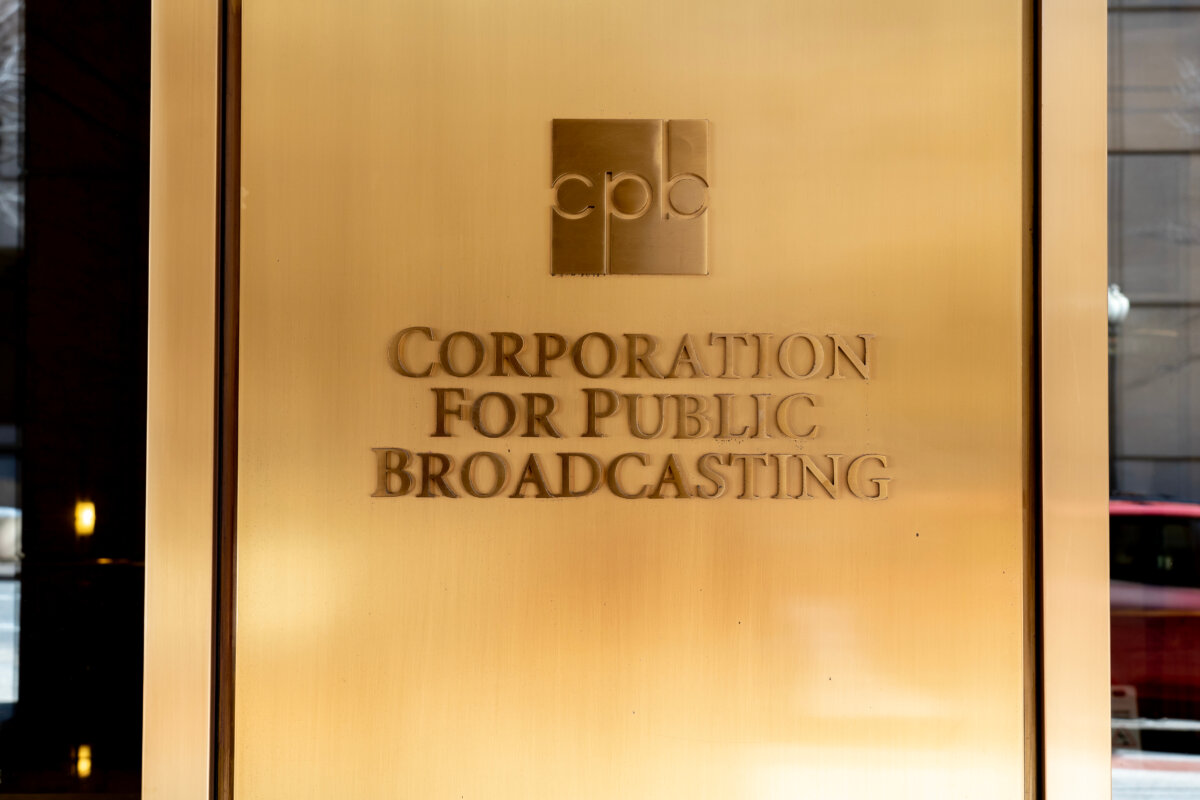

The Corporation for Public Broadcasting (CPB) announced on Aug. 1 that it is closing operations as a result of losing taxpayer dollars.
This comes a week after President Donald Trump signed a $9 billion rescissions package that included a $1.1 billion cut to the nonprofit entity.
Additionally, Senate appropriators declined to make funding available to the broadcasting corporation, which was authorized by Congress in 1967.
“Despite the extraordinary efforts of millions of Americans who called, wrote, and petitioned Congress to preserve federal funding for CPB, we now face the difficult reality of closing our operations,” CPB President and CEO Patricia Harrison said in a statement.
“CPB remains committed to fulfilling its fiduciary responsibilities and supporting our partners through this transition with transparency and care.”
Most positions in the organization will be cut on Sept. 30, which is the end of the federal fiscal year. A transition team will be on board until January 2026 to wind down operations such as paying financial obligations.
CPB has supported more than 1,500 public television and radio outlets in the United States, and it is the “largest single source of funding for research, technology, and program development for public radio, television, and related online services,” according to its website.
Until the rescissions legislation became law, the nonprofit corporation funded National Public Radio (NPR) and the Public Broadcasting Service (PBS), both of which have come under fire from Republicans and conservatives for what they say is liberal bias.
Fifteen percent of PBS’s funding came from the federal government, while less than 2 percent of NPR’s funding came from the government.
In May, Trump signed an executive order to end funding for CPB, stating that it has no right to government funding and that it is biased.
“Unlike in 1967, when the CPB was established, today the media landscape is filled with abundant, diverse, and innovative news options,” the executive order reads. “Government funding of news media in this environment is not only outdated and unnecessary but corrosive to the appearance of journalistic independence.”
Along with the CPB, NPR and PBS stations may also have to close because of a lack of federal funding.
“There’s much talk about news deserts in the country because of the lack of news organizations,” Joel Kaplan, director of the Goldring Arts, Style, and Culture Journalism Program at Syracuse University, told The Epoch Times in July. “Public broadcasting made up for that in many rural areas.”
In a statement, NPR President and CEO Katherine Maher said the defunding is “an unwarranted dismantling of beloved local civic institutions, and an act of Congress that disregards the public will.”
“Public funding has enabled the flourishing of a uniquely American system of unparalleled cultural, informational, and educational programming, and ensured access to vital emergency alerting and reporting in times of crisis—all for about $1.60 per American, every year,” she said. “Parents and children, senior citizens and students, tribal and rural communities—all will bear the harm of this vote.”
In a July 17 statement, PBS said: “These cuts will significantly impact all of our stations, but will be especially devastating to smaller stations and those serving large rural areas. Many of our stations, which provide access to free, unique local programming and emergency alerts, will now be forced to make hard decisions in the weeks and months ahead.”
 Friends Read Free
Copy
Facebook
Tweet
Friends Read Free
Copy
Facebook
Tweet