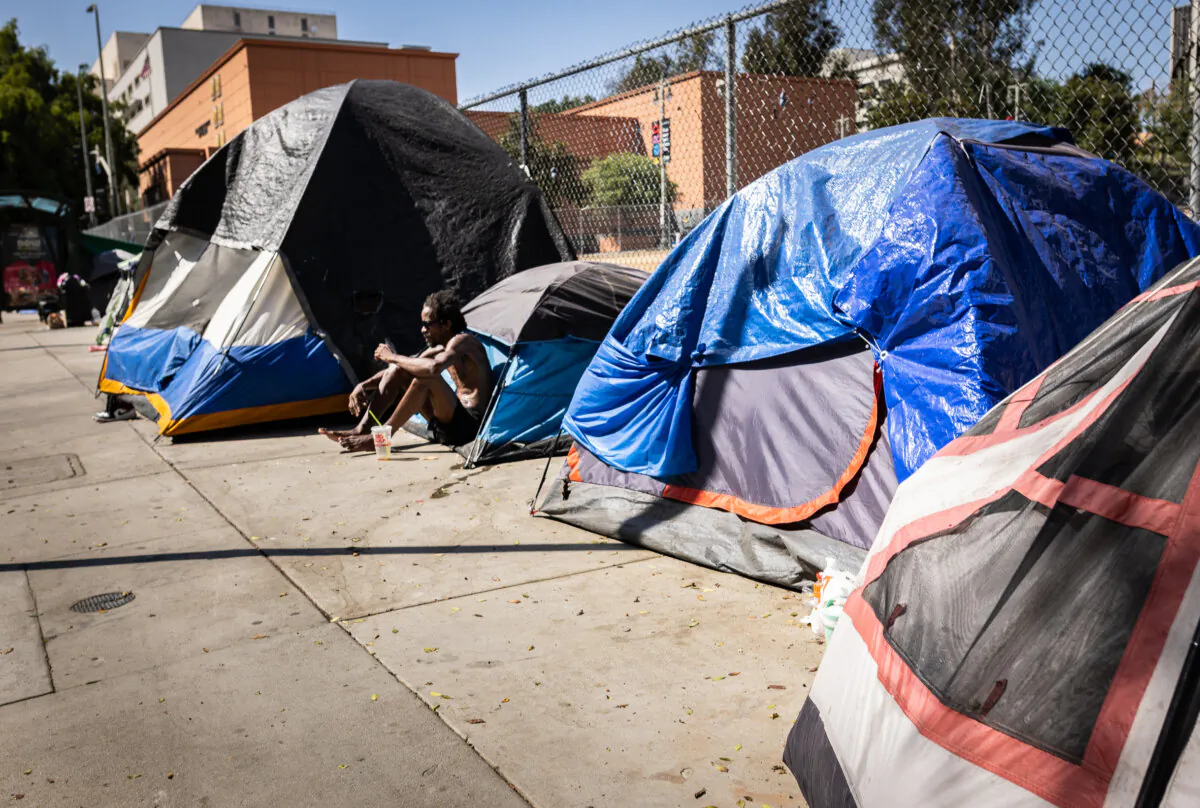

A federal judge has temporarily blocked the U.S. Department of Housing and Urban Development (HUD) from ending federal funding for Los Angeles’s homeless services programs, instructing all parties to meet in court for a status conference on Oct. 27.
The court’s preliminary injunction, which will be valid until late October, has ordered HUD to distribute around $241 million that Congress had earmarked for Los Angeles, preserve Los Angeles as a collaborative applicant, sign previously approved agreements, and adhere to grant funding distribution timelines set by Congress.
HUD announced last month that it was suspending federal grant funding following investigations into alleged fraud at the Los Angeles Homeless Services Authority (LAHSA).
LAHSA, meanwhile, is being ordered by the court to evaluate applicants seeking to work with the city on homeless services. The court also called for more transparency and accountability in how funding is used.
“LAHSA may be dysfunctional. But thousands of unhoused individuals rely on these services,” U.S. District Judge David Carter said in his Aug. 13 preliminary injunction ruling.
Tom Wolf, a recovery advocate and senior fellow at the Discovery Institute who has personally experienced living on the streets due to a previous drug addiction, told The Epoch Times that he believes HUD made the correct call by attempting to withhold funding.
“It put LAHSA … on notice that the federal government is watching how they spend their money very closely,” said Wolf. “HUD wants to have just better outcomes, but they want to see the data behind how many people are getting houses.”
According to the court document, auditors found that LAHSA was unable to provide documentation to verify around 2,300 housing sites under its responsibility, and that LAHSA failed to secure repayment agreements for $51 million in cash advances. The LA City Controller has also criticized the agency for having poorly defined goals and uncoordinated data collection, according to the document.
The court found that public criticism of LAHSA’s operations is “well-publicized and date[s] back decades,” but HUD failed to investigate the claims before the 2026 funding application process began.
“There is no reason that HUD could not have initiated its investigation and the concomitant suspension of LAHSA at the beginning of this year—or at the beginning of the funding cycle next year—and given Los Angeles time to transition,” said Carter.
The judge added that Congress had already approved the federal funding, and HUD’s decision to withhold the money would “circumvent the will of Congress.”
HUD said in its Aug. 11 press release that LAHSA had “received over $1 billion taxpayer dollars since 2013 despite its record of mismanagement, fraud, and abuse.”
After HUD withdrew funding, LAHSA sued, calling HUD’s move an “abrupt, illegal suspension.” In response to the court ruling, Stephanie Graves, the new chair of the LAHSA Commission, said she plans to comply with the judge’s orders.
“The court has called for transparency and accountability, and we intend to deliver both,” Graves said in a press release. “Every dollar will be tracked, accounted for, and put to work housing our neighbors.”
HUD, however, said it plans to continue the legal battle.
“The Trump administration will not back down from doing what is RIGHT and I will be working with [the Justice Department] to fight this legally,” HUD Secretary Scott Turner wrote on X.
Turner said Los Angeles receives the highest amount of federal funding out of all jurisdictions, but continues to see high counts of homeless people due to drug addiction.
The 2026 Los Angeles homeless point-in-time count found a 1.2 percent increase in homelessness countywide and a 3.4 percent increase in the city of Los Angeles. LAHSA said these percentages are not statistically significant and attributed them to decreases in the number of people moving into permanent housing.
The city plans to allocate around $788 million for homelessness services, including maintaining current homeless housing beds, according to the 2026–2027 budget.
Wolf said he believes the solution is not simply to provide low-barrier housing, but rather to address the mental health and drug addiction factors keeping people on the streets.
San Francisco Focuses on Recovery
Wolf said Los Angeles could learn from the reforms that San Francisco is implementing under Mayor Daniel Lurie.
“San Francisco is an example of a blue city, a Democratic left-leaning city, pivoting away from this permissive model of housing the homeless to something that’s more structured, with accountability,” he said. “We should be encouraging other cities like Seattle, Washington; Portland, Oregon; and Los Angeles to look at San Francisco as an example and follow their lead.”
Earlier this year, San Francisco revealed plans for drug-free permanent housing that focuses on a recovery-first approach. Such housing will include individualized service plans, relapse-prevention and intervention planning, and on-site recovery programs, among other services.
Wolf said Lurie consulted him in the past on the “best way forward” for addressing homelessness, and the city has since implemented over 500 drug-free housing units.
San Francisco plans to allocate around $760 million of its 2026–2027 budget for homelessness services. Plans include setting up 630 new interim housing beds as part of the mayor’s “Breaking the Cycle” plan.
A civil grand jury found that, between June 2024 and July 2025, around 26 percent of overdose deaths in the city occurred in low-barrier housing for the homeless.
Around 75 percent of the unsheltered homeless population surveyed by the California Policy Lab reported drug addiction, and 78 percent reported struggles with mental health.
Lurie said in a July press release that the goal with drug-free housing is to help people achieve “long-term stability and recovery.”
Given the reforms taking place in San Francisco, Wolf said he doesn’t foresee HUD scrutinizing the city the way it is investigating Los Angeles.
 Friends Read Free
Copy
Facebook
Tweet
Friends Read Free
Copy
Facebook
Tweet