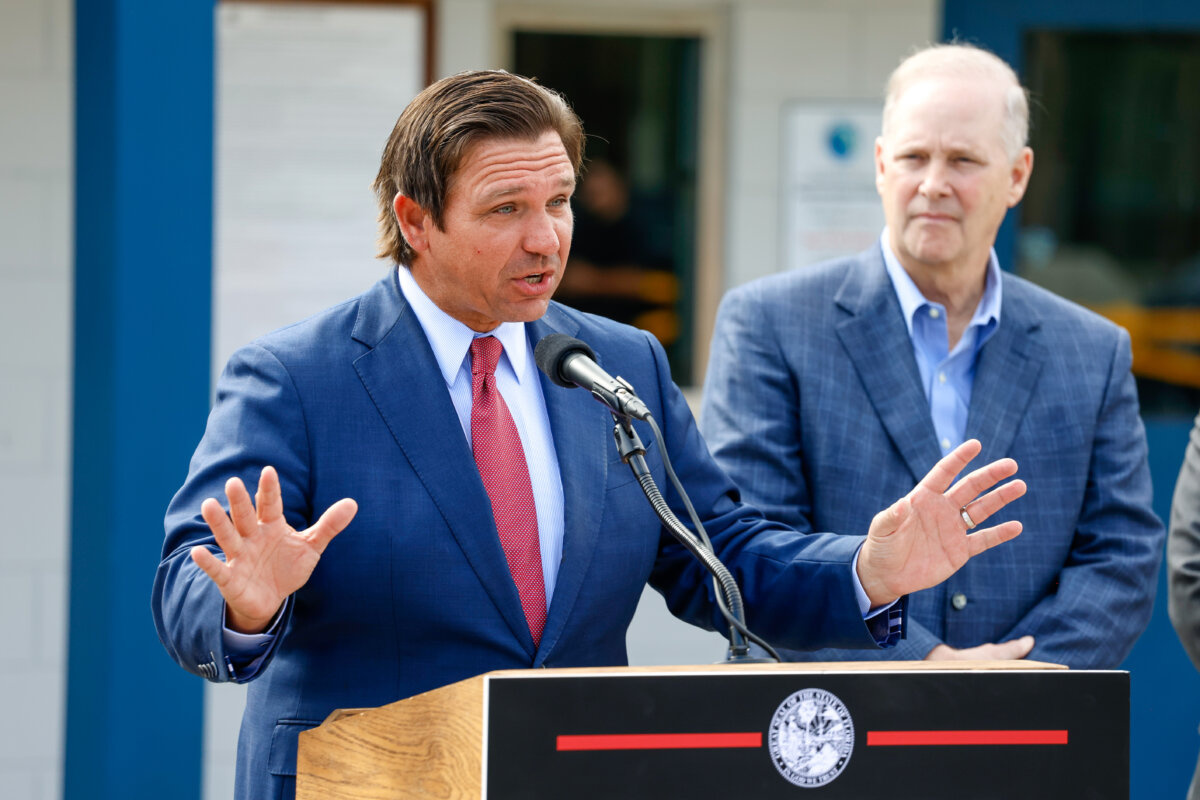

Florida Gov. Ron DeSantis kicked off the 2026 state legislative session on Tuesday by highlighting the benefits—and threats—posed by artificial intelligence.
The governor also spoke about his administration’s successes, from disaster response and higher education to his policies during the COVID-19 pandemic. He also reaffirmed his cautious stance to AI and the fine line between its advantages and perils.
“Artificial Intelligence is touted as being the key to curing cancer and expanding America’s military edge,” DeSantis said. “But this technology also threatens to upend key parts of our economy. … It presents real perils for children and parents.”
In early December 2025, DeSantis announced a proposal for protections against AI and costly data centers for Floridians. On Dec. 22, 2025, State Sen. Thomas Leek filed SB 482, dubbed the Artificial Intelligence Bill of Rights.
The legislation outlines consumer protections such as prohibiting the use of Chinese-created AI tools, requiring a notice to consumers when interacting with AI, providing parental controls for minors, allowing local governments to prohibit data center construction, and prohibiting utilities from charging Florida residents more to support data center development.
President Donald Trump previously pushed back on DeSantis’s push for individual, state-by-state regulations on AI. Only days after the Florida governor announced the AI bill of rights proposal, Trump signed the “Ensuring a National Policy Framework for Artificial Intelligence” executive order, calling for a unified federal approach.
“To win, United States AI companies must be free to innovate without cumbersome regulation. But excessive State regulation thwarts this imperative. … State-by-State regulation by definition creates a patchwork of 50 different regulatory regimes that makes compliance more challenging, particularly for start-ups,” the executive order reads.
DeSantis maintained that states should be allowed to create their own regulations.
In his address on Tuesday, DeSantis described the real-life consequences AI carries and how consumers in his state must be protected from footing the bill for costly data centers.
“AI chatbots have already been linked to teen suicides. It can also further devolve our society into a focus not on substance but on online slot,” he said.
If AI falls into the wrong hands, DeSantis warned, truth may become a foreign concept.
“An AI tool is only as good as the data that is inputted—garbage in, garbage out,” he said. “Whoever controls the data inputs will have immense power to shape the reality for hundreds of millions—maybe billions—of people.”
As AI develops, there is an obligation to ensure it does so in moral and ethical ways that reinforce American values, DeSantis said. And although he welcomes technology that enhances, he will not stand for technology that supplants, he added.
“We can never relieve ourselves of our responsibilities to think for ourselves, as Floridians, as Americans and most importantly, as the human beings that are made in the image of God.”
DeSantis did not specifically mention the proposed AI Bill of Rights, but just after referencing the technology, he said many great ideas had already been filed and to “get the bills to my desk.”
Florida’s AI Bill of Rights was referred to the appropriations and commerce and tourism subcommittees for consideration on Jan. 7.
 Friends Read Free
Copy
Facebook
Tweet
Friends Read Free
Copy
Facebook
Tweet