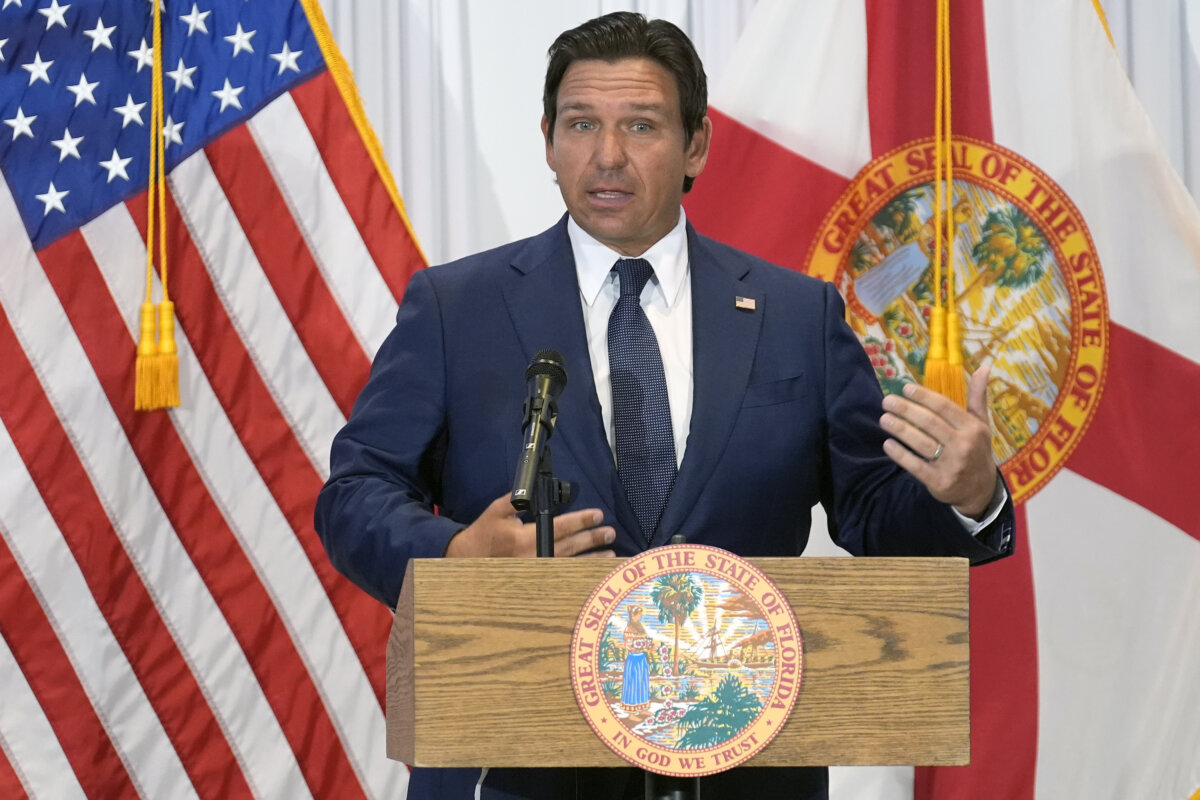

Florida Gov. Ron DeSantis said Monday he won’t let President Donald Trump’s executive order on a federal rulebook for artificial intelligence stop Florida from pursuing its own state-level regulations.
In an AI roundtable at Florida Atlantic University, DeSantis made his first public comments on Trump’s executive order he signed last week. The Florida governor said he’ll continue pushing for his proposed “bill of rights” that aims to protect citizens’ rights.
“We have a right to do this,” DeSantis said at the roundtable, despite the threat of lawsuits and withheld funding for states going against federal policies.
In Trump’s executive order, the president warns of “excessive State regulation” that he says can impede innovation.
“First, State-by-State regulation by definition creates a patchwork of 50 different regulatory regimes that makes compliance more challenging, particularly for start-ups,” he wrote.
Federal preemption says a higher-level law supersedes a lower one if they are in conflict. DeSantis said he believes the regulations he’s pushing for will be consistent with Trump’s all-encompassing rulebook.
“They’re worried about California, Colorado doing really crazy things that they could have the attorney general bring challenges to state laws,” DeSantis said.
The Florida governor doesn’t anticipate any challenges against the regulations he is proposing, but even if that did happen, DeSantis said he thinks the state would still prevail.
The Epoch Times has reached out to the White House for its response to the governor’s comments.
In the Florida governor’s proposal, some of the measures would prohibit state or local government agencies from using Chinese-created AI tools; prevent AI from using a citizen’s name, image, or likeness without their consent; and require consumers to be notified whenever they are interacting with AI. Another part of the proposal gives increased control to parents, such as allowing access to conversations a child has with an AI and notifying a parent if their child shows concerning behavior.
“I don’t know that people really make direct arguments against the things I outlined. Think about how many people you know—Republican, independent, Democrat—that would object to this stuff. Not a lot of people would. It’s just, it’s not partisan. It’s clearly standing on the side of consumers and individuals and families,” DeSantis said.
DeSantis also outlined protections for Floridians from footing the bill for AI data centers, such as prohibiting utility companies from charging residents more for electricity, gas, and water. Another measure would prevent construction of a data center on agricultural land.
“This is basically protecting against this technology running amok in a way that can be harmful to individuals,” he said at the roundtable Monday.
DeSantis also criticized federal lawmakers for introducing proposals on AI as part of recent legislative packages.
“If Congress wants to sit down and mimic some of these proposals or do it—I do acknowledge they could legislate that nationally … but that wasn’t what they proposed to do. They just wanted to kneecap the states and keep the states out of it.”
DeSantis’s AI bill of rights is expected to be considered when the state’s legislative session begins Jan. 13.
 Friends Read Free
Copy
Facebook
Tweet
Friends Read Free
Copy
Facebook
Tweet