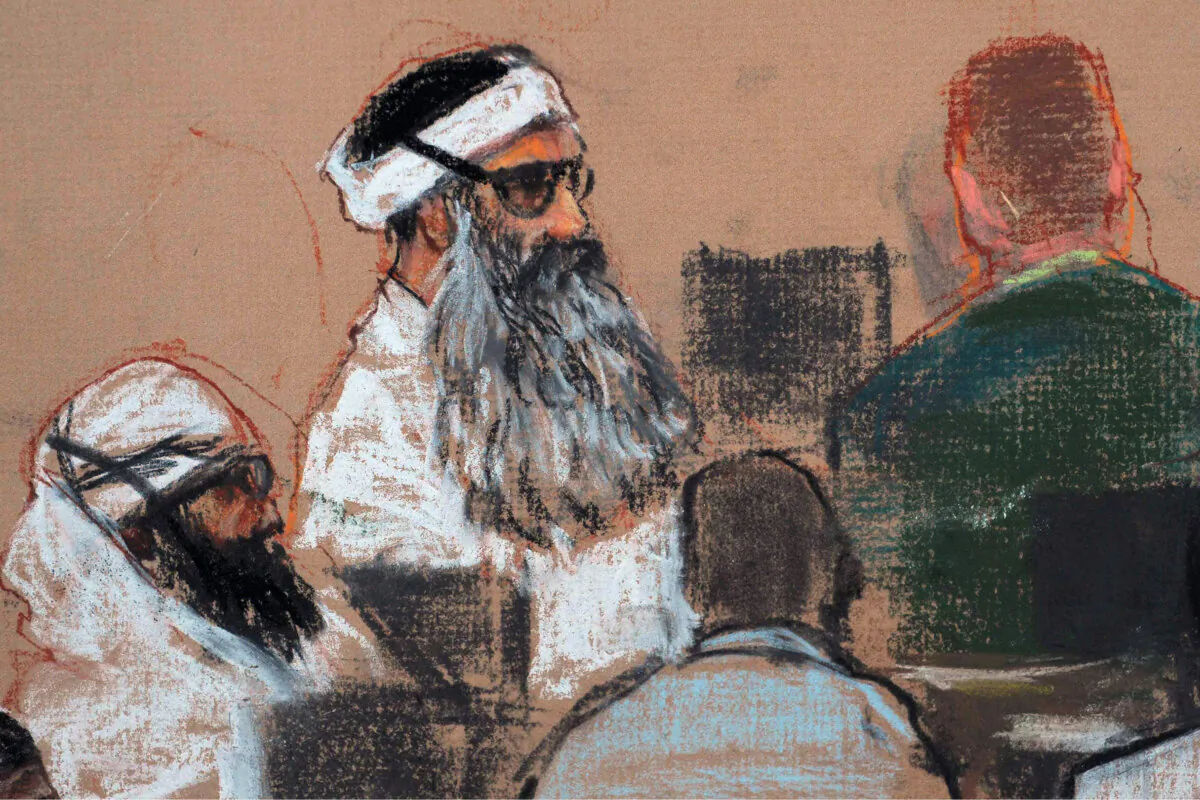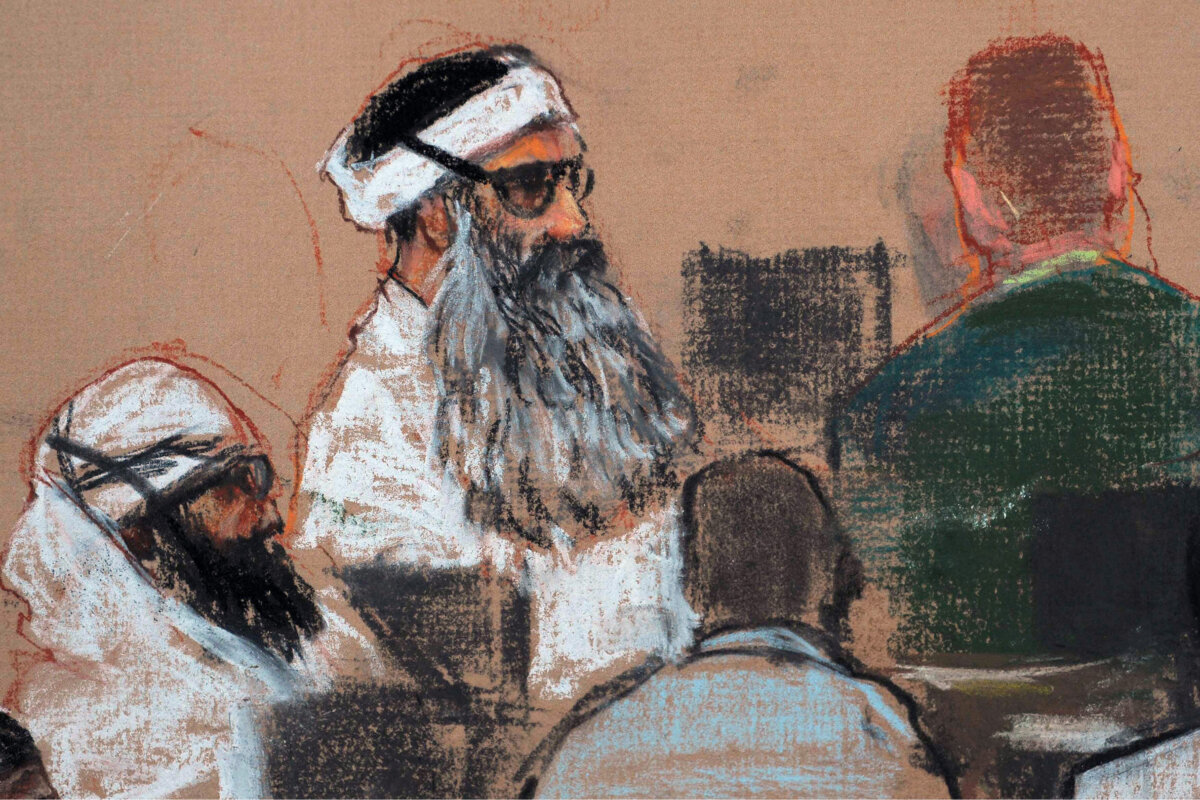

A federal appeals court on July 11 threw out a deal that would have allowed the accused mastermind of the Sept. 11 attacks to plead guilty in exchange for life imprisonment.
The deal, negotiated over two years and approved one year ago by military prosecutors and the Pentagon’s senior official for Guantanamo Bay, Cuba, stipulated life sentences without parole for Khalid Sheikh Mohammed, a Pakistani national who was a leader of terrorist group al-Qaeda, and two co-defendants.
Mohammed is accused of orchestrating a plot to crash hijacked planes into the World Trade Center in New York City and the Pentagon building in Washington on Sept. 11, killing nearly 3,000 people. Another one of the hijacked planes crashed into a field in Shanksville, Pennsylvania, killing everyone on board. Since the attacks, Mohammed has been held in the naval base in Guantanamo Bay.
Under that deal, the accused also would have had to answer any remaining questions that families of the victims have about the terrorist attacks.
Former Defense Secretary Lloyd Austin, who served under President Joe Biden, repudiated the deal and said that a decision on the death penalty in such an attack should be left up to the defense secretary.
Attorneys for Mohammed and the other defendants had argued that the agreement was already legally in effect and that Austin acted too late to try to throw it out. A military judge at Guantanamo and a military appeals panel agreed with the defense lawyers.
On July 11, the U.S. Court of Appeals for the District of Columbia Circuit, in a 2–1 vote, said that Austin acted within his capacity and said the military judge erred when issuing that order.
Referring to Austin’s decision, the court’s majority, comprising Judges Patricia Millett and Neomi Rao, wrote that “the government has adequately explained that Secretary Austin delayed action to avoid an unlawful influence challenge, waiting to see what type of agreement, if any, would result from the negotiations and only then deciding whether intervention was necessary.”
And they added that “when he found the resulting agreements unacceptable and contrary to the public interest, he promptly reclaimed part of the convening authority and withdrew from the agreements,” which “was reasonable and consistent with the Secretary’s responsibilities.”
“Having properly assumed the convening authority, the Secretary determined that the ‘families and the American public deserve the opportunity to see military commission trials carried out,'” the opinion reads. “The Secretary acted within the bounds of his legal authority, and we decline to second-guess his judgment.”
The judges further stipulated that the government satisfied the court’s criteria and that they will vacate the military court judge’s Nov. 6, 2024, order that barred the Pentagon chief from withdrawing the pretrial agreements that would have spared Mohammed and the two accomplices—Walid bin Attash and Mustafa al-Hawsawi—the death penalty.
The lone dissenting judge, Robert Wilkins, wrote that the government hasn’t “come within a country mile of proving clearly and indisputably that the Military Judge erred” in his order that blocked Austin’s directive.
On Aug. 2, 2024, Austin wrote a memo to Susan K. Escallier, a retired Army general who authorized the plea deals, to say, “I have determined that, in light of the significance of the decision to enter into pre-trial agreements with the accused in the above-referenced case, responsibility for such a decision should rest with me.”
But later, a military judge, Air Force Col. Matthew McCall, ruled against Austin that the previous plea deals with Mohammed, Attash, and Hawsawi were valid, arguing that the secretary of defense lacked the authority to void those agreements.
The judge had said that the memo from Austin to Escallier “provides no explicit rationale for attempting to withdraw” from the plea deals.
The Associated Press contributed to this report.
 Friends Read Free
Copy
Facebook
Tweet
Friends Read Free
Copy
Facebook
Tweet