
The U.S. Department of Justice (DOJ) is supporting a challenge that seeks to strike down a Hawaii law that restricts the public carrying of firearms in the state, in a case before the U.S. Supreme Court.
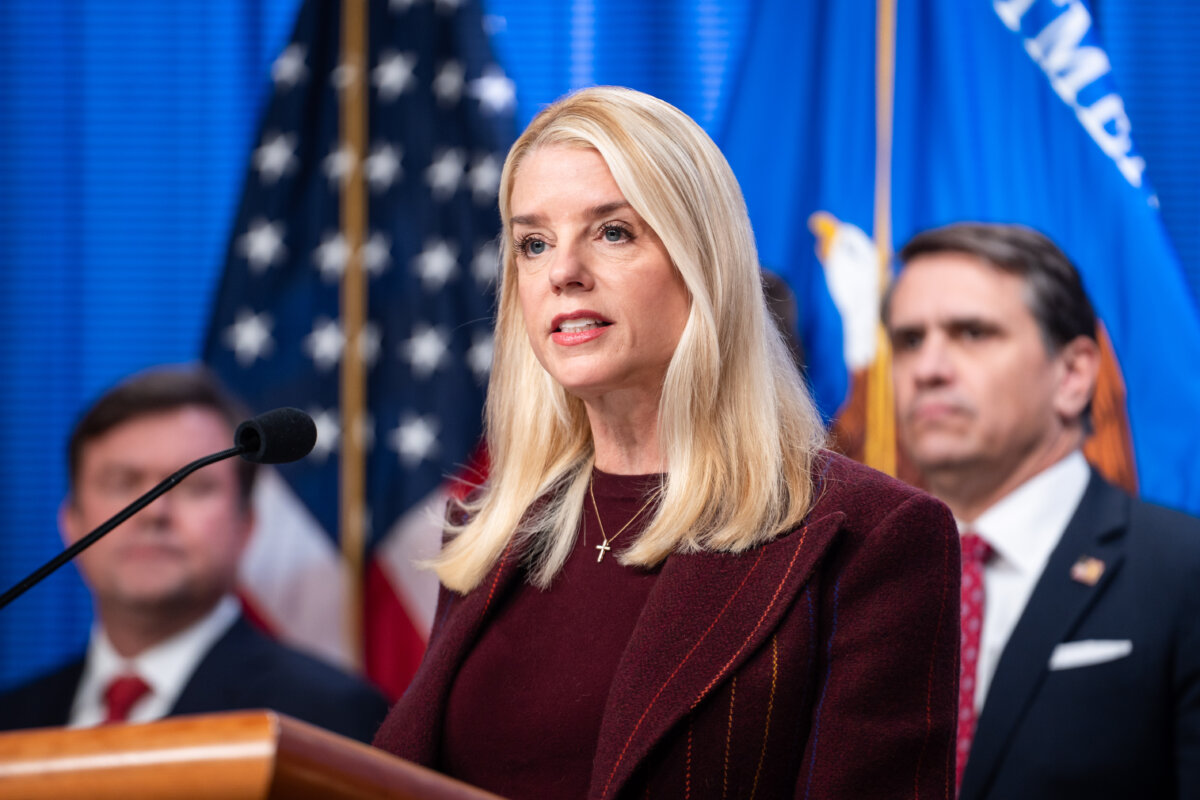
“Hawaii’s law plainly violates the Second Amendment,” U.S. Attorney General Pam Bondi wrote in a Nov. 24 post on X.
A ruling to invalidate the Hawaii law that is “effectively banning public carry” in the Aloha State could cause similar laws in California, Maryland, New Jersey, and New York to fall, she said.
“So a win in this case will restore Second Amendment rights for millions of Americans,” Bondi said.
Her comments came the same day as the DOJ filed a brief in the case, known as Wolford v. Lopez, which is scheduled for oral argument at the Supreme Court on Jan. 20, 2026.
The 2023 Hawaii law forbids concealed-carry license holders from carrying firearms on private property that is open to the public without explicit authorization from the property owner. This is known as the “default property rule.” It also bans firearms in places such as beaches, parks, bars, and restaurants that serve alcohol.
The state law was challenged by Hawaii residents Jason Wolford, Alison Wolford, and Atom Kasprzycki—who own firearms and have concealed carry licenses—along with the Hawaii Firearms Coalition, a gun rights organization. The respondent is Hawaii Attorney General Anne Lopez.
A federal district court in Hawaii temporarily blocked the law in September 2023 after the residents and the gun rights group filed their legal challenge.
The U.S. Court of Appeals for the Ninth Circuit reversed that decision in part last year and allowed Hawaii to enforce the law.
The challengers filed a petition with the Supreme Court on April 1, saying that the Ninth Circuit “erred in holding … that Hawaii may presumptively prohibit the carry of handguns by licensed concealed carry permit holders on private property open to the public.”
The challengers said the Supreme Court should take up the case to resolve a circuit split the Ninth Circuit’s ruling created with the Second Circuit, whose 2024 ruling in Antonyuk v. James “struck down an identical New York state law.”
U.S. Solicitor General D. John Sauer told the Supreme Court that Hawaii’s law conflicts with the court’s landmark 2022 ruling in New York State Rifle and Pistol Association v. Bruen.
In that case, the nation’s highest court ruled that laws preventing law-abiding individuals from carrying firearms in public for self-defense can’t be upheld unless they are consistent with the nation’s historical firearm regulation traditions.
The Bruen ruling invalidated Hawaii’s previous firearm-licensing regime, under which state residents “could virtually never obtain public-carry licenses,” Sauer said in the Nov. 24 brief.
Hawaii responded by loosening licensing restrictions, while at the same time enacting a new restriction that “effectively nullifies” public-carry licenses. The new law made it a criminal offense to take firearms onto private property open to the public unless the property owner provided “unambiguous written or verbal authorization” or posted “clear and conspicuous signage” allowing firearms, the brief said.
Four other states—California, Maryland, New Jersey, and New York—whose public-carry laws were struck down by Bruen, enacted similar laws, the brief said.
In Hawaii, licensees who pull over for gasoline with a pistol in the glove compartment face a year in prison if they don’t obtain the gas-station owner’s unambiguous consent, the brief said.
“The same goes for licensees who run errands at grocery stores, dine at restaurants, or stop to buy coffee,” it said.
The brief said the law was unconstitutional.
“History establishes that firearms regulations are per se unconstitutional if they are designed to thwart the right to publicly carry arms, or if they effectively negate the right. Hawaii’s restrictions fail both metrics,” the brief said.
Before the petition was granted on Oct. 3, Lopez filed a brief saying the Supreme Court would be acting prematurely if it granted the challengers’ petition.
The challengers’ appeal is based on a lower court ruling that dealt with questions relating to preliminary relief, as opposed to final judgment, Lopez said in the brief filed on Sept. 22.
“There are still unresolved factual disputes regarding the historical record and the reach of Hawaii’s default property rule,” Lopez said.
On Nov. 25, Sauer asked the Supreme Court for permission for the federal government, which is not a party to the appeal, to participate in the oral argument on Jan. 20, 2026.
“The United States has a substantial interest in the preservation of the right to keep and bear arms and in the proper interpretation of the Second Amendment,” the motion said.
It is unclear when the Supreme Court will rule on the motion.
Jack Phillips contributed to this report.
 Friends Read Free
Copy
Facebook
Tweet
Friends Read Free
Copy
Facebook
Tweet