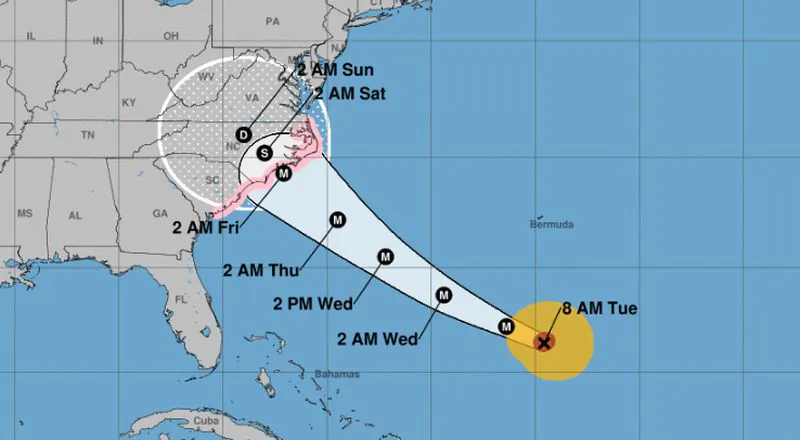
The U.S. National Hurricane Center (NHC) has started sending out coastal advisories for Hurricane Florence at 8 a.m. on Sept. 11.
A hurricane watch is now in effect for Edisto Beach South Carolina to the North Carolina-Virginia border as well as Albemarle and Pamlico Sounds, the NHC said.
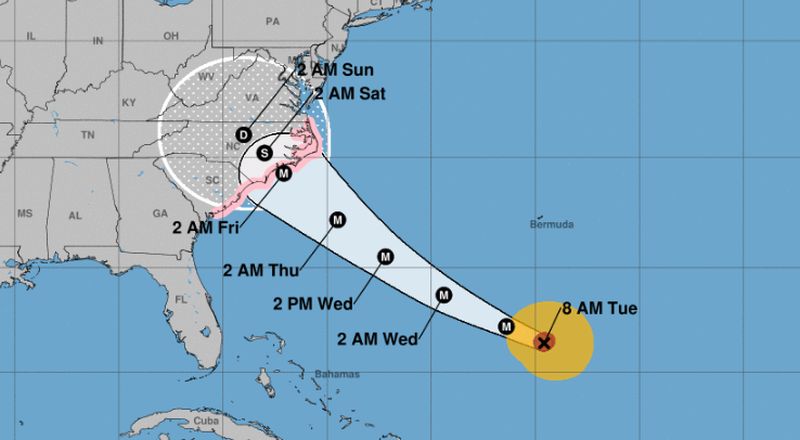 The U.S. National Hurricane Center (NHC) began sending out coastal advisories for Hurricane Florence at 8 a.m. on Sept. 11. (NHC/NOAA)
“Interests elsewhere in the southeastern and mid-Atlantic states should monitor the progress of Florence. Additional watches may be required later today,” the agency said.
Meanwhile, a storm surge watch was sent out for Edisto Beach in South Carolina to the North Carolina-Virginia border as well as Albemarle and Pamlico Sounds, including the Neuse and Pamlico Rivers.
Florence is moving west-northwest at around 15 mph, officials said. It is currently located 950 miles east-southeast of Cape Fear.
The storm weakened slightly and has 130 mph winds, but it is still a major Category 4 hurricane, according to the Saffir-Simpson Hurricane Wind Scale.
If it stays at Category 4, “catastrophic damage will occur,” said the NHC. “Well-built framed homes can sustain severe damage with loss of most of the roof structure and/or some exterior walls. Most trees will be snapped or uprooted and power poles downed. Fallen trees and power poles will isolate residential areas. Power outages will last weeks to possibly months. Most of the area will be uninhabitable for weeks or months,” the agency said.
Officials say that the storm will likely strengthen. A Category 5 hurricane means the system has 157 mph winds or higher.
https://twitter.com/RyanMaue/status/1039497451453997056
If a Category 5 hits the southeastern U.S., “a high percentage of framed homes will be destroyed, with total roof failure and wall collapse,” said the NHC. “Fallen trees and power poles will isolate residential areas. Power outages will last for weeks to possibly months. Most of the area will be uninhabitable for weeks or months,” according to the agency.
North Carolina, South Carolina, Maryland, and Virginia have declared states of emergency ahead of the storm. Evacuation orders have also been issued.
Stalling?
Some forecasters have predicted that Florence may stall over Virginia and the Carolinas for possibly several days, which would bring catastrophic flooding to the area.
“There’s never been a storm like Florence. It was located farther north in the Atlantic than any other storm to ever hit the Carolinas, so what we’re forecasting is unprecedented. Also, most storms coming into the Carolinas tend to move northward, and this storm looks like it’s going to stall over the region and potentially bring tremendous, life-threatening flooding,” AccuWeather meteorologist Marshall Moss said.
https://twitter.com/RyanMaue/status/1039460496557174785
Forecasters have said that if it lingers over the region, several feet of rain might fall. Hurricane Harvey, they said, is a recent example of what could happen.
“As we have seen with hurricanes in most recent years, such as Lane in Hawaii earlier this summer and Harvey last year in Texas, feet of rain can fall when these tropical storms stall,” AccuWeather’s Alex Sosnowski said.
 Friends Read Free
Copy
Facebook
Tweet
Friends Read Free
Copy
Facebook
Tweet