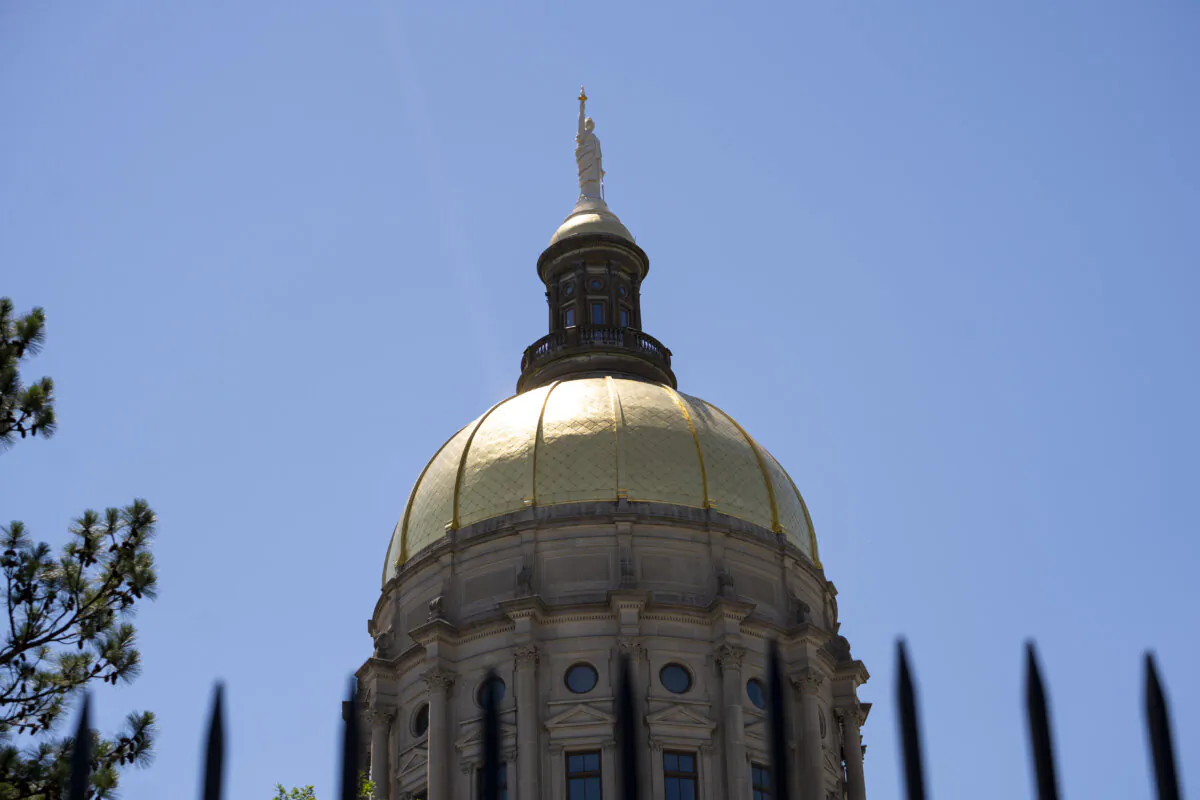

Georgia House Republicans on June 17 rejected a push to redistrict the state’s congressional districts, an effort that had the backing of both President Donald Trump and Georgia Gov. Brian Kemp.
In a letter to Kemp, Georgia House Speaker Jon Burns indicated that while Republicans would attend the special session to deal with issues like the state gas tax, redistricting the state for the 2028 cycle would not be on the agenda.
“As we gather today, the House’s sole focus is on the policies that matter most to Georgia’s future and the hardworking people who call our state home,” Burns wrote. “From advancing historic property tax relief to ratifying the extension of the state gas tax suspension, today’s work reflects the House’s shared commitment to responsible, conservative governance that puts taxpayers first and helps ensure Georgia remains the best state in the nation to live, work, and raise a family for generations to come.”
Previously, Georgia lawmakers had been set to review a plan to redistrict the state’s congressional maps for the 2028 cycle, which would have made the state the first to redistrict for a cycle beyond 2026.
“In regard to your request to redistrict for the 2028 election cycle, the House has always conducted redistricting with considerable time for public input and with careful attention to constitutional requirements and the interests of every Georgia community,” Burns said.
The special session was called amid the aftermath of the Supreme Court’s ruling in Louisiana v. Callais. That case determined Louisiana’s congressional map was an illegal racial gerrymander and redefined key sections of the Voting Rights Act, laying the groundwork for wide-reaching redistricting in several states.
But Burns said that lawmakers currently wanted to approach the issue with caution in light of shifting litigation and rulings around the topic, saying that because this “has the potential to impact every voter, it deserves the same responsible, fact-driven approach that guides every policy we consider as lawmakers, especially as we seek to understand the full implications of the U.S. Supreme Court’s decision in Louisiana v. Callais.”
Burns said he was “confident” that Georgia would win several ongoing elections-related appeals but emphasized that Georgia Republicans would wait to receive “additional judicial opinions to assist us in our future map-drawing efforts.”
Ahead of the session, critics of the proposal had shown up at the state Capitol in force, with some demonstrators chanting, “Black voters matter.”
Sen. Raphael Warnock (D-Ga.) spoke at the state Capitol, criticizing the then-expected redistricting session as “a dark day in Georgia history.”
In its April ruling, the Supreme Court majority ruled that any jurisdiction drawn with racial makeup as the primary criterion was unconstitutional and in violation of the Equal Protection Clause.
The court said that states should draw districts in a way that is “race neutral.”
Critics, like Warnock, say that the ruling will make it easier to dilute the voting power of minority blocs.
Georgia Republicans are the third group of state-level GOP lawmakers to reject national calls to join in the national mid-decade redistricting battle, which began in August 2025 with Texas’s redrawing of its congressional maps. Since then, several states on both sides of the aisle have redrawn their congressional maps.
In Indiana and Kansas, as in Georgia, Republicans despite their legislative majorities rejected the push.
In Indiana, the state Senate rejected a redrawn map by a vote of 31–19.
In Kansas, Republicans refused to bring the legislation for a vote due to the near certainty of a veto by Democratic Gov. Laura Kelly, which Republicans didn’t have the votes to override.
 Friends Read Free
Copy
Facebook
Tweet
Friends Read Free
Copy
Facebook
Tweet