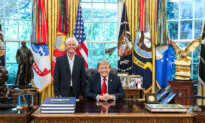


ÉVIAN-LES-BAINS, France—President Donald Trump clarified the details of the Iran deal during his closing press conference at the G7 leaders’ summit in France on June 17, addressing widespread speculation triggered by a leaked draft a day earlier.
After officials in Iran and Israel offered their own interpretations of the leaked document, the Trump administration decided to release the terms of the highly anticipated memorandum of understanding (MOU) earlier than planned.
An official told The Epoch Times on June 17 that Trump and Iran had signed the MOU.
While Trump was holding his press conference at the summit site in the French resort of Évian-les-Bains, officials in Washington held a conference call with reporters to read the full text of the document and provide clarifications.
Here are the main takeaways from the document and the president’s remarks.
60 Days of Negotiations
The deal kicks off a 60-day period of negotiations before both sides reach a final agreement to end the war and determine the fate of Iran’s “nuclear needs.”
During the 60-day period, all commercial vessels will be granted safe passage through the Strait of Hormuz, free of charge, from the Persian Gulf to the Sea of Oman.
Iran also has agreed to immediately begin downblending its stockpile of highly enriched uranium.
If the parties comply with the deal and the talks prove successful, the United States will sign a final agreement with Iran that will include relief from U.S. sanctions.
Tehran Will Begin Selling Oil
Once the MOU is signed, the United States will permit Iran to immediately sell crude oil, petrochemical products, and related goods, providing critical economic support to the Iranian regime. The sanctions waivers also include key services such as banking, transportation, and insurance that are needed to support oil sales.
This provision, numbered 10 in the MOU, has faced criticism.
The Trump administration has defended it, saying that continuing to sanction Iranian oil is ineffective, as the current system allows China to purchase this oil at a significant discount.
“It’s absurd to sanction Iranian oil in such a way that they are still allowed to sell that oil. We just give China a big fat discount,” one U.S. official explained during the call.
Another official said that letting Iran sell its oil will help bring down global prices, which in turn will lower gas prices for American families.
Iran Won’t Pursue Nuclear Weapons
For the Trump administration, the linchpin of the memorandum is Washington’s nuclear demands, which must be met before any sanctions relief or economic waivers.
The deal states that Iran reaffirms that it “shall not procure or develop nuclear weapons.”
Iran must also agree to downblend its stockpile of highly enriched uranium under the supervision of the International Atomic Energy Agency, the nuclear watchdog for the United Nations.
However, whether or not Iran will be allowed to enrich uranium at levels needed for civilian nuclear power, which was allowed in the Obama-era Joint Comprehensive Plan of Action, is not yet clear.
The memo states that Washington and Tehran agree to “discuss the issue of enrichment and other mutually agreed matters related to [Iran’s] nuclear needs” in a final deal after 60 days of negotiations.
Trump warned on June 17 that if negotiations collapse within 60 days, or if Iran doesn’t fulfill its end of the deal, especially the nuclear clauses, the United States will “go back to bombing.”
Reopening of Strait Will Boost Global Economy
According to the MOU, Iran will immediately reopen the Strait of Hormuz without tolls during a 60-day period of negotiations.
Trump said he chose not to prolong the war because continued disruptions in the strait have affected energy markets and harmed the global economy. He said that reopening the waterway would lower energy prices, support the global economy, and boost stock markets.
“Maritime traffic through the Strait of Hormuz has already increased very substantially,” he said during the press conference.
“The normal flow of energy will resume in the coming days, and trillions of dollars will be made by the world, and the stock market will, I believe, continue to rise.”
Trump also said he did not want to be remembered like President Herbert Hoover, whose policies were blamed for worsening the Great Depression in the 1930s.
“I didn’t want to see an economic catastrophe,” Trump said.
French President Emmanuel Macron said during his press conference on June 17 that the G7 leaders have supported the deal.
Unfreezing Assets and Sanctions Relief
The United States has agreed to terminate all primary and secondary sanctions against Iran if a final agreement is reached.
The final deal will also prevent Washington from imposing any new sanctions on Iran and provides for the release of frozen Iranian assets should conditions be met.
The United States and Iran “will mutually agree on the procedures related to the release of these funds during the negotiations,” the MOU states.
The U.S. official emphasized that Iran only gets access to the frozen funds and assets after brokering a final agreement with the United States. Its release will be contingent on Iran making good on nuclear demands, the official said.
Trump Clarifies $300 Billion Fund for Iran
One of the most widely reported and controversial clauses in the memorandum involves the United States and its regional partners in the Middle East developing a plan to create a $300 billion reconstruction and economic development fund for Iran.
The plan won’t be implemented until after 60 days, and the full mechanism through which it will be achieved will be outlined in the final deal.
The United States will grant all licenses, waivers, or permissions required for the relevant financial transactions to establish and implement the $300 billion fund, according to the deal.
The U.S. official explained that the United States will not be directly funneling money into the reconstruction fund, but rather will permit sanctions relief if Iran complies with the deal.
This could take the form of a nation, such as the United Arab Emirates, investing to build a power plant in Iran, the official said.
In France, Trump reiterated that the fund is contingent on Iran “doing things right.”
“Remember this also, when you talk about billions of dollars, they’ve had much more than a trillion dollars worth of damage done. They got a long way. There’ll be 15 to 20 years to rebuild what they have right now,” Trump said, referring to the destruction in Iran since the war started on Feb. 28.
US Forces to Remain in Region
As soon as the memorandum is signed, the United States will begin removing its naval blockade, as well as “any disturbances or impediments against the Islamic Republic of Iran.”
Washington has agreed to fully end the naval blockade within 30 days.
Following the ratification of a final agreement to end the war, the United States will remove its military forces “from the proximity of” Iran.
Additionally, the final agreement will “confirm the permanent termination of the war on all fronts, including in Lebanon,” and the United States has agreed not to deploy additional forces to the region.
As Trump indicated, he is ready to resume military operations against Iran if they don’t comply with his administration’s demands.
“It’s a memorandum of understanding, but we have an understanding of certain things without writing it, and if they don’t honor that, we’ll probably go back to bombing them until they honor it,” he said in France. “You know, it’s amazing what bombs can do.”
Following the press conference, Trump headed to Paris to attend a dinner at the Palace of Versailles hosted by Macron. At Paris airport, the U.S. president was asked how long American forces would remain in the Persian Gulf. He responded, “A little while,” and said that the timeline depends on “how it all goes.”
 Friends Read Free
Copy
Facebook
Tweet
Friends Read Free
Copy
Facebook
Tweet