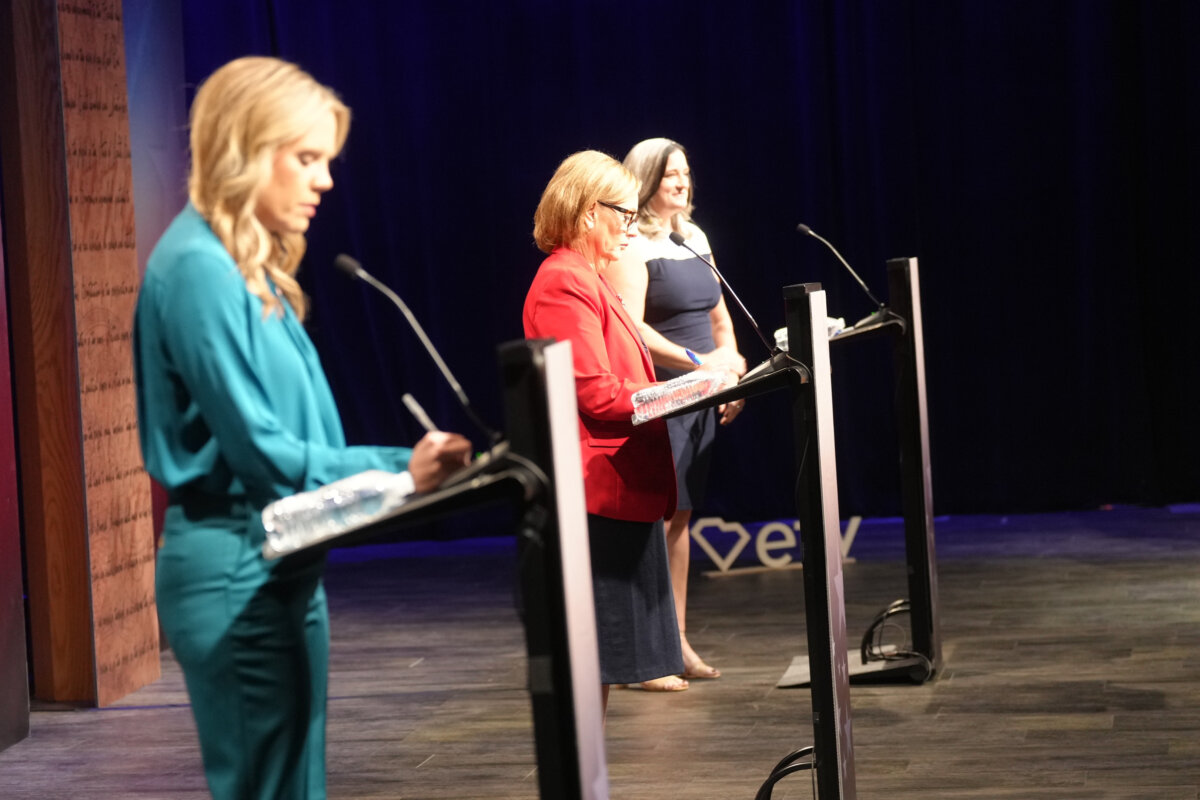

Sen. Darline Graham (R-S.C.) and Democratic nominee Annie Andrews traded jabs over qualifications, healthcare, and the Iran war, in their only scheduled debate, three weeks before the general election.
During the hour-long SCETV debate on Sunday, which also included Libertarian nominee Kasie Whitener, Graham repeatedly tied Andrews to the Democratic Party’s left wing. Andrews, a pediatrician, argued that Graham was not prepared to serve a full term.
“Annie Andrews will not stand up to the Socialist Democratic Party. She’s only going to join them,” said Graham, who was appointed to the seat after her brother, longtime U.S. Sen. Lindsey Graham, died in July.
Andrews pointed to remarks made by Graham during a Republican runoff debate about U.S. interests in Taiwan and the South China Sea in which she said that national security is “not my thing.”
“If your surgeon said that appendectomies aren’t really his thing, would you still hand him a scalpel?” Andrews said. “No. So why would we hand Darline Graham a full term in the U.S. Senate? She is unserious and unqualified.”
Graham responded that she’s willing to admit when she doesn’t know something and is “just as qualified” as Andrews, who was not being honest with voters and “flip-flopped on everything.”
On the topic of healthcare, Graham said Andrews supports government-run healthcare for all, which she said would add trillions of dollars to the $40 trillion national debt.
Andrews denied supporting Medicare for All and said she’d lower prescription drug prices and restore Medicaid funding cut by the 2025 tax and spending law, the One Big Beautiful Bill Act (OBBBA).
Graham said the OBBBA included $50 billion over five years for rural hospitals and that South Carolina received $200 million of it this year.
Andrews said Graham sparred over ending the war in Iran and associated diesel taxes and exports.
Highlighting the fact that Graham had voted to reject three Iran war powers resolutions in the Senate, Andrews called for suspending federal and state gas and diesel taxes and for a temporary ban on diesel exports to help with costs.
Graham blamed high fuel prices instead partly on Democratic regulations on drilling and refineries and pointed to the Lindsey O. Graham Sanctioning Russia and Iran Act of 2026, a sanctions law named for her brother that she sponsored as her answer to ending the war in Iran. That bill passed the Senate 86–11 and was signed into law on Sept. 18 by President Donald Trump.
The two also split on data centers. Andrews proposed a two-year moratorium on new centers, and Graham countered that a lengthy moratorium would let China pull ahead and pointed to a bill she co-sponsored that would let communities negotiate with tech companies.
They appeared closer on immigration. Andrews said both parties have failed and that “Democrats have failed on the border,” but that U.S. Immigration and Customs Enforcement (ICE) should focus on dangerous criminals and respect due process. Graham said she supports funding ICE, co-sponsored the End Sanctuary Cities Act, and accused Andrews of supporting amnesty.
On a personal level, Andrews noted that she hadn’t “changed my name recently.” Graham said her legal name has always been Graham and that she kept it to stay connected to her late parents, then rebuked her opponent “for bringing up a horrible, tragic memory for me.”
When asked by Andrews to commit to two more debates. Graham said she’d rather spend her time meeting voters.
Libertarian Whitener, a business professor at the University of South Carolina, kept her focus on the national debt, calling it the main issue facing the country.
Saying Social Security and Medicare need significant reforms, she proposed allowing young people to opt out of Social Security and opposed raising the cap on income subject to the payroll tax. She also opposed sending ground troops to Iran and argued for less government involvement in healthcare, data centers, and artificial intelligence.
“We’ve got to cut spending. We have to address the national debt. That will bring all the prices down,” Whitener said.
Early voting in South Carolina begins Oct. 19. With three women on the ballot, the state is set to elect its first woman to the U.S. Senate.
 Friends Read Free
Copy
Facebook
Tweet
Friends Read Free
Copy
Facebook
Tweet