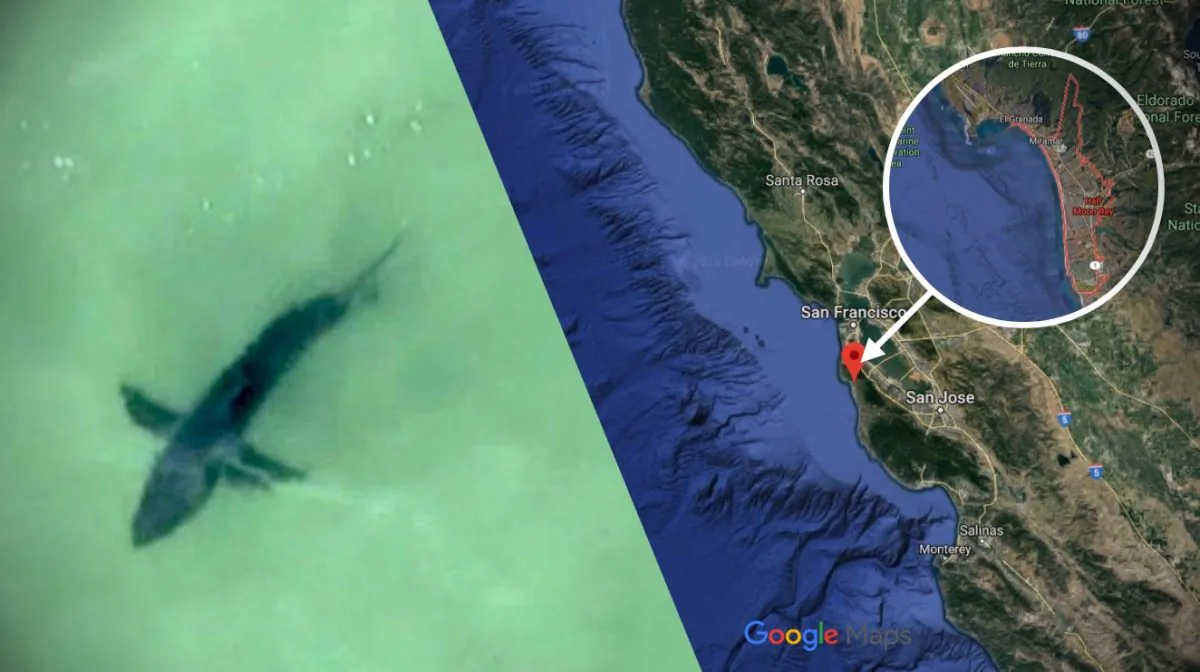

Authorities in San Mateo County are sounding the alarm after multiple pilots in the area reported seeing great white sharks in the water.
The San Mateo County Sheriff’s Office urged caution on Thursday, July 11, saying that the sharks were spotted between the Ritz Carlton and Pillar Point in Half Moon Bay.
“If visiting the area please use caution,” the sheriff’s office said on Twitter Thursday afternoon.
Great White Sharks seen in #HalfMoonBay.
Multiple pilots flying over the San Mateo County coast have spotted great white sharks in the water today.If visiting the area please use caution. ⚠️
Please refer any further questions to @CAStateParks or @PillarPointHMB image:Surfline pic.twitter.com/wTeGDwYCxm
— San Mateo County S.O (@SMCSheriff) July 11, 2019
Stephanie Roberts, a Half Moon Bay resident who lives a mile away from the beach, was cited by ABC7 News as saying that it is rare to see sharks in the area.
“It does make you nervous, because I do swim in the ocean every now and then, but it’s nature,” she told the news outlet. “That’s why we love living here.”
Local surfer Sam Huo told KPIX that she would think twice before hitting the waves.
“Uh, yeah … that’s a game changer for me,” she told the outlet.
Marine biologist Giancarlo Thomae told KPIX that shark sightings are a normal occurrence and people shouldn’t be anxious.
“I would not worry about seeing these sharks,” Thomae told the news outlet. “In fact, they are not in feeding mode. What they are doing is they are finding the warmest water that they can just to warm up.”
800-Pound Great White Shark ‘Pings’ Off Cape Cod
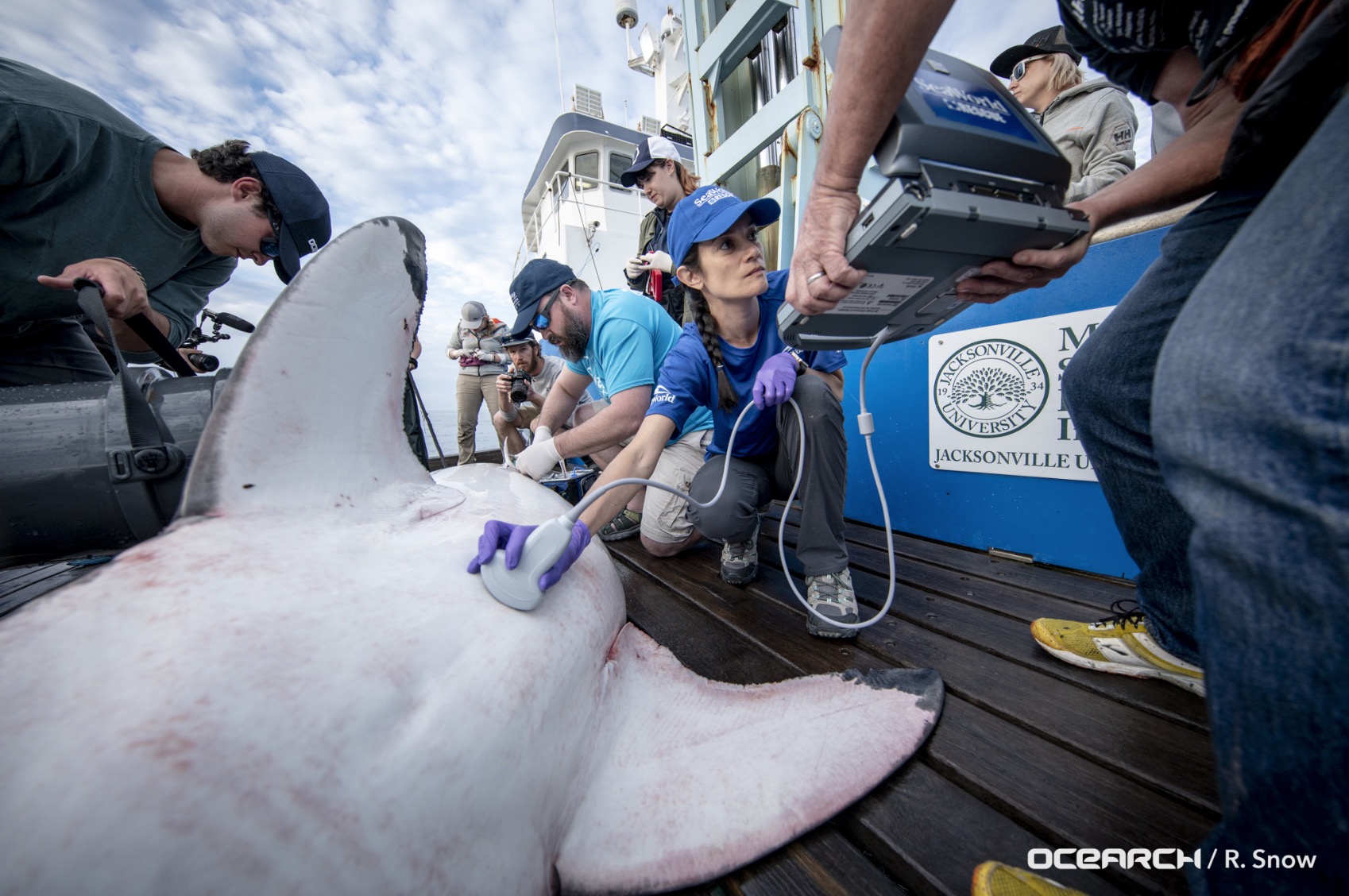
The news comes after researchers tracking a 10-foot, 800-pound shark off the eastern coast of the United States announced the massive creature has made its presence known just 15 miles off the coast of Cape Cod by way of a “ping.”
The shark—a great white dubbed Miss May—pinged in at 4:58 a.m. on July 9, according to an update on the OCEARCH website, an ocean research organization that tracks sharks.
A ping happens when a tagged shark’s dorsal fin breaks the surface of the water and transmits a signal, which is recorded for tracking purposes.
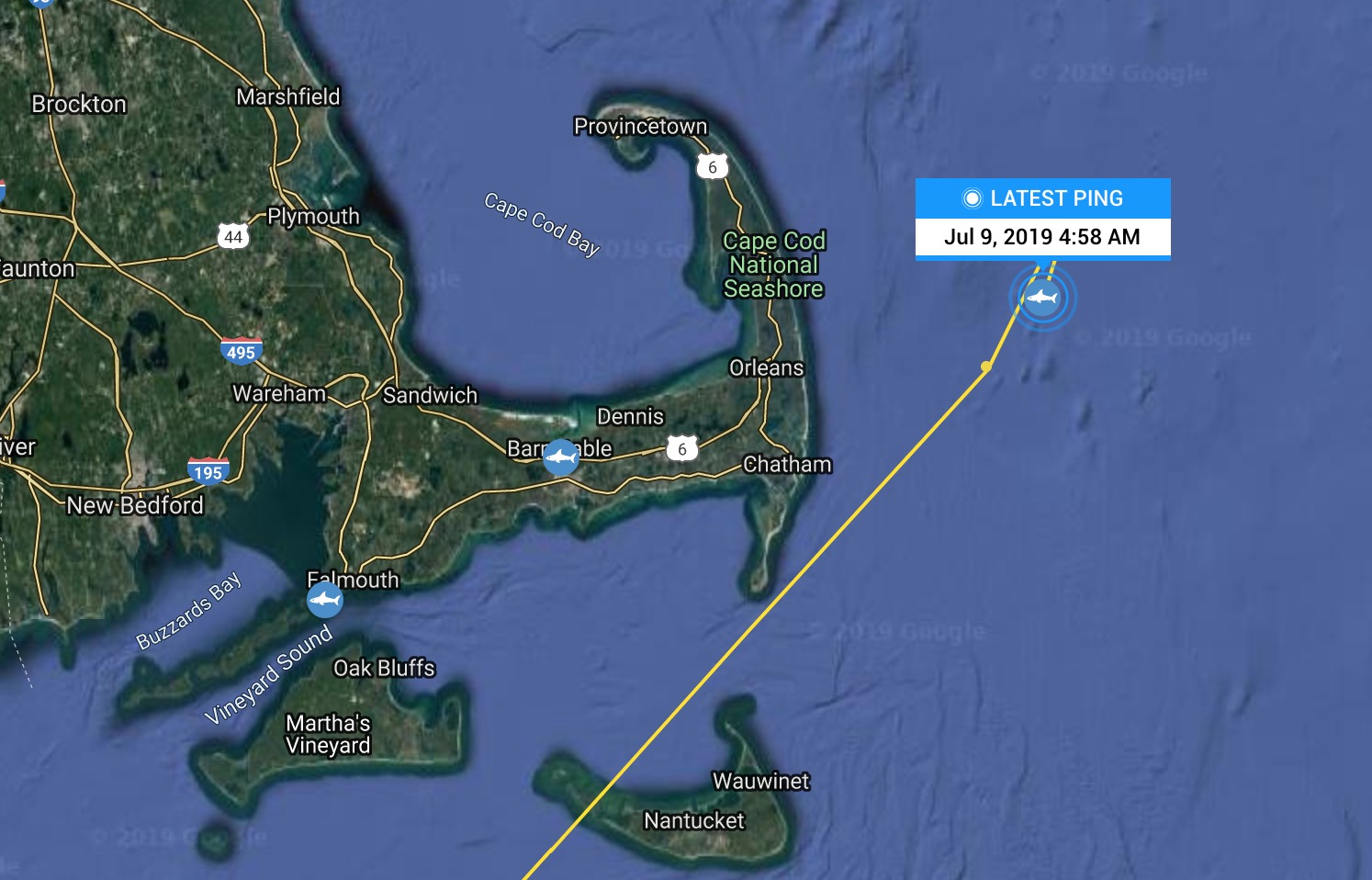
The great white has been swimming north for over a month. Earlier on June 28, OCEARCH researchers posted an update on Twitter featuring a map of the great white’s recent movements in eastern coastal waters.
“Today @MissMay_Shark is pinging close to shore a little north of Kitty Hawk North Carolina. She has been making steady progress north since the beginning of the month.”
Today @MissMay_Shark is pinging close to shore a little north of Kitty Hawk North Carolina. She has been making steady progress north since the beginning of the month. pic.twitter.com/LFKRvFwEr1
— OCEARCH (@OCEARCH) June 28, 2019
That news was met with a hint of trepidation by some commenters, with one saying, “How far off shore? We are in corolla !”
But most people commenting on the OCEARCH post struck a welcoming note.
[morearticles mode=”true”]2982386[/morearticles]
“Coming up to NJ for the nice hot summer!” wrote one.
“Welcome to North Carolina!!? We are happy to have you!!? Have some Cheerwine or Sweet Tea while you are visiting:)” wrote another.
The shark’s name—Miss May—was inspired by the town of Mayport, Florida, where OCEARCH is planning a research facility.
“Our first white shark of the expedition,” said Expedition Leader Chris Fischer, in a Feb. 24 video posted on Miss May’s own Twitter profile. “A beautiful sub-adult female, and we want to name this shark Miss May, for all the people of Mayport.”
Since we tagged @MissMay_Shark a week ago, she’s been pinging up a storm! She’s already traveled over 230 miles and we are so excited to see what new data she will share with us. pic.twitter.com/G4occqrj1J
— OCEARCH (@OCEARCH) February 24, 2019
Miss May was tagged in February, with a post on Twitter announcing that the great white was “so excited” to get a “sweet underwater iPhone” so that the shark “can take you all on an adventure through the Atlantic with me.”
What a wonderful day! So excited the @OCEARCH team just gave me a sweet underwater iPhone during #ExpeditionNASFA so that I can take you all on an adventure through the Atlantic with me. pic.twitter.com/joriBxTTwi
— White Shark Miss May (@MissMay_Shark) February 16, 2019
In an interview with Reader’s Digest, Fischer stressed the importance of sharks to the world’s oceans. “To put it simply, sharks are balance-keepers: if we lose our sharks, we lose our oceans.”
Drone Catches Sharks Making ‘Aggressive Moves’
CBS News reported on July 9 that drone footage of the waters of Cape Cod Bay showed two sharks acting aggressively toward each other.
“They’re always biting each other, we can tell from the patterns of the bites that they’re aggressive toward each other,” said Dr. Greg Skomal, a Massachusetts shark researcher. “But we’ve never seen it before.”
Drone Catches Sharks Making ‘Aggressive Moves’ In Cape Cod Bayhttps://t.co/co6I1R69Ze pic.twitter.com/lI8pdfSngL
— WBZ | CBS Boston News (@wbz) July 9, 2019
According to the report, shark researchers spent several days looking for sharks in the waters off Cape Cod and found a whopping 20 of them.
“Inside the bay, we’re seeing these sharks, you know, a mile, two miles, three miles from land,” Dr. Skomal told CBS.
Researchers believe the massive number of seals in the area may be attracting the sharks.
“You just have to be concerned, and you just have to be aware and just be careful,” a beach-goer said, via CBS.
A Danger or Endangered?
Sharks in their interactions with humans have acquired a fearsome reputation that, according to National Geographic, is not justified.
[morearticles mode=”true”]2891604[/morearticles]
“The United States averages just 16 shark attacks each year and slightly less than one shark-attack fatality every two years,” writes National Geographic’s Brian Handwerk. “Meanwhile, in the coastal U.S. states alone, lightning strikes and kills more than 41 people each year.”
Data from the Florida Museum of Natural History’s International Shark Attack File (ISAF), a database of all known shark attacks, shows that humans pose a greater threat to sharks than vice versa.
“On average, there are only six fatalities attributable to unprovoked attacks by sharks worldwide, each year. By contrast, fisheries kill about 100 million sharks and rays annually.”
Check out our new website with interactive map! #sharkresearch #sharkbite #sharkattacks Florida Museum of Natural History https://t.co/rPRjrtO703
— UF Shark Research (@UFsharkresearch) August 31, 2018
A comparison of dog attack fatalities (364) versus shark attack fatalities (11) in the United States for the years 2001-2010 shows that canines pose a considerably higher risk to humans than the much-maligned sharks.
 Friends Read Free
Copy
Facebook
Tweet
Friends Read Free
Copy
Facebook
Tweet