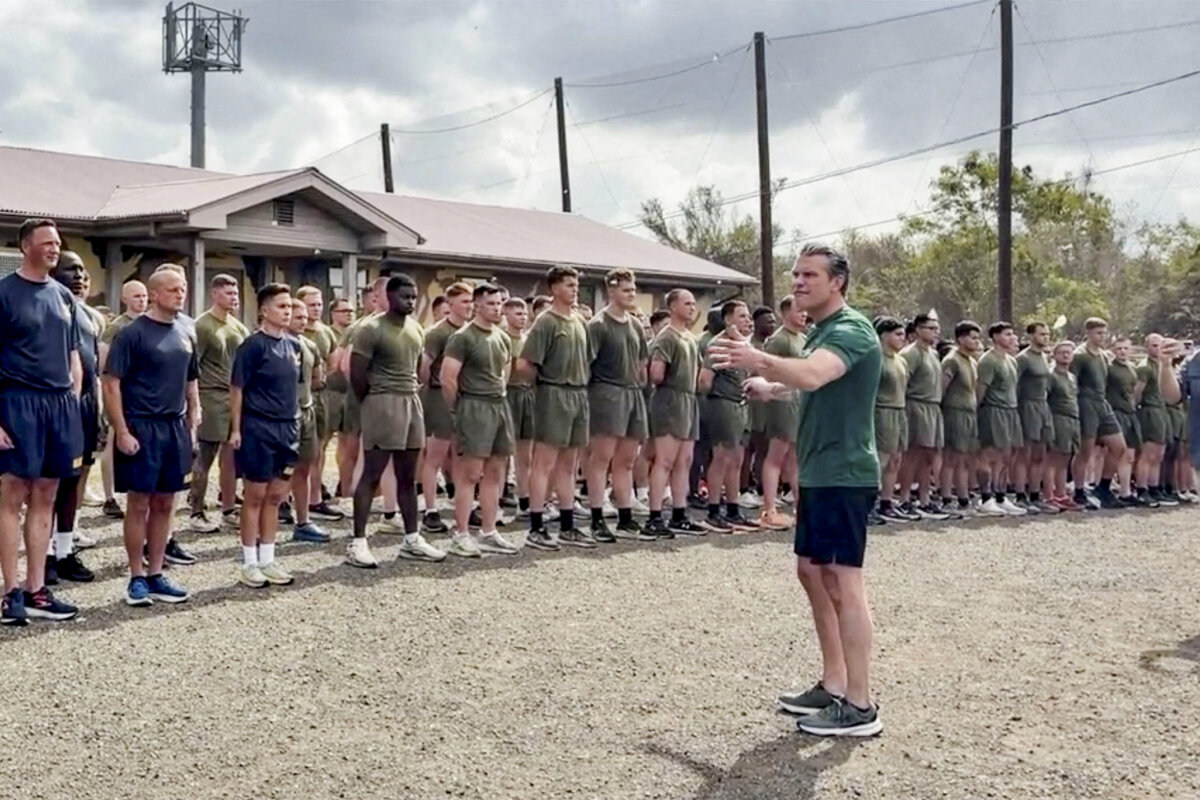

U.S. Secretary of War Pete Hegseth on June 10 is visiting U.S. forces in Cuba and at the headquarters of the U.S. Central Command (CENTCOM) in Florida amid rising tensions in their respective mission areas.
Hegseth’s visit to Cuba comes as U.S. President Donald Trump has ramped up pressure on the communist leadership in Havana.
In recent weeks, the U.S. government obtained a criminal indictment against former Cuban leader Raúl Castro and enacted new economic sanctions against current Cuban leader Miguel Díaz-Canel. Cuban officials have described these recent U.S. actions as a pretext to justify aggressive actions, including to effect regime change in Havana.
Aircraft carrier USS Nimitz and elements of a U.S. Marine Expeditionary Unit are also operating in the Caribbean Sea.
During his Cuba visit, Hegseth met with U.S. troops at Naval Station Guantanamo Bay. The U.S. outpost is the only one maintained in a communist-controlled country.
“What happens with the future of Cuba is in the hands of the president of the United States and the leadership of Cuba,” Hegseth told U.S. troops on the base. “No matter what, the Department of War is going to be prepared and postured for any possible contingency.”
Marine Corps Gen. Francis L. Donovan, the commander overseeing U.S. military operations across Latin America, also visited the Guantanamo Bay naval base on May 29. Donovan led a perimeter security assessment at the U.S. base and briefly met with several Cuban military leaders along the base perimeter. CIA Director John Ratcliffe also met with Cuban officials in Havana on May 14.
Hegseth warned Havana against attempting to amass weaponry to threaten U.S. forces at Naval Station Guantanamo Bay or on the U.S. homeland.
He said that would invite the kind of confrontation that Cuba not only does not want but also “could not stand.”
Hegseth will stop at the CENTCOM headquarters in Tampa, Florida, upon his return from Cuba.
CENTCOM is responsible for U.S. military operations across the Middle East.
U.S. and Israeli forces launched strikes on Iran on Feb. 28, setting off 38 days of large-scale fighting before Washington and Tehran entered into a ceasefire agreement on April 7. Despite the truce and efforts to negotiate a lasting peace agreement, U.S., Israeli, and Iranian forces have continued to exchange fire over the past two months.
The April 7 ceasefire has been particularly strained in recent days.
Over the weekend, Iranian forces launched renewed missile strikes targeting Israel, claiming retaliation for Israeli military operations in Lebanon. Israeli forces responded with their own strikes on Iranian territory.
Trump had urged Israeli and Iranian forces to back down from the weekend hostilities before Iranian forces shot down a U.S. Army attack helicopter near the Strait of Hormuz. Thereafter, Trump ordered a round of retaliatory strikes on Iran.
Iran has since responded to the retaliatory U.S. strikes by launching a salvo of missiles at bases hosting U.S. forces in Bahrain, Kuwait, and Jordan.
In a Truth Social post on June 10, Trump said Iran’s leaders have “taken too long to negotiate a deal that would have been great for them, now they will have to pay the price.”
Hegseth reiterated Trump’s warnings to Iran as he spoke with U.S. troops stationed at MacDill Air Force Base.
“As the president said today, if they’re not going to make a deal then we’re going to hit them hard,” he said. “CENTCOM does that very well, better than anyone else in the world.”
 Friends Read Free
Copy
Facebook
Tweet
Friends Read Free
Copy
Facebook
Tweet