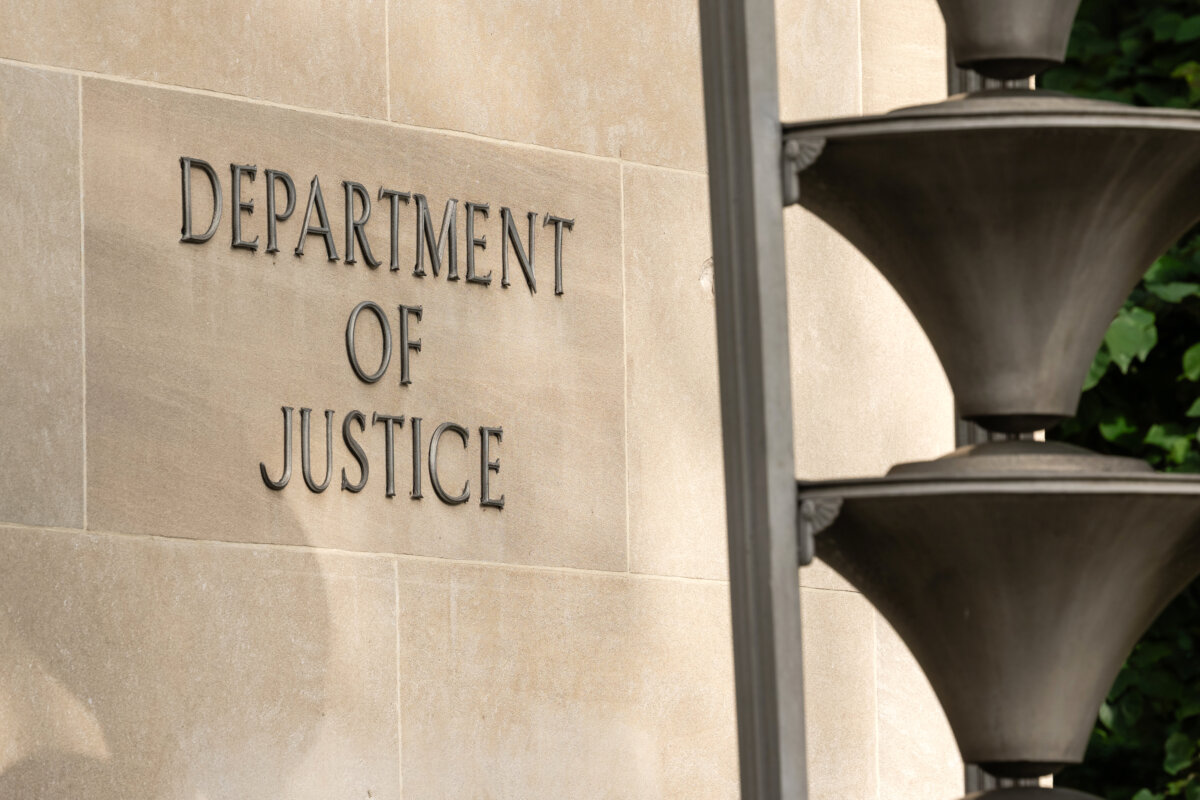

U.S. District Judge Thomas Cullen seemed skeptical on Aug. 13 of the Trump administration’s lawsuit against more than a dozen other federal judges in Maryland, which has set up an unusual battle between the executive and judicial branches.
The case, United States of America v. Russell, named each of the U.S. District Court judges in Maryland as defendants. In court on Aug. 13, Cullen told Department of Justice (DOJ) attorney Elizabeth Hedges that he lacked a “good poker face” and that she could probably tell that he was skeptical about the administration’s arguments.
The Trump administration brought the lawsuit in June after Chief U.S. District Judge George Russell set up an automatic block on deportations, citing an influx of petitions from people seeking to challenge their detention.
Hedges likened Russell’s order to a preliminary injunction or order that courts use to halt government action. These typically undergo a four-factor test, which includes judges analyzing factors such as whether the party requesting the injunction faced irreparable harm or whether they were likely to succeed in their arguments.
Russell’s order, however, didn’t come as part of any particular case. Instead, it broadly applied to cases brought by individuals facing potential deportation. In a court filing, the DOJ described Russell’s order as an “innovation” that violated “time-honored standards” for how judges should handle cases.
Paul Clement, an attorney who often argues before the Supreme Court, represented Russell and the other Maryland federal judges in court. He told Cullen that Russell’s order was more like an administrative action that was necessary to ensure that the court would be able to rule on people’s cases before the administration removed them from the country.
If individuals filed petitions, Russell’s order would purportedly prevent the administration from altering their legal statuses or removing them from the continental United States.
“The recent influx of habeas petitions concerning alien detainees purportedly subject to improper and imminent removal from the United States that have been filed after normal court hours and on weekends and holidays has created scheduling difficulties and resulted in hurried and frustrating hearings in that obtaining clear and concrete information about the location and status of the petitioners is elusive,” Russell said in a May 28 order.
During court on Aug. 13, Cullen heard arguments over the administration’s request for a preliminary injunction of its own against Russell’s order. But first, he heard arguments over the judges’ motion to dismiss the Trump administration’s legal challenge.
Cullen is a judge from the Western District of Virginia, but he presided over the hearing in Baltimore after the administration requested recusal by each of the Maryland federal judges, who were also named as defendants.
In court, Clement noted that the case was not an ordinary lawsuit and that the administration was seeking an unprecedented block on the judicial branch.
Cullen seemed concerned about how the lawsuit would play out and whether there was precedent for the administration’s course of action. At one point, he said he had a hard time understanding how, based on one of the DOJ’s arguments, it had a legal basis for pursuing the lawsuit.
After telling Hedges that he was skeptical, Cullen asked why the administration couldn’t address the issue through the normal appellate process.
The arguments came against the backdrop of ongoing tension between the executive and judicial branches, which have clashed in recent months. During President Donald Trump’s second term, the Supreme Court has issued multiple, more tentative orders either lifting or maintaining lower court orders challenged by the Trump administration.
In June, the justices weighed in with a landmark decision stating that nationwide injunctions, or judges blocking a policy on a nationwide basis, likely violated the bounds of authority that Congress set up for the judiciary.
The case, Trump v. CASA, stemmed partially from an order issued by a U.S. District Court judge in Maryland blocking Trump’s birthright citizenship policy.
Another federal judge in Maryland ordered the administration to facilitate the return of a man deported to El Salvador. In that case and the one against Russell, the administration argued that judges were encroaching on executive functions. Russell’s order, for instance, threatened to interrupt planning by the executive branch for deporting individuals, the DOJ argued.
“Removals can take months of sensitive diplomacy to arrange and often do not completely come together until the last minute,” the DOJ said in its motion for an injunction.
“A delay can undo all of those arrangements and require months of additional work before removal can be attempted again.”
 Friends Read Free
Copy
Facebook
Tweet
Friends Read Free
Copy
Facebook
Tweet