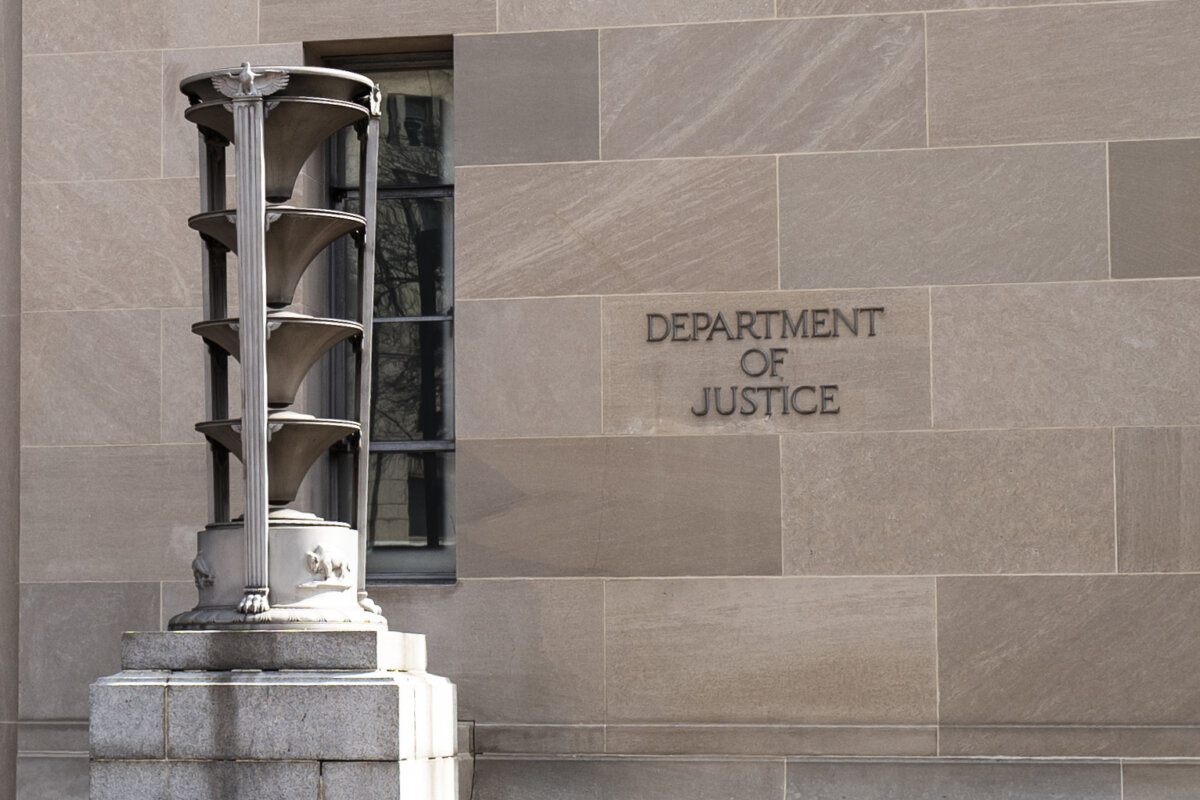

The Department of Justice (DOJ) has issued subpoenas to 14 law firms, some of which were the target of executive orders last year by President Donald Trump threatening to strip the firms of their security clearances and terminate their government contracts.
The DOJ is seeking communications the firms had with the American Bar Association (ABA) related to those executive orders and with Boris Epshteyn, an attorney and investment banker who serves as senior counsel to Trump.
The subpoenas ask for records stretching back to Trump’s first day in office in 2025, encompassing all communications and social media posts.
Trump issued the executive orders against five of those firms last year, accusing them of “dishonest and dangerous activity” and alleging that they had engaged in racial discrimination by using diversity, equity, and inclusion hiring practices.
One firm, Perkins Coie LLP, representing former Secretary of State Hillary Clinton, helped produce the Steele dossier, a since-debunked intelligence document used to spur allegations that Trump had colluded with Russia to steal the 2016 presidential election.
The executive orders against each firm mandated they be stripped of their security clearances, have their government contracts terminated, have their access to government buildings limited, and have their employees forbidden from being hired by the government.
To not be subject to those sanctions—or to avoid being targeted by a future executive order—many law firms struck agreements with the government to provide millions of dollars’ worth of pro bono legal work.
Federal judges also blocked four of those executive orders last year, after the firms sued the administration for allegedly violating their First Amendment rights.
The DOJ, as it looks to subpoena the law firms, is also asking a federal judge to block the ABA’s efforts to obtain Justice Department records.
In March, Judge Amir Ali of the U.S. District Court for the District of Columbia ruled that the ABA could move forward with a lawsuit against the government alleging that the administration has “adopted an unlawful, coordinated policy of sanctioning law firms and their lawyers for engaging in speech the government does not like.”
On July 2, the DOJ asked Ali to dismiss the ABA’s request to depose Epshteyn and to obtain internal government documents related to the case.
Those subpoenas, the government argued, were “intentionally designed to impermissibly invade the privileges afforded to the President of the United States.”
“The President cannot be compelled to divulge even the identity of any individual from whom he receives confidential advice,” the government argued.
“Accordingly, for purposes of this Motion, Defendants can neither confirm nor deny whether the President even received advice from any third party regarding the Executive Orders.”
Reuters contributed to this report.
 Friends Read Free
Copy
Facebook
Tweet
Friends Read Free
Copy
Facebook
Tweet