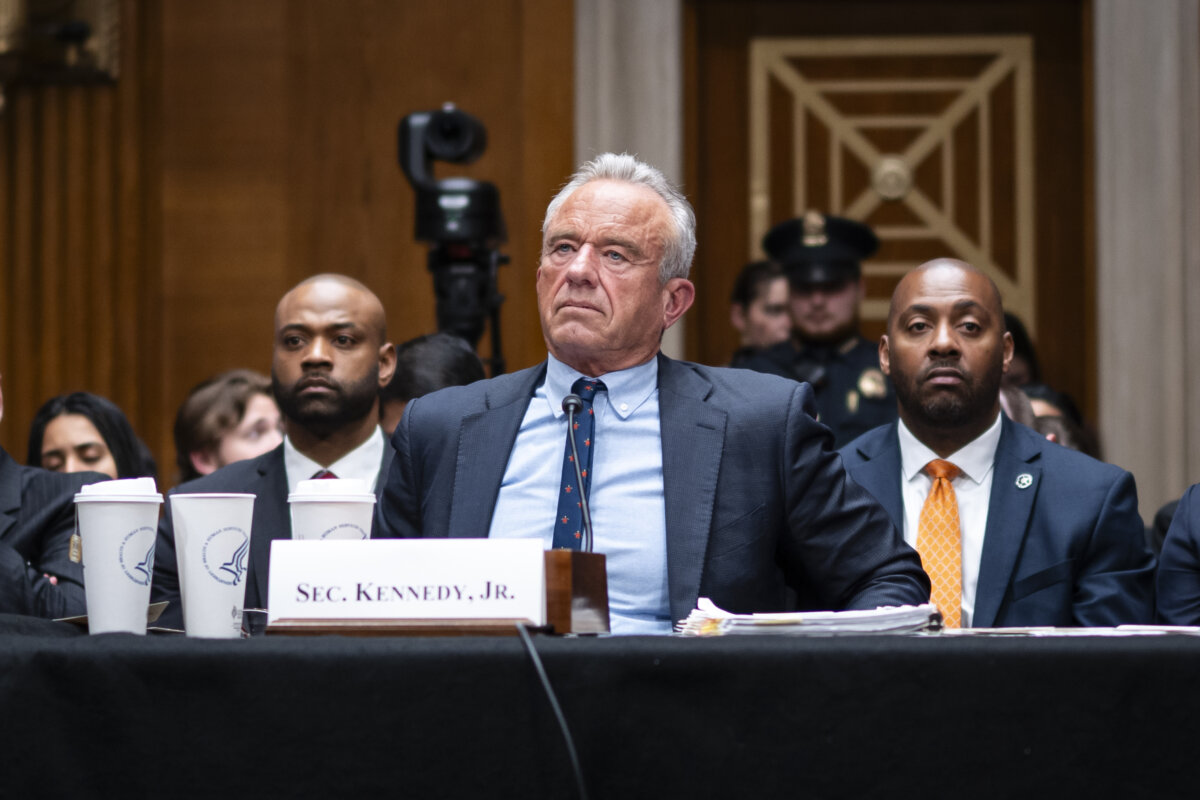

Health Secretary Robert F. Kennedy Jr. told lawmakers on April 22 that Dr. Erica Schwartz, President Donald Trump’s nominee to head the Centers for Disease Control and Prevention (CDC), would be able to make independent vaccine decisions if confirmed.
Senate Health, Education, Labor, and Pensions (HELP) Committee Chairman Bill Cassidy (R-La.) said, “There are currently political appointees at CDC who have worked to undermine trust in immunizations.”
He pressed Kennedy to ensure that Schwartz would “have the right to make decisions independently of those political appointees.” Kennedy said she would.
Just one day earlier, during a House Energy and Commerce Committee hearing, Rep. Raul Ruiz (D-Calif.) had posed nearly the same question.
“If Dr. Schwartz is confirmed, will you commit on the record today to implement whatever vaccine guidance she issues without interference?” he asked.
Kennedy replied, “I’m not going to make that kind of commitment.”
The April 22 hearing also turned to the topic of measles.
Sen. Michael Bennet (D-Colo.) asked whether Kennedy agreed “that the measles vaccine is vital to keeping American children healthy in this country.”
“We promote the measles vaccine,” Kennedy replied, noting that it “prevents measles in 97 percent of the people who take it: I’ve always said that. That’s what the science says.”
Sen. Ben Ray Luján (D-N.M.) accused Kennedy of “pushing vaccine misinformation predating [his] tenure.”
Kennedy replied: “We promote the MMR. We advise every child to get the MMR.”
The United States has recorded more than 1,700 measles cases so far in 2026.
Trump nominated Schwartz on April 16, describing her on Truth Social as “incredibly talented” and “a STAR.”
Kennedy told lawmakers that the incoming team was “extraordinary” and had “gotten applause from both Republicans and Democrats.” Schwartz, a physician who holds advanced degrees in public health and law, served as deputy surgeon general during Trump’s first term and led the Coast Guard’s network of medical clinics.
She oversaw vaccination programs and pandemic preparedness and helped coordinate the federal COVID-19 response—a track record that won cautious praise from mainstream public health groups while drawing criticism from allies of the Make America Healthy Again movement.
The agency has been without a permanent director for most of Trump’s second term. Susan Monarez was confirmed by the Senate and became CDC director, but she was fired in August 2025, less than four weeks after taking office.
The Department of Health and Human Services stated at the time that Kennedy “has full confidence in his team at the CDC who will continue to be vigilant in protecting Americans against infectious diseases.”
Monarez later testified before the Senate HELP Committee that she had been pushed out for refusing to rubber-stamp recommendations from Kennedy’s overhauled vaccine advisory panel, which she said lacked sufficient scientific grounding. Kennedy rejected her account.
Testifying before the Senate Finance Committee in September 2025, he defended the agency shakeup.
“These changes were absolutely necessary adjustments to restore the agency to its role as the world’s gold standard public health agency, with the central mission of protecting Americans from infectious disease,” he said.
Kennedy had replaced all members of the CDC’s Advisory Committee on Immunization Practices in June 2025, citing conflicts of interest. A federal court later invalidated those changes. In April, Kennedy issued a revised charter for the panel—expanding member eligibility and requiring it to assess “gaps in vaccine safety research”—after the court ruling blocked the earlier version.
Reuters contributed to this report.
 Friends Read Free
Copy
Facebook
Tweet
Friends Read Free
Copy
Facebook
Tweet