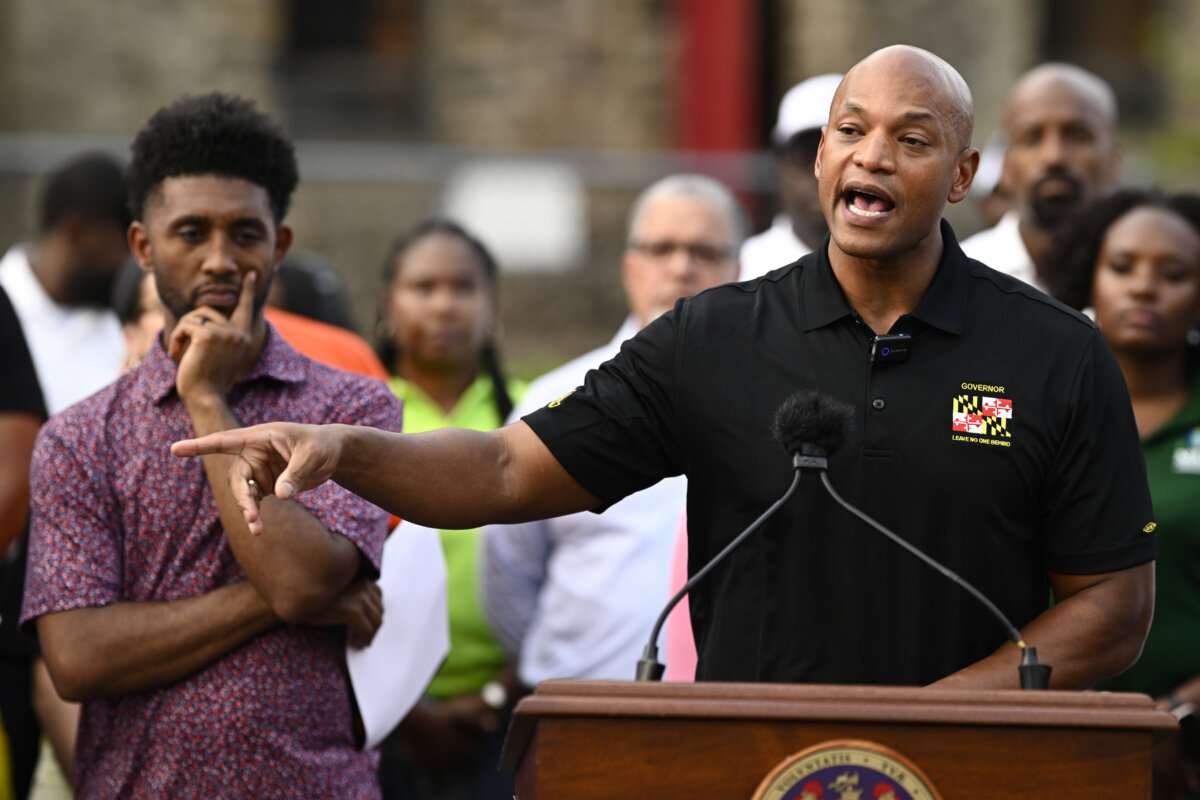

Maryland Gov. Wes Moore announced on Nov. 4 the creation of a Governor’s Redistricting Advisory Commission that will hold public hearings and review existing congressional districts “to promote fairness, competition, and representation.”
Moore, a Democrat, framed the move as a response to Republican-led states that are redrawing maps ahead of the national mid-term elections.
“President Donald Trump and his allies are trying to rig the system and are handpicking Republican states to go through redistricting processes,” he said in a video statement. “… If we’re serious about protecting our democracy, we cannot and will not just sit back and watch. Not in Maryland, not anywhere.”
The governor said Maryland’s review will be bipartisan and public.
“The commission will begin its work immediately, holding public hearings and listening to Marylanders directly and taking a hard, honest look at our congressional maps,” Moore said. “While other states are determining whether or not they have fair maps, so will Maryland.”
The announcement follows weeks of discussion about a potential redraw. In an interview last month, Moore said he was open to “conversations” about new lines, adding, “So will Maryland, and we will make sure that we have fair maps.” Democrats currently hold seven of Maryland’s eight U.S. House seats.
State Sen. Clarence Lam submitted a draft map in August that targets the state’s lone Republican-held district, represented by Andy Harris. Lam, a Democrat, said he introduced the plan to “send a message to other states” and called it “an effort to draw a line in the sand.” At the time, Moore said, “All options are on the table.”
Moore’s move is at odds with Senate President Bill Ferguson who last week said that the chamber would not move forward with a special session of the General Assembly to redraw the maps.
A broader mid-cycle fight over maps around the country started this summer when President Donald Trump called on Texas to begin mid-decade redistricting.
In Ohio, the state’s redistricting commission recently adopted new congressional lines with bipartisan support, while North Carolina and Missouri have taken similar steps.
In Virginia, Democratic lawmakers advanced a constitutional amendment on a party-line vote in both houses this past week to allow a redraw before the 2026 election. In Louisiana, legislators on Oct. 29 approved a Republican-led measure to delay primary elections in the spring by a month to give the state more time for possible revisions.
California citizens on Tuesday were voting on a temporary congressional map, Proposition 50, with supporters saying it answered Republican-led redistricting in other states. Opponents called it a Democratic power grab that would weaken rural representation.
Supporters of mid-decade changes argue they are needed to counter moves elsewhere and to ensure “fair maps.” Critics in several states say that redistricting before the next census undermines independent processes and could dilute communities’ voices.
 Friends Read Free
Copy
Facebook
Tweet
Friends Read Free
Copy
Facebook
Tweet